

Oyster racks drying in the sun
On the vast tidal flats, moving between the oyster farms is as simple as walking from one farm to another. Walking on the closely spaced rafts, Mr. Xuan said: “In the past, the water flow here was excellent, the oysters grew quickly, and there were few diseases. Things have changed in recent years…”

The oyster beds lay tilted precariously on the muddy surface. The air was pungent with the smell of brackish water mixed with the stench of dead oyster shells. Occasionally, a few locals would quietly inspect the rafts, picking up any surviving oysters. On many of the oyster beds, piles of dead oyster shells covered the entire surface.
Mr. Nguyen Van Xuan's family currently owns six oyster farming rafts in the Bac Luan estuary area. Mr. Xuan has been involved in oyster farming for decades and also provides raft pulling services for local households whenever the tide rises and falls.
Stopping beside a raft still partially submerged in water, Mr. Xuan used his hand to lift a string of oysters he had been cultivating for over eight months. The opaque gray oyster shells clung densely, but when he tried to separate them, only a few were still alive. “The oyster deaths started in March. Initially, only a few strings died, but now almost every raft is affected. About 30-40% of my rafts have died, some even more,” Mr. Xuan sighed.

According to Mr. Xuan, the prolonged low tide at this time of year forces the oyster beds to remain exposed to the sun for too long. Some days, the oysters lie on the beach from morning until late evening before the water returns. Oysters, which depend on circulating water for their survival, weaken and eventually die when exposed to the sun for many consecutive days.
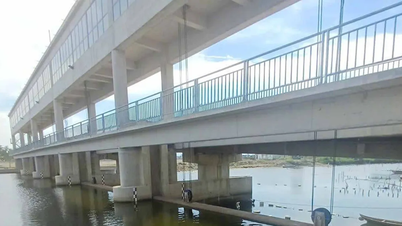
Mr. Xuan believes the biggest reason is that the water flow in the Bac Luan estuary area is no longer as smooth as before. Since the construction of the Tra Binh bridge in October 2018 and its commissioning in 2020, the water flow has changed significantly. In many areas, the water is more stagnant and the salinity is higher than before. "Previously, the water flow was strong, but now the alluvial plains have increased, and when the tide recedes, the seabed is completely dry. In some places, people can even walk on it. The oysters have been exposed to the water for too long, so they are weak and gradually dying," Mr. Xuan said.

Oyster farmers anxiously follow the tides.
These days, oyster farmers can only wait for high tide to quickly move their oyster beds out to sea, where the current is clearer. But moving them is quite difficult and expensive. "Sometimes, even when the tide rises in the middle of the night, we still have to go and move them. If we're slow, more oysters will die," Mr. Xuan said.
Leaving Mr. Xuan's family's oyster farm, we visited the oyster farms of Mr. Pham Van Van's family, also in Hamlet 12, Trang Vi area. More than 10 oyster farms stretched along the waterway. Under the early summer sun, many oyster ropes were emitting a foul odor. Mr. Van was busy gathering the ropes with live oysters to tie them together into new ones. At the end of the raft, Mr. Van's wife quietly sat picking out the surviving live oysters from the ropes where more than half had died. The work was slow and laborious.

Mr. Van said that his family has decades of experience in oyster farming, but they have rarely encountered such prolonged difficulties as in recent years. "Currently, about 40-50% of the oysters on my rafts are dying. Some rafts are almost completely wiped out. The oysters were growing normally and then died gradually, not all at once," Mr. Van said.
According to Mr. Van, for many years, oyster farmers in this area have continuously had to adapt to changes in the water environment. The oysters can no longer be kept in one place as before, but must be regularly moved in and out with the tides. "We can only completely pull them out around the middle of the fifth lunar month. Before that time, the water here is too shallow, the salinity is too high, and the oysters can't tolerate it," Mr. Van shared. 

These days, oyster farmers live almost entirely dependent on the tides. Whenever the tide rises and the water stabilizes, households are busy hiring people to pull the rafts out to sea to "save" their oysters. Each move costs 2-3 million VND per raft, and with about three high tides each month, people have to constantly move the rafts in and out, incurring significant expenses.
But once the oyster farms are moved to deeper water, another worry arises. Many powerful motorboats frequently pass through the oyster farming area, creating strong waves that collide with and break the mooring ropes, damaging the farms and rafts. The locals then have to hire people to reinforce and repair them. "This job is much harder than before. The oysters die, and that's already a loss of money, but the cost of moving the farms, repairing the rafts, and replacing the ropes keeps increasing every day," Mr. Van said.

Besides facing disease outbreaks and environmental changes, oyster farmers now also have to bear the added cost of switching to new standard floating buoys. Leading us to a corner of a raft with a broken frame, Mr. Van pointed to the warped plastic buoys, some already soaked with water, and said: "Plastic buoys cost many times more than styrofoam buoys, but they are not suitable for this farming area. When waves hit, the rigid buoys break the frame immediately. Some buoys are punctured and leak water after only a short time of use."
According to oyster farmers, a single oyster farm requires hundreds of buoys. Each buoy costs 520,000 VND. The replacement cost amounts to hundreds of millions of VND. "Not replacing the plastic buoys is against regulations. Replacing them with low-quality, unsuitable plastic buoys is problematic. Any raft that replaces the buoys will have its entire structure broken after only a year," Mr. Van expressed his concern.

Behind the Tổ Chim mountain, the situation is even worse. In the oyster farming area of Mr. Phạm Văn Hưởng's family, many oyster farms are located deep within the tidal flats. Here, the mortality rate of oysters has reached 70-80%. The oyster caretaker lifted up six oyster lines in quick succession to check. Each line had more than 30 oysters of various sizes densely packed together. When they tried to pry open the shells, all were empty or dead and dried up. Not a single living oyster could be found. "Each farm costs several hundred million dong to invest. This kind of oyster death is devastating for many families," Mr. Hưởng said.

Struggling between planning and reality.
According to the marine aquaculture plan previously approved by the People's Committee of Mong Cai City in 2024, Mong Cai 1 ward has 4 aquaculture zones with a total area of 191.3 hectares, including Hai Hoa 1, Hai Hoa 2, Hai Hoa 3 and Tra Co areas. The Tra Co area alone has an area of 76 hectares.
Currently, the locality has 132 individuals engaged in aquaculture with 287 rafts and cages covering an area of approximately 80 hectares. The People's Committee of the ward has allocated coastal water land to 34 individuals with an area of over 20 hectares; many households are still completing the procedures for leasing land according to regulations. The planning and allocation of water land is expected to help the aquaculture industry develop more systematically, creating conditions for people to confidently invest in the long term.

Speaking with reporters, Mr. Nguyen Thanh Hai, Vice Chairman of the People's Committee of Mong Cai 1 Ward, emphasized that the locality regularly educates people to comply with regulations on aquaculture, use floating materials according to technical standards, and proactively prevent and control diseases in farmed aquatic animals.
“The ward has coordinated with specialized agencies to strengthen propaganda and guidance for aquaculture households to monitor water environment and proactively implement disease prevention measures; at the same time, we have reviewed and guided households to complete the dossiers for land allocation and lease of water surface for aquaculture according to regulations. We have repeatedly requested the relevant authorities to pay attention to assessing the water environment in the aquaculture area, especially in the Bac Luan estuary area, where many people's aquaculture rafts are concentrated. Regarding the conversion of floating materials, the locality continues to encourage people to replace styrofoam floats with suitable materials according to standards, but also acknowledges feedback related to the quality of some types of plastic floats,” said the Vice Chairman of the People's Committee of Mong Cai 1 ward.

Late in the afternoon, as the tide gradually recedes on the muddy tidal flats, hundreds of rafts remain motionless under the sun. From afar, motorboats and barges roar to life, preparing to pull the surviving oyster beds out to sea.
Oyster farmers in the Bac Luan estuary area still cling to their rafts and the sea, quietly adapting to the tides. They only hope that the Bac Luan estuary waters will soon receive a comprehensive environmental and flow assessment; that the difficulties in aquaculture will be resolved, so that oyster farming will no longer be plagued by the cycle of good and bad seasons.
Source: https://baoquangninh.vn/bap-benh-nghe-nuoi-hau-cua-song-bac-luan-3407683.html


![[Photo] Admire the coral "masterpiece" amidst the million-year-old heritage of Dak Lak province.](https://vphoto.vietnam.vn/thumb/1200x675/vietnam/resource/IMAGE/2026/05/31/1780221235105_anh-man-hinh-2026-05-31-luc-16-53-27.png)
![[Photo] Solemn bathing ceremony and Buddha procession in Hue](https://vphoto.vietnam.vn/thumb/1200x675/vietnam/resource/IMAGE/2026/05/31/1780228263543_1-jpg.webp)

















![[Video] Sunset at Lap An Lagoon – Where the sun sets over the fishing nets](https://vphoto.vietnam.vn/thumb/340x192/vietnam/resource/IMAGE/2026/05/31/1780192137701_beach-landscape-sea-water-nature-grass-745871-pxhere-com.jpeg)






































![[Photo] Admire the coral "masterpiece" amidst the million-year-old heritage of Dak Lak province.](https://vphoto.vietnam.vn/thumb/402x226/vietnam/resource/IMAGE/2026/05/31/1780221235105_anh-man-hinh-2026-05-31-luc-16-53-27.png)































Comment (0)