

While digital transformation and artificial intelligence (AI) are dramatically changing the labor market, policies supporting vocational training through unemployment insurance are expected to become a "foundation" to help workers improve their skills and adapt to the new demands of the economy .
Adapting to new trends
According to the Ministry of Interior , in the first quarter of 2026, approximately 1.06 million people of working age nationwide were unemployed; the youth unemployment rate was 8.86%, indicating significant pressure on the labor market, especially among young workers.
In light of this reality, unemployment insurance policies are being refined to proactively support workers in re-entering the labor market. Instead of merely assisting workers during the period of unemployment, the new policy focuses on helping them return to the labor market as quickly as possible through vocational training, skills development, and job transition.
Mr. Pham Xuan Vinh, Head of the Unemployment Insurance Department (Ministry of Interior), stated that a key new feature of the 2025 Employment Law and Decree No. 374/2025/ND-CP is the shift in focus of unemployment insurance policy from income support to support reintegration into the labor market.
Accordingly, workers who have participated in unemployment insurance for at least 9 months but less than 12 months may be eligible for vocational training or new skills development, even if they do not yet meet the eligibility requirements for unemployment benefits.
Not only have the eligibility criteria for support been expanded, but the level of support for vocational training has also been increased. For courses under 3 months, workers receive a maximum support of 4.5 million VND per course, along with an additional 50,000 VND per day for meals during the training period.
According to Vu Thi Thanh Lieu, Deputy Director of the Hanoi Employment Service Center (Hanoi Department of Internal Affairs), the policy of providing meal allowances is practical and meaningful, especially for workers who live far away or are in difficult circumstances. "This support demonstrates the State's very specific concern for workers during their vocational training and skill development," Ms. Lieu stated.
Experts believe that, in the context of rapidly changing technology, supporting vocational training from unemployment insurance funds not only helps workers overcome difficult times but also contributes to building a skilled workforce that is well-adapted to the new development requirements of the economy.
Besides traditional occupations, many localities and training institutions are also focusing on developing digital skills, technology application skills, and skills for working in a digital environment for workers.
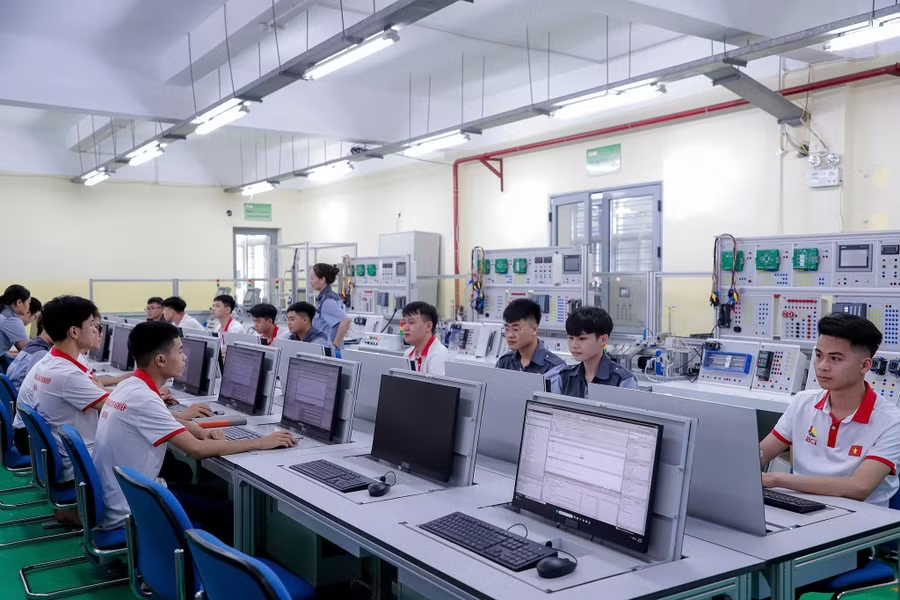
Training that is linked to practice increases job opportunities.
In the context of a constantly changing labor market, vocational training support from unemployment insurance funds is increasingly asserting its role as a strategic social security policy.
According to Ms. Vu Thi Thanh Lieu, Hanoi currently has 16 registered training centers offering courses in fields such as food processing, beverage mixing, industrial sewing, motorcycle repair, and office computer skills.
The training courses are all linked with recruiting businesses to create job opportunities for workers immediately after completing the course. "We not only focus on training, but also connect with businesses so that workers can access jobs right after the course," Ms. Lieu said.
Mr. Pham Xuan Vinh also pointed out that unemployed people are not only those who need assistance, but also a human resource that needs to be trained, have their skills supplemented, and their capabilities enhanced so that they can return to the labor market as soon as possible.
The Hanoi People's Committee issued Plan 193/KH-UBND dated May 16, 2026, on supporting vocational training, retraining, and job placement for vulnerable labor groups in the capital city during the period 2026-2030.
According to the plan, many priority labor groups will receive support in vocational training, job placement, and access to preferential loans to develop production and business. This will focus on vulnerable groups such as poor and near-poor households, ethnic minorities, people with disabilities, the elderly, rural workers, youth, those recovering from drug addiction, and those who have completed their prison sentences.
On average, the city aims to attract approximately 20,000 workers to participate in vocational training within the vocational education system each year; and to train about 15,000 workers from priority groups. The city also aims for 100% of those in need to receive policy advice on vocational training and appropriate training support.
At least 50% of elderly people in need will receive career guidance and vocational retraining. Priority training areas include digital transformation, e-commerce, tourism, services, high-tech agriculture, agricultural product processing, garment manufacturing, and small-scale handicrafts.
In addition, Hanoi has identified the "learn while you work" model as a key solution, where businesses participate in direct training on the production line, helping workers both earn income and quickly adapt to the real working environment.
For people with disabilities, the elderly, and workers in disadvantaged areas, the city will open classes right in residential areas, village cultural centers, and neighborhood groups to facilitate access to vocational training.
In addition to providing vocational skills, workers are also supported in connecting with job opportunities, accessing digital technology, and securing financial resources to proactively advance their careers.
Mr. Pham Xuan Vinh stated: The context of rapidly developing AI and digital transformation necessitates vocational training activities to be more closely linked to the needs of businesses and labor market trends. Training institutions need to base their training programs on the needs of businesses so that graduates can meet actual recruitment requirements. At the same time, they need to proactively strengthen labor market analysis and forecasting to guide workers, especially young workers, towards suitable occupations.
Source: https://giaoducthoidai.vn/be-do-phat-trien-nguon-nhan-luc-ben-vung-post779349.html
![[Photo] Admire the coral "masterpiece" amidst the million-year-old heritage of Dak Lak province.](https://vphoto.vietnam.vn/thumb/1200x675/vietnam/resource/IMAGE/2026/05/31/1780221235105_anh-man-hinh-2026-05-31-luc-16-53-27.png)

![[Image] Hanoi Police officially crowned champions of V-League 2025/2026](https://vphoto.vietnam.vn/thumb/1200x675/vietnam/resource/IMAGE/2026/05/31/1780244769054_ndo_br_039d561b692be875b13a-jpg.webp)

![[Photo] Solemn bathing ceremony and Buddha procession in Hue](https://vphoto.vietnam.vn/thumb/1200x675/vietnam/resource/IMAGE/2026/05/31/1780228263543_1-jpg.webp)
![[Photo] The General Secretary, President and his wife begin their state visit to the Philippines.](https://vphoto.vietnam.vn/thumb/1200x675/vietnam/resource/IMAGE/2026/05/31/1780230559452_anh-man-hinh-2026-05-31-luc-19-28-11.png)





















![[Video] Sunset at Lap An Lagoon – Where the sun sets over the fishing nets](https://vphoto.vietnam.vn/thumb/340x192/vietnam/resource/IMAGE/2026/05/31/1780192137701_beach-landscape-sea-water-nature-grass-745871-pxhere-com.jpeg)







































![[Photo] Admire the coral "masterpiece" amidst the million-year-old heritage of Dak Lak province.](https://vphoto.vietnam.vn/thumb/402x226/vietnam/resource/IMAGE/2026/05/31/1780221235105_anh-man-hinh-2026-05-31-luc-16-53-27.png)

































Comment (0)