

In that strategic orientation, General Secretary and President To Lam offered historically significant suggestions for researching and piloting the construction of socialist commune and ward models to transform the principles of socialism from a macro-level vision into vibrant practice. To realize this goal, administrative procedure reform and the application of digital transformation are considered two core foundations, acting as parallel "launchpads" to enable local governments to make breakthroughs.
Years ago, the image of citizens carrying stacks of documents back and forth between government agencies, or businesses struggling to complete investment permits, was a significant obstacle to economic development. Essentially, administrative reform is not simply about reducing paperwork. It's a reform of the mindset in state governance: When barriers are removed, compliance costs for citizens and businesses are drastically reduced, not only creating a more favorable investment environment but also directly strengthening public confidence in the inherent superiority of the regime.

Affirming that the first foundation for building socialist communes and wards is a change in governance thinking, shifting from a "governing" administration to a "creative and service" administration, Associate Professor, Dr. Dang Quang Dinh (Director of the Institute of Philosophy, Ho Chi Minh National Political Academy) argues that socialist communes and wards must be places where administrative procedures are simplified, public, and transparent; and where people are treated as subjects of development, not as passive objects. This reform is not just a technical tool but a method to enhance transparency and reduce corruption.
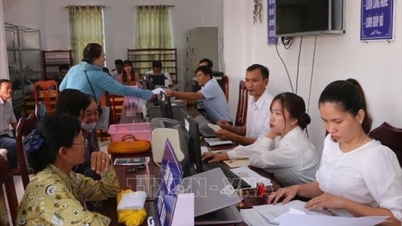
Decree 121/2025/ND-CP, which stipulates the implementation of the "non-geographical" principle when handling administrative procedures for citizens, is a clear example of this and has garnered public support. This decree allows citizens the right to go to any commune-level People's Committee to request the resolution of administrative procedures, regardless of their place of residence.
The "one-stop shop" model, encompassing all administrative boundaries, has yielded significant results, allowing citizens to handle administrative procedures flexibly and conveniently, enabling many localities to accelerate the implementation of political tasks. According to a recent announcement by the Ministry of Interior, the 2024 PAR Index results show that Hai Phong city has risen to the number one position nationwide in both the Administrative Reform Index and the Citizen Satisfaction Index (SIPAS).
This shows that a streamlined and responsive administration is not only a driving force for a more efficient economy but has also become a factor in enhancing competitiveness and attracting investment. In particular, since the implementation of the two-tiered local government model, many procedures have seen a 30-50% reduction in processing time; citizens feel more secure investing, and society functions more efficiently.
However, administrative reform only truly creates a breakthrough when coupled with digital transformation. In the era of the digital economy, a locality's competitiveness lies in the speed of data processing and the level of digitalization of its administration. In many localities, the Intelligent Operations Center (IOC) has become a typical model of digital governance at the grassroots level, where all feedback on the environment and urban order is received, processed, and progress publicly disclosed on a digital platform.
In Hai Phong's criteria for building socialist communes and wards, the goal of digital transformation and administrative reform has been applied at a record level: requiring 100% of administrative documents to be processed online and the rate of online administrative procedures reaching over 95%. The combination of high-speed economic growth and comprehensive digitalization of administrative procedures in Hai Phong is strong evidence that: When administrative barriers are removed and technology is widely applied, the locality will free up labor, attract massive investment, and maintain spectacular growth momentum.
According to some scientists, successful digital transformation lies not in the quantity of software deployed, but in the ability to change the way the state apparatus operates. If data is interconnected, processes are digitized, and citizens have more convenient access to public services, then digital government will truly demonstrate its value.
Experts propose a quantitative indicator called "Paperless Ward," requiring 100% of work-related documents at the ward level to be processed online, and citizens to access essential public services through the entire online process.
According to an analysis by Associate Professor, Dr. Nguyen Thi Thu Ha (Academy of Public Administration and Management), by mid-2025, the whole country will have more than 83.5 million registered electronic identity accounts, of which about 60 million accounts will have reached level 2 authentication, making them eligible for online public transactions. This is a huge infrastructure that allows citizens to conduct all administrative transactions without having to go to the office.
Sharing this view, Associate Professor, Dr. Nguyen Binh Minh (Institute of Digital Technology and Economics, Hanoi University of Science and Technology) proposed a very practical metric: 100% of records must have a clear search status; the rate of timely responses to requests should aim for over 90-95%.
Associate Professor, Dr. Nguyen Binh Minh emphasized that in the era of digital transformation, the essence of the socialist commune and ward model must be linked to modern governance based on technology and data. This includes building a digital government, digitizing management processes, providing online public services, using data to support decision-making, and strengthening the connection between the government and the people through digital platforms.

According to Chairman of the Hanoi People's Committee Vu Dai Thang, the capital city has urgently developed a pilot project for the "Socialist Commune/Ward" model with 54 substantive measurement criteria. Criteria groups 1 and 8 place absolute emphasis on the rate of administrative procedures resolved on time, citizen satisfaction (SIPAS), the percentage of citizens with digital skills, and full-process online public services.
Hanoi city also identifies digital transformation as a strategic task. The digitization of population data, cashless payments, and full-process online public services are being accelerated. In addition, speeding up data connectivity from the city to the grassroots level helps save costs, improve management efficiency, and reduce pressure on staff…
This is a shift from an "administrative government" to a "development-oriented government," in line with the directives of General Secretary and President To Lam!
When a commune or ward minimizes transaction costs, builds a transparent data environment, and processes tasks quickly, it will act as a magnet attracting innovative businesses, promoting the digital economy and the circular economy.
This is a prerequisite for promoting double-digit GRDP growth and realizing the country's goal of rapid and sustainable development, aiming to become a developing country with modern industry, high middle income, and among the top 30 economies in the world by 2030.
Thus, the "parallel launchpad" of administrative procedure reform and digital transformation will open up new development space for the socialist commune and ward model, create new growth momentum for the economy, and contribute to realizing the aspiration of building a strong and prosperous Vietnam by 2045…
Source: https://baotintuc.vn/thoi-su/be-phong-song-hanh-dua-xa-phuong-but-pha-20260601095220598.htm






























![[Photo] Reception to welcome General Secretary and President To Lam and his wife on their State visit to the Philippines](https://vphoto.vietnam.vn/thumb/1200x675/vietnam/resource/IMAGE/2026/06/01/1780295488620_vna-potal-chieu-dai-chao-mung-tong-bi-thu-chu-tich-nuoc-to-lam-va-phu-nhan-tham-cap-nha-nuoc-toi-philippines-8798060-7855-jpg.webp)









































































Comment (0)