


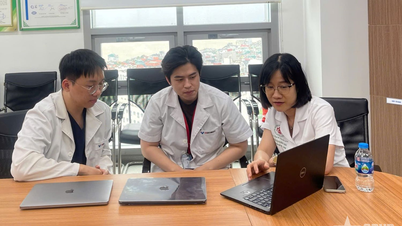
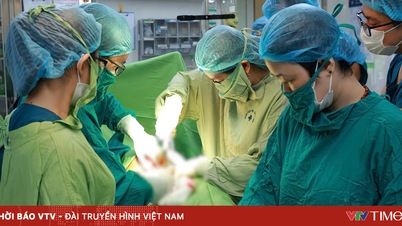
Doctors at Military Central Hospital 108 examine a child patient - Photo: Hospital provided.
Be cautious about hypospadias in boys.
According to Dr. Nguyen Van Phuc from the Department of Andrology at the Central Military Hospital 108, hypospadias is a congenital defect in boys that occurs when the urinary opening is not located at the tip of the glans penis as normal. Instead, the urethral opening may be in a lower position, such as the glans furrow, the shaft of the penis, the base of the penis, or near the scrotum.
Infants with hypospadias often experience no pain, fever, or unusual fussiness, making it easy to overlook in the first few months of life. Many families only discover the condition when they notice the child urinating unevenly, leaking urine, or wetting their clothes, or when a doctor examines the genital area during a routine health check.
Some parents believe that hypospadias only affects aesthetics. However, in reality, depending on the severity, this condition can impact urination, hygiene, psychology, and reproductive function in adulthood.
In mild cases, the urethral opening is located near the glans, and the child can still urinate while standing, but the stream is lệch (deviated). In moderate or severe cases, the urethral opening is located lower, the penis may be noticeably curved, and the child must urinate while sitting or experiences difficulty using the toilet at school.
As they grow up, children may feel self-conscious about their different genitalia, be reluctant to change clothes, avoid group activities, or worry about their future fertility.
Some severe cases may also be accompanied by undescended testicles, scrotal abnormalities, or sexual development abnormalities, requiring further specialized evaluation.
The most common sign is an abnormal urine stream. Instead of spraying straight forward, the urine stream may flow downwards, veer to one side, splash onto the legs, or wet clothing.
Some children have a downward-curving penis, which is especially noticeable during erections. In severe cases, children may need to urinate while sitting instead of standing as they get older.
Additionally, a child's foreskin may have an abnormal shape. The skin on the upper surface of the glans remains intact, while the underside lacks skin, creating a "hood-like" appearance. This sign is easily confused with phimosis, paraphimosis, or uneven foreskin development.
Easily mistaken for phimosis (narrowing of the foreskin).
According to Dr. Phuc, phimosis and hypospadias are two different problems, but many parents confuse them.
Phimosis is a condition where the foreskin cannot retract or causes inflammation and difficulty urinating. Hypospadias, on the other hand, is an abnormality in the location and structure of the urethra.
Therefore, before performing any procedure on the foreskin, especially circumcision, the child needs to be thoroughly examined by a specialist.
"In children with hypospadias, the foreskin is not simply excess skin. In many cases, it can be an important source of tissue for doctors to use during urethral reconstruction surgery."
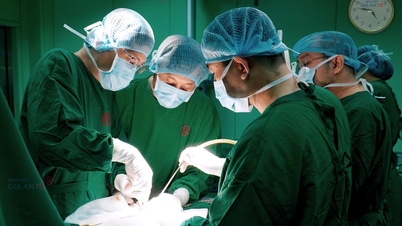
Surgery for hypospadias typically involves reconstructing the urinary tract, repositioning the urethral opening to near-normal, correcting penile curvature if present, and covering any tissue deficiencies. The foreskin may be used to assist in this reconstruction process.
"Not all surgeries require the use of a foreskin. However, if the child has already been circumcised, the doctor will lose a valuable tissue source. This can make the surgery more complicated, especially in cases of moderate or severe hypospadias," Dr. Phuc advised.
Free medical examinations and surgeries for children.
According to Dr. Phuc, it is estimated that about 2-4% of male newborns experience abnormalities such as phimosis, urethral opening deviation, buried penis, penile curvature, micropenis, etc.
Congenital abnormalities not only affect health but can also negatively impact psychology and quality of life later in life. If not detected and treated promptly, they can lead to infertility, testicular torsion, testicular cancer, endocrine disorders, and more.
To support the community and raise awareness about male reproductive health issues in children, Military Central Hospital 108 is organizing the program "Humanitarian examination, consultation and surgery for male children with genital abnormalities in 2026", taking place from May 25 to June 5.
The free screening program is open to male children under 16 years of age who exhibit abnormalities such as phimosis, urethral opening deviation, buried penis, penile curvature, small penis, etc. People can go to the hospital to register for the free screening.
Source: https://tuoitre.vn/be-trai-tieu-lech-tieu-kho-co-the-la-dau-hieu-benh-ly-20260520175706474.htm


![[Photo] Ba Lang An Lighthouse - the "eye of the sea" amidst the "rock museum" of Quang Ngai province.](https://vphoto.vietnam.vn/thumb/1200x675/vietnam/resource/IMAGE/2026/05/29/1780038698840_anh-man-hinh-2026-05-29-luc-14-10-42.png)


![[Image] Pleasant weather helps students enter the 10th grade entrance exam with confidence.](https://vphoto.vietnam.vn/thumb/1200x675/vietnam/resource/IMAGE/2026/05/29/1780034401612_ngay-1-thi-lop-10-minh-duy-8-5009-jpg.webp)

























































































Comment (0)