

The Hanoi Center for Disease Control (CDC) has just issued a warning about the increasingly complex rabies situation in animals. Accordingly, from the beginning of 2024 to the present, six outbreaks of rabies in dogs have been recorded, all in Soc Son district.
The Hanoi CDC reports that there have been cases of rabid dogs biting people, so there is a risk of detecting human rabies cases in the near future if people do not fully implement post-exposure prophylaxis measures as recommended by the health sector.
 |
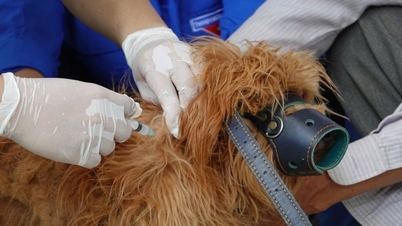
| Vaccination is the most effective proactive disease prevention measure. Photo: Chi Cuong |
Given the complex situation regarding rabies, the Hanoi Department of Health has directed the CDC and the Soc Son District Health Center to coordinate with veterinary agencies to implement measures to prevent and control rabies in animals in Soc Son district.
In particular, in communes with outbreaks, it is crucial to quickly contain the disease. Commune health stations are instructed to continue reviewing, monitoring, and reminding people exposed to rabies to get vaccinated fully and on schedule according to the protocol.
According to a representative from the Department of Preventive Medicine, Ministry of Health , the risk of rabies infection is very high due to the low vaccination rate against rabies among the total dog and cat population; limited management of dog and cat populations; and limited public awareness.
Rabies is an extremely dangerous disease; once it develops, the mortality rate for those infected is almost 100%. The only way to save someone bitten by a rabid dog or cat is to get a rabies vaccine as soon as possible.
There is currently no specific cure for rabies, but it is entirely preventable. To proactively prevent rabies, people should implement the following measures: People who own dogs and cats should ensure they receive all necessary rabies vaccinations and booster shots annually as recommended by the veterinary industry; dogs should be kept on a leash or confined, and must wear a muzzle when taken out in public.
Do not tease or provoke dogs or cats. If bitten by a dog or cat, immediately wash the wound under running water with soap for 15 minutes; if soap is unavailable, rinse the wound with plain water. Afterwards, clean the wound with 70% alcohol or iodine alcohol; avoid bruising the wound and do not bandage it tightly.
Seek prompt medical attention for examination, consultation, and rabies vaccination or anti-rabies serum; absolutely do not self-treat or seek treatment from traditional healers.
Communicate and educate children on how to prevent dog and cat bites and how to immediately inform their parents or relatives after being bitten by a dog or cat.
Rabies is preventable with a vaccine. The rabies vaccine is harmless to those who receive it. The vaccine is made from inactivated rabies virus, therefore it is incapable of causing disease, and does not affect memory or other neurological issues.
The Ministry of Health advises people not to hesitate or delay getting vaccinated against rabies if bitten by a dog or other animal. Go immediately to the nearest medical facility for advice and timely treatment.
According to Dr. Nguyen Tuan Hai from the Safpo/Potec vaccination system, people who have the means can get a preventative rabies vaccine before exposure.
Accordingly, if vaccinated preventively, only 3 doses are needed, offering complete flexibility in terms of timing. If bitten by a dog or cat, the vaccination schedule will be simpler, requiring only 2 doses of vaccine without the need for anti-rabies serum, even if the wound is severe, the bite is close to the central nervous system, or an area with a high concentration of nerves.
Meanwhile, if you haven't been vaccinated against rabies before being bitten by a dog or cat, you need five injections at strict intervals of one month. This is especially true in cases of severe wounds or those in critical areas, where serum injections are necessary. This significantly impacts your mental state and daily routine, as well as causing more pain and side effects.
Particularly in remote areas, anti-rabies serum and vaccines are not always readily available, and there are times when shortages cause great anxiety and fear among people bitten by animals.
For children, pre-exposure rabies vaccination is especially important because children often don't notice animal-related injuries while playing with pets and may forget to inform their parents (except in severe cases).
Furthermore, children are shorter, so when bitten by a dog, they are more likely to be bitten on the head, face, and neck than adults. This also allows the rabies virus to travel faster to the central nervous system and cause disease more quickly.
Furthermore, regarding concerns about rabies vaccines having side effects, such as affecting the nervous system and causing memory loss, Dr. Chinh stated that older generation vaccines had this problem.
However, modern rabies vaccines are now produced using advanced technology and do not contain nerve cells, so they are harmless and do not affect the health or memory of users.
The new generation rabies vaccine uses fractional centrifugation technology, ensuring low levels of impurities and compliance with World Health Organization (WHO) quality standards (less than 10 nanograms per dose).
Some types of vaccines do not use the preservative thimerosal (mercury), therefore the new generation rabies vaccine also minimizes local side effects such as swelling, pain, fever, etc., compared to the older generation vaccine which has been discontinued.
Source: https://baodautu.vn/benh-dai-dien-bien-phuc-tap-tai-ha-noi-d222220.html





![[Photo] General Secretary and President To Lam presides over the meeting to approve the draft report on the results of the second inspection by the Politburo of the Standing Committee of the Hanoi City Party Committee.](https://vphoto.vietnam.vn/thumb/1200x675/vietnam/resource/IMAGE/2026/05/26/1779789811432_a2-bnd-4430-9620-jpg.webp)








































































































Comment (0)