

In the overall trend towards greening, businesses can seize the opportunity to introduce products that anticipate low-carbon trends and meet market demands.
Searching for a "green passport"
Among the first 110 businesses to receive emission quota allocation decisions from the Ministry of Agriculture and Environment , Viet Ý Steel Joint Stock Company is a prime example of proactive thinking. With a quota of over 33,000-38,000 tons of CO2 per year for the period 2025-2026, this company has prepared well in advance to avoid being caught off guard by the new rules of the game.
Specifically during the period 2018-2024, Viet Y Steel focused on reducing direct greenhouse gas emissions (scope 1) through optimizing production processes, applying advanced electric arc furnace (EAF) technology using scrap steel, and gradually reducing the amount of coal and oil used. Currently, the company is focusing on reducing emissions from indirect sources (scope 2) by using electricity efficiently and effectively. The long-term orientation will be a strong shift towards renewable and environmentally friendly energy.

Viet-Italian Steel Plant, Hai Phong branch. Photo: Provided by the company .
According to Mr. Le Thanh Bac, Head of Safety Department, Viet Y Steel Company, Hai Phong branch: The company currently has stable orders in Southeast Asia and several Asian countries. To prepare for entering demanding markets such as the US and Europe, the company has proactively improved product quality and "green steel" indicators. Specifically, Viet Y Steel has completed its Life Cycle Assessment Report (LCA) and Environmental Product Disclosure (EPD). The results show that the company's products are approaching the low emission levels of advanced countries in the region such as South Korea and Japan.
In greenhouse gas inventories, scope 1 is emissions generated by businesses themselves through direct operations.
Scope 2 covers indirect emissions from using energy purchased from suppliers.
Scope 3 covers indirect emissions from a company's supply chain.
However, the biggest challenge currently facing Vietnam's steel products in meeting stringent European standards (such as the CBAM mechanism) depends on two external objective factors. Firstly, indirect emissions (scope 2) depend on the "cleanliness" of the national power grid. Due to the large proportion of coal-fired power plants, the average emission factor of Vietnam's power grid remains high. Therefore, even with new production technologies that use more electricity instead of coal and oil, steel products still have the potential to leave a high "carbon footprint" from the input electricity. This means that businesses will have to pay higher carbon taxes than competitors using cleaner electricity sources.
Secondly, LCA calculations include the transportation of raw materials and finished products. Meanwhile, Vietnam's logistics system is not yet optimized and relies too heavily on road transport, so the emission factor from transportation also pushes up the total emissions of the product.
Vietnam's current quota regulations only require businesses to pay back their quotas based on greenhouse gas emissions within zone 1. However, in reality, high-value export markets have introduced higher and increasingly stringent regulations on greenhouse gas emissions. This is a significant gap that businesses need a shift in national infrastructure to bridge in the future.
Opening up a promising market for green products.
A similar problem is also occurring in the cement industry – a sector with 51 factories participating in Vietnam's pilot quota allocation program. Associate Professor Dr. Luong Duc Long, Vice President and General Secretary of the Vietnam Cement Association (VNCA), said the industry is facing the risk of exceeding the quota ceiling by approximately 14 million tons of CO2 equivalent.
Explaining this "difficulty in reducing" emissions, Associate Professor Dr. Luong Duc Long stated that traditional clinker firing technology has an insurmountable physical limit. Even if businesses optimize kiln heat consumption to an ideal level, the chemical reaction process of limestone decomposition still produces a fixed emission of approximately 525 kg CO2/ton of clinker. Therefore, optimizing thermal efficiency only addresses the symptoms. The potential for reducing emissions through firing technology has gradually reached its limit, as the overall industry heat consumption has already decreased significantly to an average of 817 kcal/kg of clinker.

Many domestic cement plants have invested in waste heat recovery (WHR) systems to reduce CO2 emissions and save energy. Photo: Provided by the company .
The most viable leverage between now and 2030 is to reduce the clinker content in blended cement by expanding the use of mineral additives such as calcined clay, blast furnace slag, and pozzolanic fly ash. In the long term, new carbon capture and storage solutions are the key to addressing the remaining core emissions of the cement industry.
In the current context, Associate Professor Dr. Luong Duc Long proposes that the emission reduction roadmap for the industry should be phased according to technological readiness and compliance costs. The period up to 2030 should focus all efforts on fundamental solutions that can be implemented immediately, such as optimizing heat and electricity consumption efficiency, digitizing operating processes, and investing in a synchronized system for utilizing waste heat for power generation. Simultaneously, power plants should proactively increase the proportion of alternative fuels from waste and biomass, and standardize inventory data systems according to the Measurement, Reporting, and Verification (MRV) standard.
From 2030-2040, the focus will shift to a structural transformation of materials, applying low-carbon composite products and next-generation binders such as fired clay and geopolymer concrete to suitable construction segments. A complete system of standards and regulations for testing the quality of mineral additives will be established. This will also be the time when the domestic carbon market officially becomes operational, further boosting green financing for businesses.
After 2040, the industry will activate technologies for deep emission reduction, particularly the widespread deployment of carbon capture, utilization, and storage solutions to comprehensively address the remaining unavoidable core emissions. The widespread adoption of this high-tech solution requires synchronization as global technologies mature, national storage infrastructure is ready, and robust carbon finance mechanisms are established.
This process, coupled with a gradual reduction in the carbon content of cement products, will allow Vietnamese businesses to completely dominate the market right from their "home turf".
Experts believe that the green building materials segment serving low-emission projects has enormous potential and is being strongly driven by two key factors: pressure to comply with ESG (Environmental, Social, Governance) criteria from international financial institutions; and stringent technical barriers imposed by the new domestic building standards system.
To access preferential green credit and attract foreign investors, project developers are required to optimize all accumulated emissions right from the input material selection stage, especially materials that meet low-carbon standards and international green certifications.
Conduct greenhouse gas inventories according to guidelines.
The pilot phase of quota allocation from now until 2028 is essentially an opportunity for businesses with advanced technology to demonstrate their low-emission advantages with state recognition. A particularly noteworthy point is the determination of the "carbon footprint of products" within a narrower but more in-depth scope compared to conventional greenhouse gas inventories.
Mr. Luong Quang Huy, Head of the Greenhouse Gas Emission Management and Ozone Layer Protection Department (Climate Change Department, Ministry of Agriculture and Environment), emphasized: Businesses must focus on accurately identifying direct emission sources in Category 1 and the different "inventory tiers" (Tier) for each emission source.
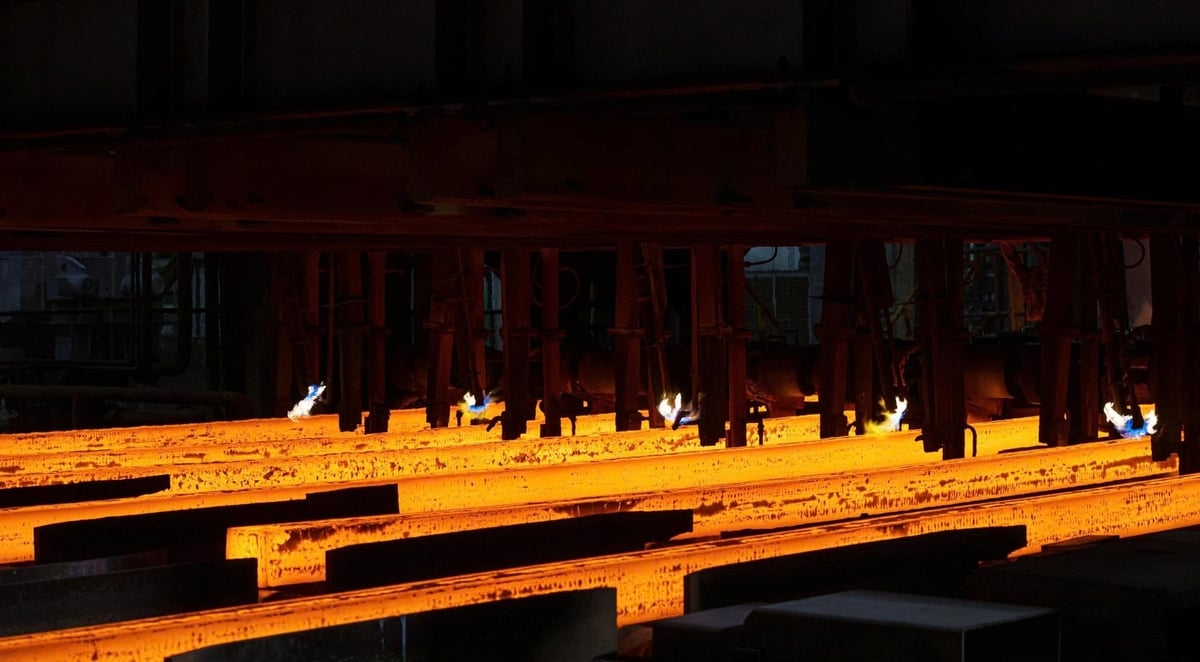
The crude steel production process accounts for over 85% of total emissions in the steel industry. Photo: Provided by the company .
Consistency in using emission factors according to Decision No. 2626/QD-BTNMT and applying the default net calorific value as guided by the IPCC is "key" to the acceptance and approval of a company's greenhouse gas inventory data.
For emissions directly from burning fossil fuels, Tier 1 methods are applied based on default coefficients. However, for emissions from industrial processes such as raw material consumption in steelmaking or carbonate decomposition during clinker burning, businesses will apply Tier 2 methods. Applying Tier 2 requires more detailed data, allowing for a more accurate classification of facilities with advanced, low-emission technologies compared to those with more outdated technologies.
In addition, businesses should note the consistent use of emission factors according to Decision No. 2626/QD-BTNMT of the Ministry of Natural Resources and Environment (now the Ministry of Agriculture and Environment) and the default factors from the Intergovernmental Panel on Climate Change (IPCC).
Regarding fuel calorific value, during the pilot phase until 2028, all enterprises will apply the default net calorific value according to the IPCC; or the MRV guidelines and greenhouse gas inventory circulars of the relevant ministries. In subsequent allocation periods, when the capacity to provide data from the base improves, consideration may be given to using individual calorific values for each enterprise.
According to Mr. Huy, businesses need to proactively develop emission reduction roadmaps based on a thorough assessment of their technical potential, financial capacity, and long-term growth goals. Successfully implementing these steps will not only help businesses avoid legal risks but also build a strong reputation in the market, optimize production costs, and open up opportunities for deeper participation in the global green supply chain in the era of a low-carbon economy.
Source: https://nongnghiepmoitruong.vn/bien-ap-luc-giam-phat-thai-thanh-co-hoi-don-dau-d814049.html






















![Transforming from Resolution 57: [Part 1] 'Digital Field' in the Heart of the City](https://vphoto.vietnam.vn/thumb/402x226/vietnam/resource/IMAGE/2026/06/01/1780313803412_2848-htx-nong-nghiep-tuan-ngoc-8-173833_249-173836.jpeg)
![[Photo] Reception to welcome General Secretary and President To Lam and his wife on their State visit to the Philippines](https://vphoto.vietnam.vn/thumb/1200x675/vietnam/resource/IMAGE/2026/06/01/1780295488620_vna-potal-chieu-dai-chao-mung-tong-bi-thu-chu-tich-nuoc-to-lam-va-phu-nhan-tham-cap-nha-nuoc-toi-philippines-8798060-7855-jpg.webp)


























































Comment (0)