

Preserving the "treasure" of the Hau River
Instead of choosing stable office jobs in the city, Mr. Duong Ke Hien (residing in Area 17, Binh Thuy Ward, Can Tho City) chose a bold and unique path: He dedicated himself to the waterways, enriching himself through the local strengths via a model of cage fish farming combined with eco-tourism on the river, known as "Fish Village." This decision not only changed his life but also opened up a promising new direction for community tourism in this sand dune area.

Mr. Duong Ke Hien introduces the characteristic fish species of the Hau River to tourists visiting the floating fish farm combined with ecotourism at Con Son. Photo: Le Hoang Vu.
Born and raised right on the banks of the Hau River, Mr. Hien deeply understands the habits of the water currents and the characteristics of aquatic life. Recognizing the potential of eco -tourism linked to rural life, which is increasingly attracting domestic and international tourists, he boldly invested in and renovated his family's system of more than 25 fish farms into a unique experiential destination. Visitors come here not only to admire the pristine natural scenery and enjoy rustic dishes such as fish, shrimp, and vegetables from the garden, but also to immerse themselves in the authentic riverine culture and feel the generous and genuine spirit of the Southern Vietnamese farmers.
What sets Duong Ke Hien's startup model apart and gives it a profound humanistic value is his commitment to preserving aquatic life. On his vast floating cages, he doesn't choose to raise common commercial fish with short-term economic value such as striped catfish, pomfret, tilapia, elephant ear fish, snakehead, freshwater dolphin fish, and catfish. Instead, he dedicates a large portion of his time and water surface area to collecting, breeding, and preserving rare and valuable fish species of the lower Mekong River basin, such as the giant catfish, giant carp, flagtail catfish, and basket catfish, which are facing extinction over time.

Tourists, especially children, enjoy the experience of swimming in rafts and playing in the fish cages of Mr. Duong Ke Hien at Con Son, creating a unique attraction for riverine ecotourism. Photo: Le Hoang Vu.
Visiting Mr. Hien's floating village, tourists will be amazed to witness firsthand schools of catfish, flagtail catfish, and other specialty fish like the basketfish, which exhibit unique behaviors such as spraying water to catch prey. These fish are not only raised in a natural conservation environment, close to the flow of the Hau River, but also become incredibly environmentally friendly "tourism ambassadors."
Mr. Hien shared that, by combining fish farming in floating villages with tourism, the fish become an excellent visual educational tool about the ecological environment, helping tourists, especially children, understand and appreciate wild nature even more.

The fish-feeding demonstration at Con Son floating village attracts the attention of many tourists, contributing to the promotion of the unique aquatic ecosystem of the lower Mekong River region. Photo: Le Hoang Vu.
Thanks to meticulous and scientific care, the fish in the floating village grow quickly, are healthy, and extremely tame. Experiences such as hand-feeding the fish, massaging them, or watching the powerful tail movements of the fish raised in the cages have created a unique attraction.
According to Mr. Hien, the annual revenue from commercial fish farming combined with tourism brings in around 1 billion VND. He reinvests the profits from tourism into fish farming, expanding his fish cages, and conserving new fish species, creating a sustainable ecological cycle that is both economically efficient and protects natural resources.

The floating fish farms on the Hau River have become an attractive check-in and relaxation spot, drawing many young tourists to experience it when visiting Con Son Island. Photo: Le Hoang Vu.
Linking production and community tourism in Con Son Island.
Beyond simply developing his family's economy, Duong Ke Hien's entrepreneurial story is also highly relevant to current events, closely linked to the overall picture of tourism development in Con Son Island based on a model of agricultural and rural production linkages. Hien firmly believes that while one must go fast alone, one must go far together. A single floating village cannot create momentum for an entire region; only through the unity and cooperation of farmers in developing ecotourism can a complete and attractive tourism service supply chain be created.
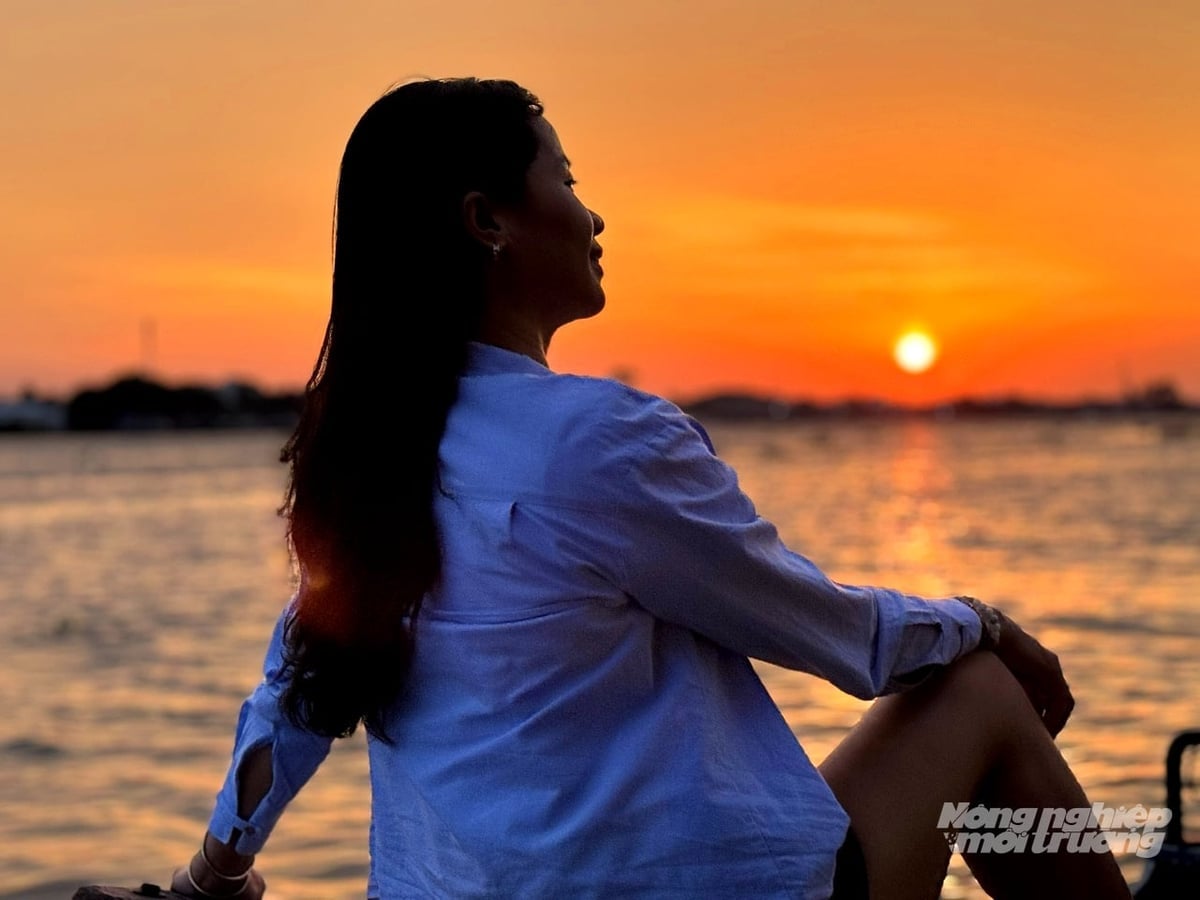
The sunset over the Hau River creates a peaceful and romantic scene, one of the attractive features of community-based tourism on Con Son Island. Photo: Le Hoang Vu.
At Con Son Island, the model of community-based ecotourism is developing strongly. Visitors to Mr. Hien's floating fish farm will then be transported by rowboat to visit the fruit orchards of neighboring households on Con Son Island, enjoying seasonal fruits and many traditional Southern Vietnamese cakes made by the women in the village, or experiencing activities such as draining canals to catch fish and rowing traditional sampan boats.
This equitable and mutually beneficial distribution of benefits helps improve the livelihoods of the entire local farming community, minimizes unhealthy competition, and preserves the warm and hospitable cultural identity.

Grilled green prawns, a rustic specialty of the riverine region, are served to tourists at the floating fish farm and tourism village of Mr. Duong Ke Hien. Photo: Le Hoang Vu.
In reality, ecotourism on Con Son Island is clearly flourishing. Tourist boats are bustling, transporting visitors, and laughter echoes along the Hau River. Images captured on location show the lively and enthusiastic atmosphere as families and children enjoy swimming in the river, walking on bamboo bridges, and watching fish, creating a vibrant and joyful rural tourism atmosphere on the Hau River.
Source: https://nongnghiepmoitruong.vn/bien-lang-be-nuoi-ca-thanh-diem-den-du-lich-doc-dao-d814387.html
![[Photo] General Secretary and President To Lam presides over a meeting on preparations for the review of one year of operation of the three-tiered government system.](https://vphoto.vietnam.vn/thumb/1200x675/vietnam/resource/IMAGE/2026/06/02/1780391821195_a1-bnd-4595-9717-jpg.webp)













![Transforming from Resolution 57: [Part 2] Businesses Lead the Way](https://vphoto.vietnam.vn/thumb/402x226/vietnam/resource/IMAGE/2026/06/02/1780399668663_5332-dsc09931-2-235637_295-235639.jpeg)



































Comment (0)