

The goal is to disseminate digital knowledge and skills to all segments of the population, so that no one is left behind.
Rapidly implement the digital version of the Popular Education program.
Professor Pham Tat Dong, former Vice President of the Vietnam Association for the Promotion of Learning and a researcher who has extensively studied the Popular Education Movement, stated: After the victory of the August Revolution in 1945, the Democratic Republic of Vietnam was established. At the first meeting of the Provisional Government on September 3, 1945, President Ho Chi Minh expressed his concern that over 90% of the people were illiterate… An illiterate nation is a weak nation. Therefore, he proposed launching a campaign to combat illiteracy.
Following President Ho Chi Minh's directive, on September 8, 1945, the Government issued a decree establishing the Department of Popular Education. The movement quickly spread, taking root in every village and hamlet. Within just one year, the entire country had 75,000 classes with 95,000 teachers participating, helping more than 2.5 million people learn to read and write. This was a remarkable achievement in the history of the nation's education system.
Continuing that tradition, Professor Pham Tat Dong emphasized that, in the context of the fourth industrial revolution and the national digital transformation process, the "Digital Literacy Movement" aims to popularize digital skills, helping people access, use, and master technology. Through this, it seeks to build a modern learning society, ensuring that no one is left behind.
To understand the importance of the "Digital Literacy Movement" in its mission to popularize digital skills and bring technology to the masses, Mr. Nguyen Nhat Quang - a founding member of VINASA and Director of the VINASA Institute of Science and Technology - believes that if we aim to "stand shoulder to shoulder with the world's leading nations," then the general knowledge and capabilities of the entire population must be different from the past.
If people do not adapt to the digital environment and are not equipped with appropriate digital skills, they will be left behind – this is contrary to our development path. Therefore, we must urgently implement digital literacy programs for the masses. To achieve this, digital transformation must be people-centered, and people must be identified as the main actors in carrying out the digital transformation revolution.
"Therefore, disseminating knowledge, skills, attitudes, and awareness about digital technology in general, artificial intelligence technology, and other technologies to the entire population is extremely urgent and important," Mr. Nguyen Nhat Quang emphasized.
A bridge between the past and the future.
Sharing the same view, Mr. To Hong Nam, Deputy Director of the Department of Science, Technology and Information (Ministry of Education and Training), stated that when implementing digital transformation, focusing on the people, and deploying a digital government, digital economy, and digital society, digital citizens are the decisive factor. In the digital space, if people lack digital skills, they cannot work, do business, or even enjoy entertainment. A system, no matter how well-designed and user-friendly, is truly wasteful if people do not know how to use it or do not fully utilize its functions.
"Therefore, it is essential for every citizen to have digital competence, especially in the current period, when we are implementing Resolution No. 57-NQ/TW of the Politburo on breakthroughs in the development of science, technology, innovation and national digital transformation," Mr. To Hong Nam stated.
In response to the "Digital Literacy Movement," Associate Professor Dr. Huynh Quyet Thang, Director of Hanoi University of Science and Technology, pledged to mobilize all resources to effectively implement the movement. Accordingly, Hanoi University of Science and Technology will focus on three key solutions: Firstly, the university will play a pioneering role in improving digital skills for lecturers and students, contributing to the nationwide digital literacy campaign.
Secondly, Hanoi University of Science and Technology (HUST) is determined to become a digital university, promoting comprehensive digital transformation. The university will perfect the eHUST platform, conduct research, training, and strongly apply digital technology and artificial intelligence, thereby promoting digital education and developing high-quality human resources for the country. Thirdly, the university will develop centers of excellence in strategic technology, contributing to the ecosystem of science, innovation, and digital transformation.
Associate Professor Huynh Quyet Thang believes that the "Digital Literacy Movement" not only has educational significance but also plays a crucial role in socio-economic development. When every citizen masters technology, society will progress faster on the path to modernization. With the active participation of educational organizations, businesses, and citizens, this movement promises to contribute to making Vietnam an advanced digital nation, steadily advancing in the digital age.
At the launching ceremony of the "Digital People's Education" movement and the "Digital People's Education" platform, Prime Minister Pham Minh Chinh acknowledged that the "Digital People's Education" movement has significant and profound humanitarian importance for the country's development, demonstrating the Party and State's determination in the development of a digital nation, digital government, digital economy, digital society, and digital citizens, aiming for rapid, comprehensive, and sustainable development.
The Prime Minister reiterated that 80 years ago, the "Popular Education Movement" was launched with the urgent goal of eradicating illiteracy and raising the cultural level of the people. Now, the "Digital Popular Education Movement" is inspired by, inherits, and develops from this movement.
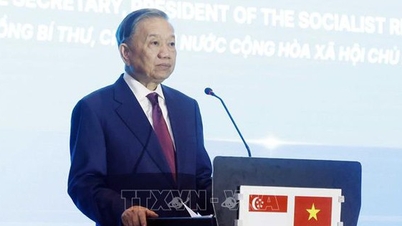
As General Secretary To Lam said, the "Digital Popular Education" movement is not only an educational initiative, but also a bridge between the past and the future. By building upon historical lessons, we strive to create a society that is not only rich in knowledge, but also strong in technology, ready for integration and development.
To spread the "Digital Literacy Movement," the Prime Minister stated that it requires not only policies and support from the Government and social organizations, but above all, the people themselves are the main actors. They need to proactively learn, readily share, and apply digital knowledge to build a progressive society in the new era. The country is facing a historic opportunity to enter a new era of strong development, driven primarily by science, technology, innovation, and digital transformation.
"We must undertake a particularly important and urgent task: to disseminate knowledge and technology about digital transformation and digital skills to the entire population, that is, to eliminate illiteracy about digital transformation," the Prime Minister stated.
Source: https://giaoducthoidai.vn/binh-dan-hoc-vu-so-ke-thua-tu-lich-su-post744683.html
![[Image] Pleasant weather helps students enter the 10th grade entrance exam with confidence.](https://vphoto.vietnam.vn/thumb/1200x675/vietnam/resource/IMAGE/2026/05/29/1780034401612_ngay-1-thi-lop-10-minh-duy-8-5009-jpg.webp)


![[Photo] Ba Lang An Lighthouse - the "eye of the sea" amidst the "rock museum" of Quang Ngai province.](https://vphoto.vietnam.vn/thumb/1200x675/vietnam/resource/IMAGE/2026/05/29/1780038698840_anh-man-hinh-2026-05-29-luc-14-10-42.png)


















































































Comment (0)