

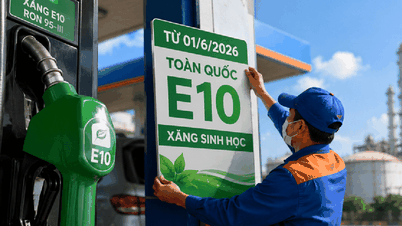
From June 1st, all unleaded gasoline on the market must be blended with ethanol to form E10 bioethanol fuel. Prior to this, this type of fuel had been sold on a trial basis since August 2025 and has been expanded in distribution by many businesses in recent months.
Prior to the transition, most consumer concerns revolved around vehicle compatibility, fuel consumption, and potential engine impacts. Accordingly, the Ministry of Industry and Trade has just published 85 frequently asked questions and answers to address these issues.
Can the vehicle I'm currently using refuel with E10?
According to the Ministry of Industry and Trade, most cars and motorcycles currently in circulation in Vietnam can use E10 gasoline. The exception is a line of light trucks manufactured between 1996 and 2023 that have ceased production, and a few older Suzuki motorcycles whose compatibility with E10 has not yet been confirmed.
Engines for lawnmowers, water pumps, leaf blowers, and other gasoline-powered agricultural machinery manufactured in recent years are all compatible with E10.
For vehicles that are too old or whose specifications are unclear, the regulatory agency recommends that users continue to use E5 RON92 gasoline. According to current regulations, this type of fuel is still permitted to be used until the end of 2030.
The Ministry of Industry and Trade also stated that people do not need to adjust the engine or flush the fuel tank when switching from RON95 to E10 under normal operating conditions. However, if the vehicle has been used for many years and the fuel tank shows signs of rust or has a lot of accumulated dirt, it should be cleaned before switching.
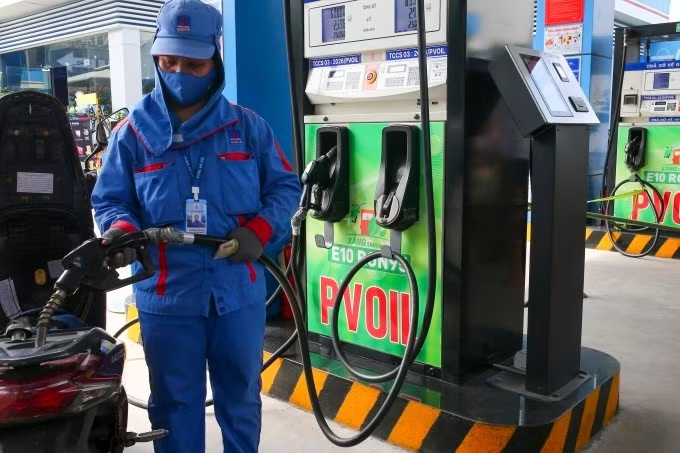
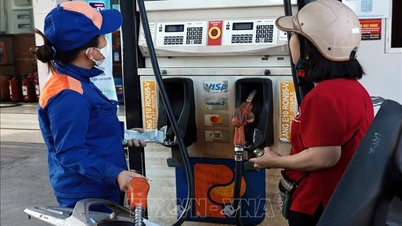
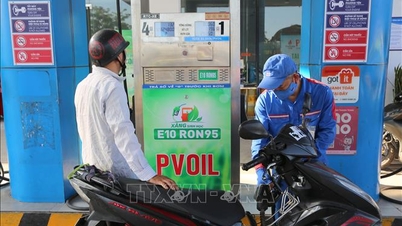
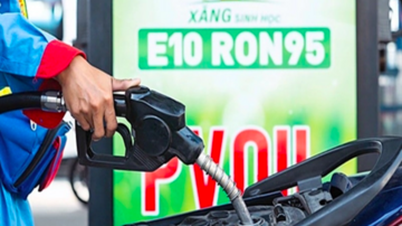
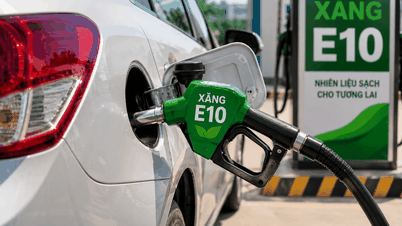
A gas station attendant pumps E10 fuel at a gas station in Hanoi , May 2026. Photo: Pham Chieu
Does E10 make cars less powerful and consume more fuel?
According to the Ministry of Industry and Trade, ethanol has a lower calorific value than mineral gasoline, so some tests have shown that E10 fuel consumption is about 2-3% higher than traditional gasoline.
However, this difference is not always apparent. This is because ethanol helps the fuel mixture burn more completely, thereby partially compensating for the energy loss due to its lower calorific value. Some tests have even shown that E10 has a driving range equivalent to or greater than conventional gasoline.
Regarding driving feel, the regulatory agency believes that users will find it difficult to notice the difference under normal conditions. Some cases of vehicles experiencing reduced acceleration after switching to E10 may stem from dirt and rust in the fuel system being dissolved and carried away by ethanol, reducing the flow of fuel into the combustion chamber.
Does E10 cause engine damage?
The Ministry of Industry and Trade affirms that there is no scientific evidence to suggest that E10 gasoline damages engines. According to the agency, E10 has been used for many years in approximately 60 countries worldwide. Domestic and international tests have also not recorded any engine damage resulting from E10 fuel itself.
Regarding concerns about corrosion, the Ministry of Industry and Trade stated that ethanol is more corrosive than mineral gasoline, but the impact on engine components is considered very small. Furthermore, most modern vehicles are designed with materials compatible with ethanol-containing fuels.
Questions related to spark plugs, engine sensors, electronic fuel injection system, starting ability, electrical system, or air conditioning on the vehicle were also answered by the regulatory agency, indicating no unusual effects were observed.
What should users be aware of?
One of the distinguishing characteristics of ethanol is its higher moisture absorption capacity compared to mineral gasoline. Therefore, the Ministry of Industry and Trade recommends against storing E10 for too long, ensuring that the container is tightly sealed to prevent water and moisture from entering the fuel. For vehicles that are used infrequently, regular starts, fuel checks, and maintenance should be performed according to the manufacturer's recommendations.
The regulatory agency also advises against adding ethanol to gasoline without authorization, removing ethanol from E10 fuel, and using additives without technical guidance from the engine manufacturer. According to the Ministry of Industry and Trade, these measures do not increase fuel efficiency and may compromise safety or reduce gasoline quality.
According to the biofuel roadmap approved by the Prime Minister in 2012, Vietnam had set a target to deploy E10 nationwide from 2017. However, implementation was delayed for many years due to market factors and supply capacity.
Authorities argue that the use of E10 not only reduces dependence on fossil fuels but also contributes to promoting the domestic biofuel industry. Environmentally, E10 can help reduce greenhouse gas emissions compared to conventional gasoline. Some studies show that emission reductions can reach up to 30%, depending on the vehicle type and operating conditions.
The Ministry of Industry and Trade also emphasized that E10 is a step in the green energy transition process, but not the only solution for sustainable transportation. In the future, technologies such as electric vehicles, hybrid vehicles, or hydrogen fuel will continue to be developed in parallel.
According to the Ministry of Industry and Trade, most of the controversy surrounding E10 fuel in recent times stems from a fear of change or unverified information on social media. The agency recommends that people seek information from official sources, consult vehicle manufacturers' recommendations, and purchase fuel from reputable stores.
If any abnormalities are detected in the fuel, the operator recommends that people stop using it and report it to the authorities or the fuel supplier, and have their vehicles inspected at a reputable technical facility.
"If there is sufficient evidence to prove that the fault was caused by E10 gasoline, the E10 gasoline supplier will be held responsible first, followed by the state agency managing petroleum," the Ministry of Industry and Trade stated.
Source: https://baohatinh.vn/bo-cong-thuong-giai-dap-ve-xang-e10-post311491.html


![[Video] Sunset at Lap An Lagoon – Where the sun sets over the fishing nets](https://vphoto.vietnam.vn/thumb/1200x675/vietnam/resource/IMAGE/2026/05/31/1780192137701_beach-landscape-sea-water-nature-grass-745871-pxhere-com.jpeg)
















![[Video] Sunset at Lap An Lagoon – Where the sun sets over the fishing nets](https://vphoto.vietnam.vn/thumb/800x450/vietnam/resource/IMAGE/2026/05/31/1780192137701_beach-landscape-sea-water-nature-grass-745871-pxhere-com.jpeg)






![[Infographic] Roadmap for merging villages and residential areas in Ha Tinh](https://vphoto.vietnam.vn/thumb/402x226/vietnam/resource/IMAGE/2026/05/31/1780179052356_fb_1200x80000-17-38-07still042-jpg.webp)








































![[Video] Sunset at Lap An Lagoon – Where the sun sets over the fishing nets](https://vphoto.vietnam.vn/thumb/402x226/vietnam/resource/IMAGE/2026/05/31/1780192137701_beach-landscape-sea-water-nature-grass-745871-pxhere-com.jpeg)


























Comment (0)