

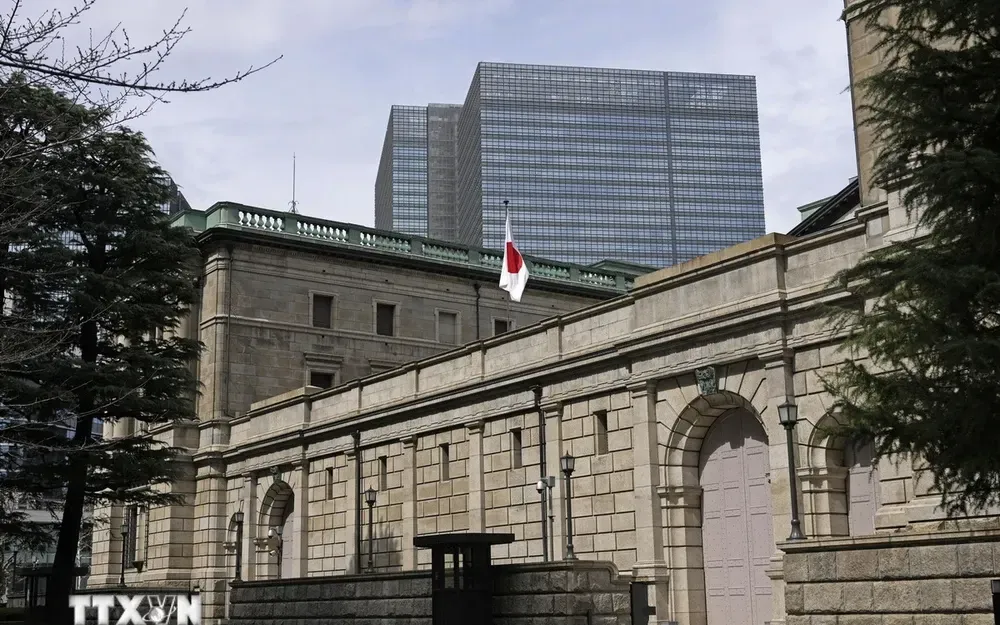
The Bank of Japan keeps interest rates unchanged.
The Bank of Japan (BoJ) raised its forecast for economic growth in fiscal year 2025 (ending March 2026) to 0.9%, compared with the 0.7% forecast in October 2025, and also raised its forecast for economic growth in fiscal year 2026 from 0.7% to 1%.
Japan's latest GDP figures show that its economy contracted more sharply than initially expected in the second quarter of fiscal year 2025 (June-September 2025), declining by 0.6% compared to the previous quarter and 2.3% compared to the same period of the previous fiscal year.
The Bank of Japan (BoJ) kept interest rates stable at 0.75%, after raising them to a 30-year high in December 2025.
Japan began normalizing its monetary policy in March 2024, ending negative interest rates and emphasizing that interest rate increases depend on the cycle of wage and price growth.
However, the BoJ's current policy is under pressure from leaders, including Prime Minister Sanae Takaichi, who advocates maintaining low interest rates to stimulate growth.
Newly released data shows that Japan's core inflation in December 2025 fell to 2.1%, the lowest level since March 2022, but still exceeded the Bank of Japan's 2% target for the 45th consecutive month.
The market is closely watching Governor Kazuo Ueda's assessment of how the recent weakening of the yen might affect inflation.
Despite the Bank of Japan's tightening of monetary policy, Japanese bond yields have continued to rise, reaching multi-decade highs, leading to capital outflows and weakening the yen. This is happening against a backdrop of persistently negative real interest rates and growing financial concerns.
Prime Minister Takaichi has planned a record budget of $783 billion for fiscal year 2026, in addition to last year's $135 billion economic stimulus package aimed at helping households cope with rising living costs.
Source: https://vtv.vn/boj-giu-nguyen-lai-suat-100260123134723983.htm

![[Photo] The General Secretary, President and his wife begin their state visit to the Philippines.](https://vphoto.vietnam.vn/thumb/1200x675/vietnam/resource/IMAGE/2026/05/31/1780230559452_anh-man-hinh-2026-05-31-luc-19-28-11.png)

![[Image] Hanoi Police officially crowned champions of V-League 2025/2026](https://vphoto.vietnam.vn/thumb/1200x675/vietnam/resource/IMAGE/2026/05/31/1780244769054_ndo_br_039d561b692be875b13a-jpg.webp)
![[Photo] Admire the coral "masterpiece" amidst the million-year-old heritage of Dak Lak province.](https://vphoto.vietnam.vn/thumb/1200x675/vietnam/resource/IMAGE/2026/05/31/1780221235105_anh-man-hinh-2026-05-31-luc-16-53-27.png)
![[Photo] Solemn bathing ceremony and Buddha procession in Hue](https://vphoto.vietnam.vn/thumb/1200x675/vietnam/resource/IMAGE/2026/05/31/1780228263543_1-jpg.webp)
















![[Video] Sunset at Lap An Lagoon – Where the sun sets over the fishing nets](https://vphoto.vietnam.vn/thumb/340x192/vietnam/resource/IMAGE/2026/05/31/1780192137701_beach-landscape-sea-water-nature-grass-745871-pxhere-com.jpeg)




































![[Photo] Admire the coral "masterpiece" amidst the million-year-old heritage of Dak Lak province.](https://vphoto.vietnam.vn/thumb/402x226/vietnam/resource/IMAGE/2026/05/31/1780221235105_anh-man-hinh-2026-05-31-luc-16-53-27.png)






























Comment (0)