

The development of social sciences and humanities in the new era is extremely important; however, social sciences and humanities have not been addressed deeply, fully, and specifically in Resolution No. 57-NQ/TW as well as other resolutions of the Party . On May 25th, at the Party Central Headquarters, General Secretary and President To Lam, Head of the Central Steering Committee on Science , Technology Development, Innovation and Digital Transformation, chaired a working session of the Standing Committee to provide guidance on basic scientific research.
At the meeting, General Secretary and President To Lam delivered strategic directives, emphasizing the need to correctly identify the position and role of basic science in the country's new development model, including the social sciences and humanities. General Secretary and President To Lam stressed the importance of clarifying the differences between natural sciences, fundamental technologies, and social sciences and humanities in order to establish appropriate financial mechanisms, evaluation mechanisms, and mechanisms for utilizing scientific results.
According to the General Secretary and President, social sciences and humanities create foundational knowledge, policy arguments, governance models, cultivate cultural values, forecasting capabilities, and national soft power. It can be said that the guiding ideology of General Secretary and President To Lam has elevated the social sciences and humanities, placing them in a strategic relationship on par with natural sciences and technology. This also demonstrates the special attention the Party and State are paying to social sciences and humanities.
In this article, I would like to offer some advice and recommendations for the development of social sciences and humanities, so that they can truly fulfill their role as fundamental and foundational sciences.
First , it is necessary to have an accurate and comprehensive understanding of the role and importance of the social sciences and humanities .
Social sciences and humanities are the cornerstone of the Party and State's guidelines, strategies, and policies, and the foundation for developing an advanced Vietnamese culture rich in national identity. They are the direct basis of the Vietnamese Party and State's guidelines and policies, directly related to the nation's destiny, national sovereignty, fundamental national interests, national security, cultural security, human security, and the promotion of the nation's prestigious brand internationally. They also provide the scientific and practical basis for the Party, State, business community, and people of Vietnam to conduct ideological dialogues, strategic dialogues, institutional dialogues, and intercultural dialogues with international partners, businesses, and friends and people of other countries in the process of international integration in the context of globalization, developing Vietnam's soft power, preserving and promoting Vietnamese cultural identity, and selectively absorbing the best of human culture to ensure integration without assimilation, and integration to shine.
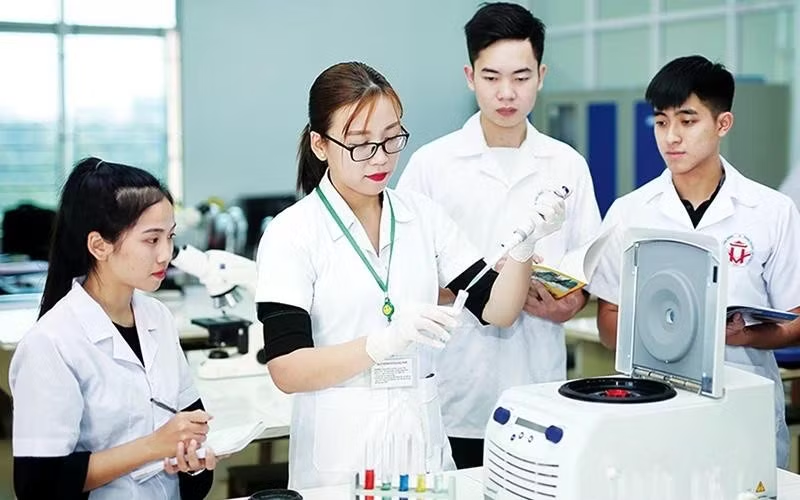
Secondly, because the fields of science and technology are increasingly integrated and intertwined , social sciences and humanities also serve as a foundation and basis for the sustainable development of natural sciences and technology. Simultaneously , innovation and digital transformation provide opportunities for social sciences and humanities to transform and develop to a new level, aligning with the global trend of social sciences and humanities. Therefore, it is impossible to separate these fields from science and technology; instead, policies and solutions in research and training are necessary to promote the integration of these scientific fields in Vietnam. The development of high technology, such as AI, must always consider the role of humanism, national sovereignty, and national identity, and how these should be protected and promoted. Meanwhile, the social sciences and humanities must move beyond mere sentimentality and qualitative analysis and instead rely on empirical evidence and verifiable tools and methods to become arguments and "inputs" for the policy-making process.
Thirdly, it is necessary to establish the principle of respecting academic freedom and continuously expanding the space for academic creativity so that intellectuals and scientists can contribute even more to the cause of national construction and defense . Professional issues should be resolved through scientific debate; other issues of a criminal nature, such as spreading false information, scientific fraud, and violations of integrity, should be handled according to the provisions of the law. Most importantly, scientists must constantly improve their capacity for academic dialogue at a global level, and must be worthy of being "intellectual and cultural ambassadors" of the country, both preparing and leading the Vietnamese nation to integrate and shine in the globalized world.
Fourth, we need to create and strengthen "pull forces," combining "pull forces" with "push forces" to generate momentum for the sustainable and effective development of Vietnamese social sciences and humanities . Most policy solutions aimed at overcoming difficulties and promoting the development of science, technology, innovation, and digital transformation, including addressing the challenges facing Vietnamese social sciences and humanities, have so far mainly focused on unlocking " driving forces," that is, solving internal problems such as theoretical and methodological innovation, increasing investment, enhancing capacity, ensuring academic freedom, removing bottlenecks in mechanisms, prioritizing certain areas, and supporting others. All these solutions, over the years, have shown little effectiveness. The reason is that Vietnamese social sciences and humanities still lack "pull forces." It is the synergy of these two forces that gives the social sciences and humanities the impetus and strong motivation to move forward.
In my opinion, the "driving force" for the entire development of science, technology, innovation, and digital transformation, including social sciences and humanities, lies in the science and technology market and the sustainable development of the country.
Meeting and working with representatives of scientists attending the conference on October 26, 2025, General Secretary To Lam also affirmed: “Your works not only help the world understand us better, but also help us to reflect on ourselves more frankly. In the process of formulating guidelines, policies, and strategies for national development, the Vietnamese Party and State always listen to independent, serious, and well-intentioned scientific criticism. Valuable research with rich practical content and a long-term vision is a valuable source of reference for us in building our national development strategy.”
The process of planning and implementing the Party and State's strategies and policies is where the research results of various scientific disciplines, especially the social sciences and humanities and interdisciplinary sciences, are received. This is the most important "market segment" that creates the "driving force" for the development of the social sciences and humanities and interdisciplinary sciences. The Party and State need to "commission" individuals and organizations in the social sciences and humanities to provide the scientific and practical basis and arguments for the entire process of leadership, governance, and administration in Vietnam. Commissioning through transparent and rigorous contractual mechanisms will ensure the best quality "input," guaranteeing the efficiency, effectiveness, and effectiveness of the country's leadership, governance, and administration.
Regarding the two-tiered local government system, I believe it is the second most important "segment" of Vietnamese social sciences and humanities. To optimize development opportunities and resources, to expand development space, and to improve local governance capacity, it is essential to rely on information and solutions provided by social sciences and humanities and interdisciplinary sciences. Therefore, the "market segment" of social sciences and humanities and interdisciplinary sciences in the new era is the process of rapid and sustainable development in localities.
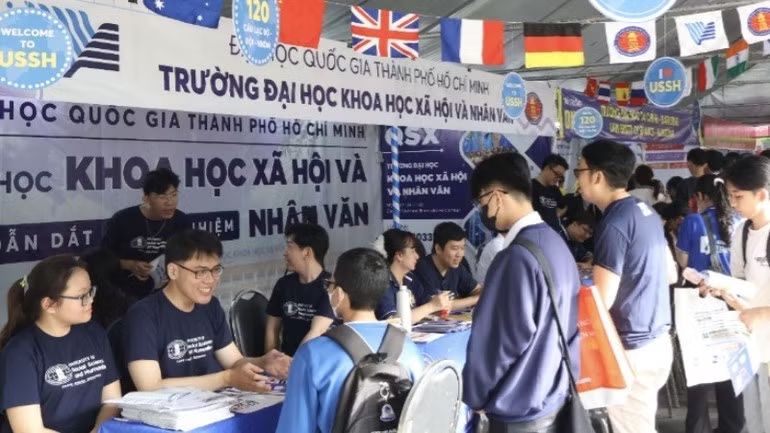
The Vietnamese education system is the third most important "market segment" for the Vietnamese social sciences and humanities. The social sciences and humanities have the mission of providing learning materials for many subjects and disciplines within the education system, from preschool to postgraduate levels. These include subjects such as Literature, Civic Education, History, Geography, Economics and Law Education, Local Education, Fine Arts, Foreign Languages, and minority languages. These are extremely important subjects at the secondary level, aiming to equip young people – the future owners of the country – with cultural knowledge and help them develop their character and cultivate their citizenship. This is a decisive factor in ensuring the sustainability of Vietnamese culture and the political system, enabling the Vietnamese nation to integrate and shine globally. Therefore, the State needs to commission the Vietnamese social sciences and humanities to provide this "market segment" with the best products through appropriate solutions.
The Vietnamese business sector is also an important market segment for the social sciences and humanities in Vietnam. Not only production, business, brand development, and corporate governance strategies, but also employer-employee communication methods, and domestic-international interactions, require the advice and contributions of social science and humanities experts. Furthermore, in the new era, the cultural industry and cultural economy are also important development directions. Ensuring cultural welfare for millions of workers is a major need. Social sciences and humanities can work together with businesses to become a direct productive force, contributing to the sustainable and efficient development of businesses, and helping to achieve continuous double-digit growth in the Vietnamese economy for many consecutive years.
The entire Vietnamese society is the final, and equally crucial, "main market segment" for the social sciences and humanities . Raising the intellectual level of the population and strengthening the intellectual, spiritual, and cultural foundations of the Vietnamese nation is the sacred mission of Vietnamese social sciences and humanities. Especially in the era of digital transformation, fierce competition will ensue among various forces and parties aiming to influence the spiritual values and value orientations of societies, including Vietnamese society. The Party and State should promptly develop solutions to help social sciences and humanities regain the domestic market and gradually expand into the global market.
Fifthly, it is necessary to strengthen the global dialogue capacity of Vietnamese social sciences and humanities .
Unfortunately, one of the major limitations of Vietnamese social sciences and humanities is their capacity and effectiveness in participating in global academic dialogue. It can be said that a large proportion of scientists in this field have poor foreign language skills, or if they do, it's only at a low level, making it difficult to communicate and exchange academic ideas with foreign colleagues. Even their ability to read foreign-language materials is very slow. With the development of supporting tools, the language barrier will gradually decrease. The younger generation of social scientists and humanities also has better foreign language skills. However, the capacity for global academic dialogue on academic theory, research methods, and new approaches is what is truly important. To improve the situation, we propose solutions to support them in enhancing their capacity for global academic dialogue: Cultivating a global mindset; improving foreign language proficiency; and removing barriers to international cooperation in science. Promulgate mandatory standards on the level of globalization for each field and discipline in the social sciences and humanities.
Sixth, we need to innovate the evaluation methods for Vietnamese social sciences and humanities . Each field, even each discipline or specialization of science, needs and should have its own methods, criteria, and tools for measurement and evaluation, because the most important purpose of evaluation is to measure and determine the level of contribution and realization of the goals of that field, discipline, or specialization of science. At the same time, the evaluation must also point out the performance (input - output), the level of health, and the risks and shortcomings of the evaluated subject, thereby enabling solutions for investment and adjustment of development methods...
Seventh, it is necessary to build and develop a national database (on geography, population, politics, administration, history, culture, economy, etc.) and continuously update it (accurate, complete, clean, and up-to-date) to serve as a basis and tool for national governance and ensure national data security in the digital age .
In the era of digital transformation and artificial intelligence (AI), digitized data is not only a resource and asset but also a direct source of capital for production and business activities; it is the foundation for scientific research, education, culture, and arts... It is also the basis for protecting national sovereignty and security in the digital space, especially in the AI era. Whoever dominates and controls digitized data will have the power to manipulate many aspects of life.
The national database system needs to be continuously developed, ensuring that it is accurate, complete, clean, active, and well-managed.
Therefore, the State's investment in and assignment to several scientific institutions such as Hanoi National University and the Vietnam Academy of Social Sciences to jointly organize the construction and management of the national foundational database is extremely necessary and urgent. It will certainly bring many great and practical contributions, creating an important foundation for the development of social sciences and humanities in the new era.
Source: https://cand.vn/buoc-dot-pha-cho-khoa-hoc-xa-hoi-va-nhan-van-post812516.html

![[Photo] Admire the coral "masterpiece" amidst the million-year-old heritage of Dak Lak province.](https://vphoto.vietnam.vn/thumb/1200x675/vietnam/resource/IMAGE/2026/05/31/1780221235105_anh-man-hinh-2026-05-31-luc-16-53-27.png)
![[Image] Hanoi Police officially crowned champions of V-League 2025/2026](https://vphoto.vietnam.vn/thumb/1200x675/vietnam/resource/IMAGE/2026/05/31/1780244769054_ndo_br_039d561b692be875b13a-jpg.webp)

![[Photo] Solemn bathing ceremony and Buddha procession in Hue](https://vphoto.vietnam.vn/thumb/1200x675/vietnam/resource/IMAGE/2026/05/31/1780228263543_1-jpg.webp)
![[Photo] The General Secretary, President and his wife begin their state visit to the Philippines.](https://vphoto.vietnam.vn/thumb/1200x675/vietnam/resource/IMAGE/2026/05/31/1780230559452_anh-man-hinh-2026-05-31-luc-19-28-11.png)







![[Video] Sunset at Lap An Lagoon – Where the sun sets over the fishing nets](https://vphoto.vietnam.vn/thumb/340x192/vietnam/resource/IMAGE/2026/05/31/1780192137701_beach-landscape-sea-water-nature-grass-745871-pxhere-com.jpeg)






































![[Photo] Admire the coral "masterpiece" amidst the million-year-old heritage of Dak Lak province.](https://vphoto.vietnam.vn/thumb/402x226/vietnam/resource/IMAGE/2026/05/31/1780221235105_anh-man-hinh-2026-05-31-luc-16-53-27.png)































Comment (0)