

As the only locality in the country with three sides bordered by the sea, possessing a unique mangrove forest ecosystem and many outstanding potentials in fisheries, renewable energy and ecotourism, Ca Mau is facing a great opportunity to rise to become a marine economic growth hub of the Mekong Delta region.
However, there are still many challenges between potential and practical development. How can we effectively exploit marine resources? What are the "bottlenecks" that need to be overcome so that Ca Mau can truly reach out to the open sea?
The series "Ca Mau's Aspiration for 'Building a Great Future from the Blue Sea'" will comprehensively analyze the pillars of the marine economy, from the current situation and difficulties to solutions for development in the new phase.
Lesson 1: Rich in potential, why haven't we become rich from the sea?
Compared to many localities in the Mekong Delta region, Ca Mau possesses marine economic potential that ranks among the highest in the country. However, these advantages have not yet been exploited to their full potential to create a breakthrough in development. In the development plan until 2030, with a vision to 2050, the marine economy is identified as a strategic "pillar," playing a fundamental role in the province's long-term growth.
Combining unique advantages
Ca Mau has over 300 km of coastline, an exploitable sea area of approximately 120,000 km², and three island clusters: Hon Khoai , Hon Chuoi, and Da Bac. This provides favorable conditions for developing a multi-sector marine economy, from fishing and aquaculture to renewable energy and ecotourism .
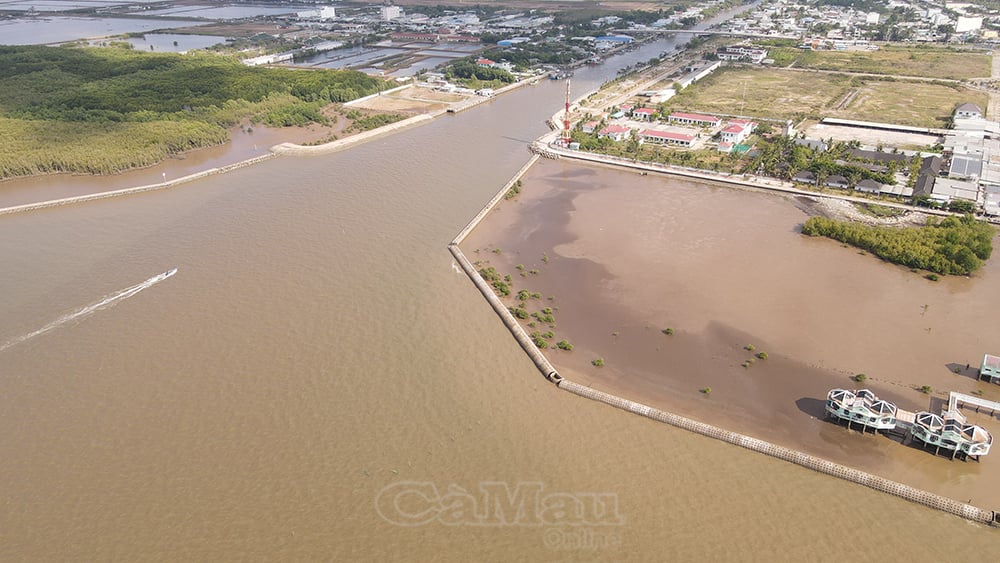 Ca Mau is the only locality in the country with three sides bordered by the sea, possessing many advantages for developing a marine economy.
Strategically located, Ca Mau lies on the southern economic development corridor of the Greater Mekong Subregion (GMS), connecting both the East Sea and the Gulf of Thailand. The province is also considered a dynamic growth pole of the Mekong Delta region, playing a special role in maritime economy and national defense and security.
Following the merger with Bac Lieu, the development space has expanded, creating additional advantages for the formation of a "capital" of renewable energy and the largest shrimp production center in the country. In particular, the strength of coastal wind power combined with the Ca Mau gas-electricity-fertilizer complex is opening up significant potential for the development of the green energy industry.
 The vast fishing grounds provide abundant marine resources for the Ca Mau sea region.
Furthermore, the mangrove ecosystem, covering over 57,000 hectares, is considered one of the world's exemplary ecosystems, playing a dual role in coastal protection and creating livelihoods through economic models such as shrimp-mangrove and ecological shrimp farming.
Ca Mau has all the necessary conditions for developing a comprehensive marine economy. From fisheries and aquaculture to renewable energy and ecotourism, there is still enormous potential if properly managed and exploited.
Currently, the province has over 5,000 fishing vessels and approximately 450,000 hectares of aquaculture, the largest in the country. This is an important foundation for Ca Mau to maintain its role as the regional fisheries center.
 Many high-tech shrimp farming areas have been established along the coast, contributing to increased production value.
Furthermore, coastal areas with stable wind speeds year-round are opening up great prospects for the wind power industry. In the tourism sector, destinations such as Ca Mau Cape, U Minh Ha National Park, and other unique coastal regions have begun to develop eco-tourism and experiential tourism products with their own distinct characteristics.
Overall, Ca Mau has met all the necessary conditions to develop a multi-pillar marine economy in line with the spirit of Resolution 36-NQ/TW.
Underexploitation!?
Despite possessing numerous potentials and outstanding advantages, the reality shows that the exploitation and transformation of Ca Mau's marine resources into development value still faces many limitations. The risk of unsustainable development, backwardness, or even being left behind is entirely possible if issues related to strategic vision, planning, and resource mobilization are not effectively addressed.
 The unique mangrove ecosystem provides favorable conditions for Ca Mau to develop a sustainable shrimp farming model under the mangrove canopy.
First and foremost is the decline in marine resources. Long-term coastal exploitation has led to a significant decrease in seafood stocks. According to survey results, seafood stocks in the former Bac Lieu sea area have decreased by approximately 11-12% in the last 5 years.
While the province has 6 seaports and a fishing fleet of over 5,200 vessels with a total capacity exceeding 800,000 horsepower, Ca Mau still lacks large-capacity fishing vessels capable of long-distance voyages. The main reasons are the difficulties fishermen face in securing investment capital, the underdeveloped state of aquaculture, the lack of high-value farming models, and the limited large-scale seafood processing industry, which mainly focuses on shrimp processing.
In addition, illegal, unreported, and unregulated (IUU) fishing remains an issue that needs continued strict control to meet the requirements of international integration.
 The decline in fish stocks is making fishing activities increasingly difficult for fishermen.
In the environmental sector, pollution, depletion of groundwater resources, and coastal erosion are becoming increasingly serious. On average, Ca Mau loses 200-300 hectares of coastal forest each year; in 2025 alone, the area of forest lost is expected to be around 204 hectares, directly impacting the ecosystem and livelihoods of people in coastal areas.
To Hoai Phuong, Director of the Department of Agriculture and Environment of Ca Mau province, warned: “Climate change, sea level rise, land subsidence, and extreme weather events are putting immense pressure on ecosystems and production. Without fundamental solutions, the risk of resource depletion and exhaustion is very clear.”
Another "bottleneck" is the lack of synchronized transportation and logistics infrastructure. Expressways such as the Ha Tien - Rach Gia - Bac Lieu expressway, coastal roads, and the seaport system have not met development requirements, leading to increased freight costs and affecting the ability to attract investment.
Despite possessing significant potential with its long coastline, unique ecosystem, and established ecotourism models, Ca Mau's tourism products remain repetitive and have not effectively exploited the unique features of renewable energy projects or coastal island clusters. Therefore, the contribution of tourism to the GRDP remains quite modest.
Mr. Nguyen Quoc Thanh, Director of the Department of Culture, Sports and Tourism of Ca Mau province, said: "The length of stay for tourists is still short, and their spending is not high. Tourism products are not diverse enough, lacking highlights that can retain tourists."
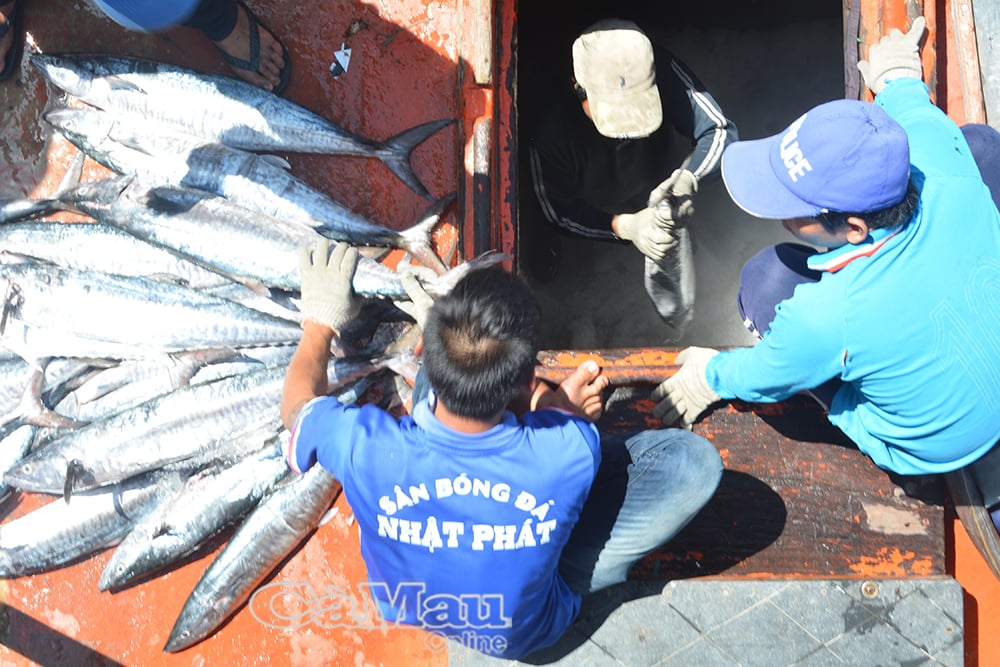 Fishermen in Gành Hào commune "bring home" a catch after their fishing trip.
With a determination to prosper from the sea, Ca Mau province has issued numerous resolutions and action programs, including Resolution No. 39/NQ-HĐND for the period 2026-2030, which clearly defines the pillars of marine economic development as: fisheries, renewable energy, and ecotourism. However, to realize this strategic goal, the province needs to restructure its growth model in depth, shifting from a mindset of "maximizing exploitation" to "efficient and sustainable exploitation," linking economic development with environmental protection, and enhancing the added value and competitiveness of the marine economy.
Hong Phuong - Kim Trung - Huu Tho - Hoang Lam
Source: https://baocamau.vn/ca-mau-khat-vong-bien-xanh-dung-co-do--a128880.html


![[Image] Close-up view of the interchange connecting the two expressways and Long Thanh Airport.](https://vphoto.vietnam.vn/thumb/1200x675/vietnam/resource/IMAGE/2026/05/25/1779703378210_ndo_br_z7863716673926-224453a31600126cce10622af6290afd-4549-jpg.webp)


![[Image] Hanoi's urban life under the challenge of a "scorching hot" environment](https://vphoto.vietnam.vn/thumb/1200x675/vietnam/resource/IMAGE/2026/05/25/1779706979265_nang-nong-t5-2026-minh-duy-7-4636-jpg.webp)






































































Comment (0)