

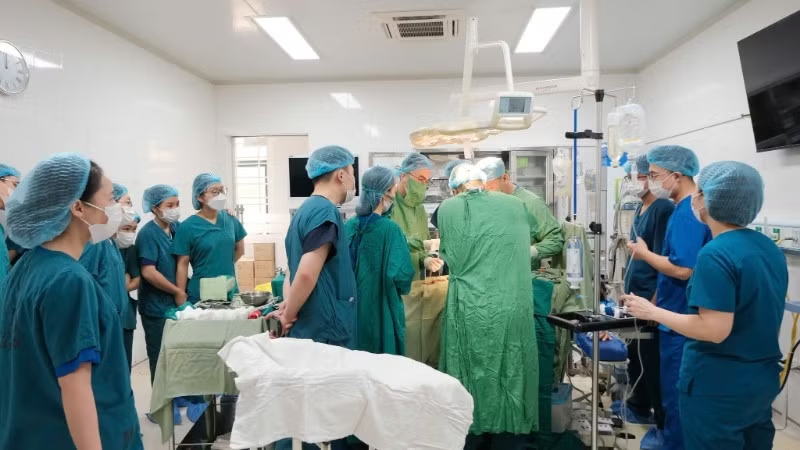
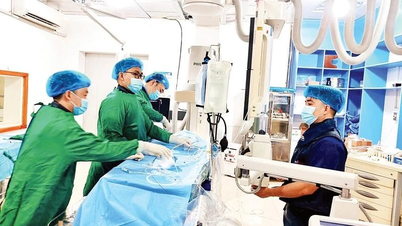
Recently, Hanoi Obstetrics and Gynecology Hospital successfully treated a 39-year-old pregnant woman, NTM, who suffered from central placenta previa and placenta accreta on a background of three previous cesarean sections – one of the most challenging and dangerous scenarios.
The pregnant woman was admitted to the hospital at 38 weeks and 5 days of gestation with a complicated medical condition. A history of three previous cesarean sections resulted in the entire anterior surface of the uterus adhering tightly to the abdominal incision, obscuring normal anatomical landmarks.
Through examination and ultrasound, doctors determined that the placenta was not only in an abnormal position (central placenta previa) but also deeply penetrating the uterine muscle (placenta accreta - Percreta type), accompanied by polyhydramnios causing uterine distension, increased vascular proliferation, and a high risk of intraoperative hemorrhage.
In obstetrics, central placenta previa and placenta accreta are always situations that doctors must be particularly vigilant about because of the extremely dangerous risk of postpartum hemorrhage, which directly threatens the lives of both mother and child.
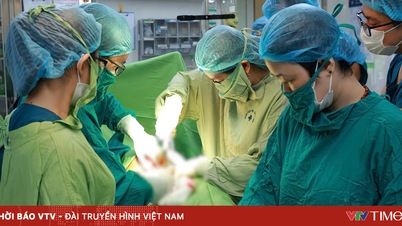
Recognizing this as a case with a very high risk of postpartum hemorrhage, the surgical team, consisting of Master's degree holder and specialist doctor Nguyen Pham Tien Dat - Head of the Normal Delivery Department A2, and Master's degree holder and doctor Dam Van Hung, closely coordinated with the Anesthesia and Resuscitation team led by Master's degree holder and doctor Tran Thu Thao to prepare an intensive resuscitation plan during the surgery, ensuring absolute safety in terms of the mother's survival rate.
During the surgery, the doctors faced a major challenge as the area where the bladder was dissected was highly adherent and bleeding profusely. With meticulous care and extensive experience, the team skillfully dissected and freed the uterus to deliver the baby. A baby boy weighing 3,400g was safely born.
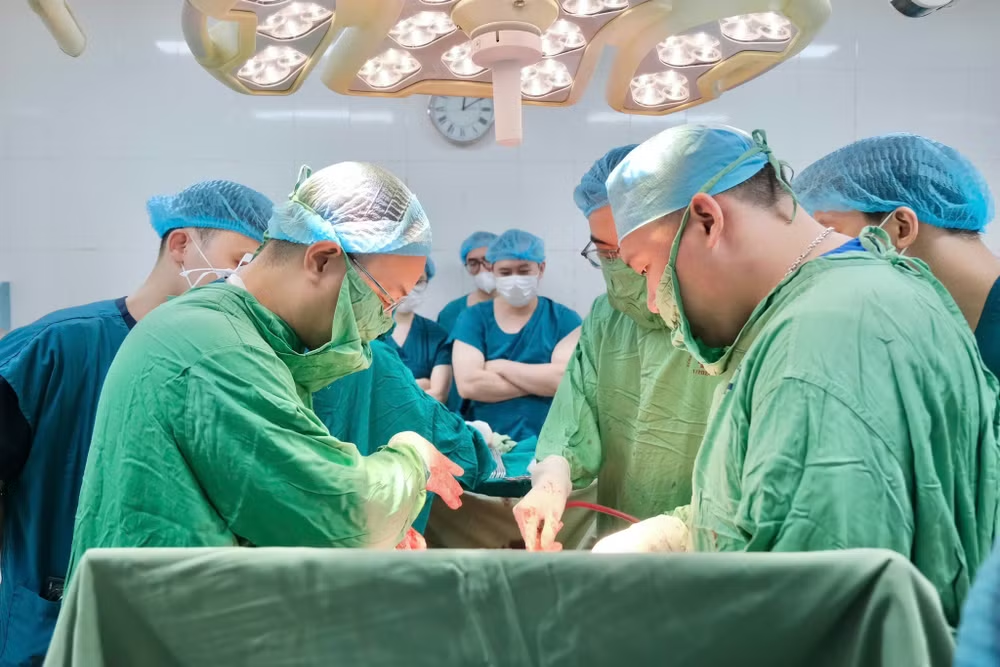
However, because the placenta had deeply penetrated and pierced many large blood vessels, the uterus could not be preserved. To ensure the mother's safety, the doctors decided to perform a partial hysterectomy and ligate the internal iliac artery to completely stop the bleeding.
Throughout the surgery, the patient received over 1,000ml of blood and blood products in a timely manner to stabilize her health. After more than an hour of intense concentration, the surgery was successfully completed.
After two days of close monitoring and intensive care under the watchful eyes of the doctors, the mother's endotracheal tube was successfully removed. Hemodynamic indicators remained at safe levels. Currently, both mother and baby are in stable condition, bringing complete joy to the family and the entire team.
The successful surgery was not only an effort to save the mother's life but also highlighted the crucial role of close pregnancy management in cases with multiple previous cesarean sections.
Doctors advise that women of childbearing age should limit cesarean sections unless medically indicated. Cases with previous cesarean scars require close pregnancy management and ultrasound consultations at specialized hospitals to detect placental abnormalities early, allowing for proactive intervention and ensuring maximum safety for both mother and baby.
Source: https://nhandan.vn/ca-mo-can-nao-cuu-me-con-san-phu-mac-rau-cai-rang-luoc-the-nang-post963938.html
![[Image] Pleasant weather helps students enter the 10th grade entrance exam with confidence.](https://vphoto.vietnam.vn/thumb/1200x675/vietnam/resource/IMAGE/2026/05/29/1780034401612_ngay-1-thi-lop-10-minh-duy-8-5009-jpg.webp)
![[Photo] Ba Lang An Lighthouse - the "eye of the sea" amidst the "rock museum" of Quang Ngai province.](https://vphoto.vietnam.vn/thumb/1200x675/vietnam/resource/IMAGE/2026/05/29/1780038698840_anh-man-hinh-2026-05-29-luc-14-10-42.png)












































































Comment (0)