

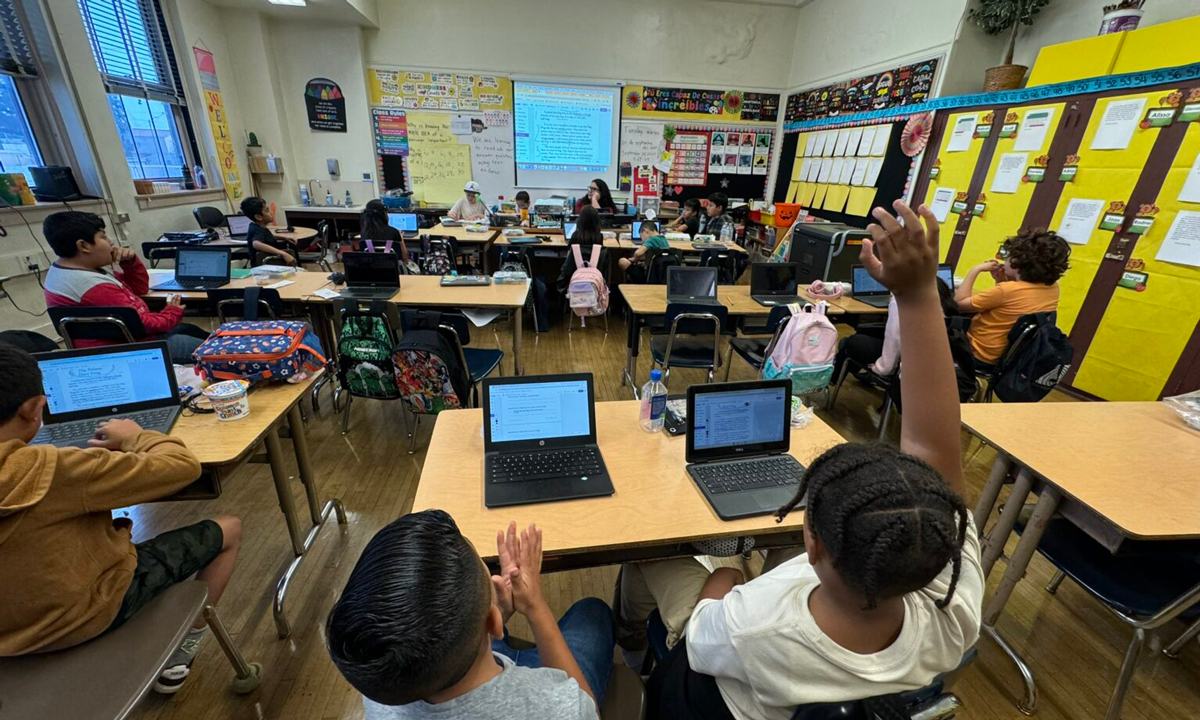
Just a few years ago, American public schools were racing to equip every student with a computer, but now, after spending billions of dollars on laptops, tablets, and learning apps, many schools are beginning to face a "digital backlash" as more and more parents, teachers, and school districts believe it's time to limit electronic devices.
The first move from Los Angeles.
According to a resolution passed by the Los Angeles Board of Education last month, the school district will remove electronic devices from students up to the second grade; implement daily and weekly screen time limits for higher grades; block YouTube on learning devices; and ban the use of electronic devices during lunch breaks and recess in elementary and middle school. The district will also review approximately $1.6 billion worth of educational technology contracts.
Los Angeles' move is fueling a wave of reform across the United States. Previously, many parents advocated for banning phones in schools, and this has now become a common trend. But realizing that phones aren't the only source of distraction, they're beginning to shift their focus to devices provided by schools.
At least 14 states in the US have proposed bills aimed at limiting screen time in schools. Last week, the federal government also warned that excessive screen time among children is becoming a worrying public health issue.
Children are becoming increasingly addicted to screens and electronic devices.
In Los Angeles, a group of parents called “Schools Beyond Screens” was formed last year to pressure the school district. Many said they struggled to limit screen time at home, while schools forced students to use screens constantly for learning.
Katie Pace, a mother of three, says her family only has one iPad and one TV, doesn't allow her children screen time during the week, and bans electronic devices in their bedrooms. Her daughter, Clementine, is in eighth grade but doesn't have her own phone.
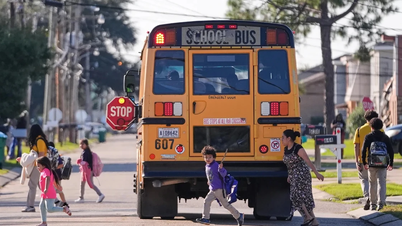
However, everything changed the moment Clementine boarded the school bus with Wi-Fi. On the way to school, she watched YouTube on her school-provided Chromebook. In Spanish class, assignments were given via Duolingo, but many students used Google Translate. Most homework was also done online.
The mother said her daughter used to read books after school, but now she spends hours listening to music, creating Spotify playlists, and watching makeup videos or cat clips on YouTube. “That really infuriates me. My daughter is in high school and has brought home a screen addiction,” she said.
The Covid-19 pandemic has accelerated the wave of school digitalization.
The trend of providing digital devices to all students began more than a decade ago to bridge the “digital divide,” but accelerated sharply during the Covid-19 pandemic. As learning shifted entirely online in 2020, American schools rushed to provide devices to students. By the 2021-2022 school year, as many as 96% of American public schools reported having provided digital devices to students who needed them.
Many schools are shifting their budgets from textbooks and paper materials to digital platforms, causing the field of educational technology to explode into a multi-billion dollar industry.
Nick Melvoin, a member of the LAUSD education board and the author of the new resolution, acknowledges that during the pandemic, electronic devices were a "lifesaver." But now, he believes it's time to "reset." He argues that many classrooms are using screens inefficiently, even replacing teaching with online applications.
Many schools are starting to tighten management.
Educators argue that the biggest challenge is that technology has become so deeply intertwined with learning, especially at higher levels, making screen time reduction anything but simple.
In Fresno, California's third-largest school district is spending approximately $4 million annually on laptop repairs and replacements. Therefore, the district has decided to require 40,000 elementary school students to return their laptops and take them home, and starting this fall, they will only be allowed to use computers in the classroom.
The Simi Valley school district near Los Angeles also stopped allowing younger students to take the devices home due to high repair costs and the problem of students using the devices to search for inappropriate content or play games.
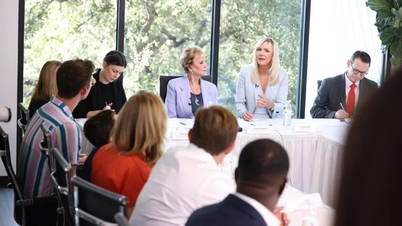
In Arlington, Virginia, many parents recently gathered to share the difficulties their children are facing due to screen addiction. One parent said her sixth-grade son frequently visits gaming websites during school hours. Another worried about her child's spelling mistakes that aren't being corrected because there's too little handwriting practice.
After a three-hour meeting, the group of parents agreed to petition the school to allow students to "reject technology and return to textbooks and pen and paper."
A parent named Kristina Jackson commented: "Ten years from now, I don't think we'll look back on this with any other reaction than: How could we have been so naive as to so easily give these devices to children?"
Source: https://daibieunhandan.vn/cac-truong-hoc-my-truc-lan-song-phan-doi-thiet-bi-so-10418161.html



![[Photo] General Secretary and President To Lam presides over the meeting to approve the draft report on the results of the second inspection by the Politburo of the Standing Committee of the Hanoi City Party Committee.](https://vphoto.vietnam.vn/thumb/1200x675/vietnam/resource/IMAGE/2026/05/26/1779789811432_a2-bnd-4430-9620-jpg.webp)

























































































Comment (0)