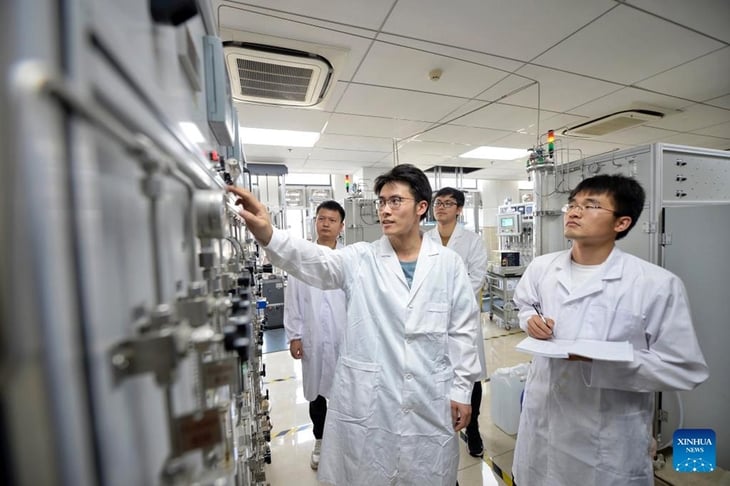
Chinese R&D teams often focus on applied technologies that can be quickly put into production - Photo: XINHUA
For decades, China has been seen by the world as the "world's factory," relying on cheap labor, low-cost energy, and large-scale supply chains, while much of its core technology is concentrated in the US and Europe.
However, recent data and observations suggest that this structure is shifting as China ramps up investment in R&D and gradually emerges as one of the world's leading technology testing centers.
From catching up to overtaking
According to the World Intellectual Property Organization, 2025 marks the first time China has entered the top 10 of the Global Innovation Index and continues to lead the group of upper-middle-income economies , climbing a total of 25 places compared to 2013.
A report by the People's Daily in early October indicated that China's total R&D spending in 2024 reached over $506 billion, an 8.3% increase year-on-year.
The results were also impressive, with many indicators related to Beijing's intellectual property, from patents to industrial designs and trademarks, ranking among the world's leading countries.
Furthermore, China's network of 26 technology innovation clusters has ranked among the global top 100, along with over 460,000 active high-tech enterprises, reflecting a significant concentration of R&D resources and the ability to translate research results into practical applications.
This also shows that the world's transition from "factory" to "laboratory" is not just a slogan, but is being formed on fairly clear institutional and investment foundations.
In a Financial Times report on November 28th , a case study of Volkswagen's driver assistance system development was cited as a positive example of the speed of research and development in China: the entire process of development, testing, and commercialization took only about 18 months, involving approximately 700 software engineers, the majority of whom were highly qualified and experienced Chinese engineers.
According to German technical expert Marcus Hafkemeyer, speaking to the Financial Times , a similar process in Germany typically takes more than four years, involving multiple rounds of consultation and coordination among stakeholders.
This impressive pace has attracted many international corporations to open R&D centers right in Shanghai, Beijing, and other industrial cities.
As of September 2025, Shanghai alone had 631 foreign-funded R&D centers, while Beijing had 279, with dozens of new units established in less than a year.
Many analyses by Western observers also note that China's advantage stems not only from the scale of its R&D investment, but also from its ability to coordinate industrial policy, its complete supply chain, and its large workforce of engineers and technicians.
This combination is enabling the country to advance more rapidly in areas requiring ongoing investment, such as new materials, 5G, batteries, electrical equipment, and clean energy.
The gap from the US
Besides expanding in scale, China's R&D investment in recent years has also shifted more towards technologies directly linked to the needs of the real economy, easily implemented in production, and capable of rapid commercialization.
Across the rest of the technology competition landscape, the balance of power also shifted as the U.S. drastically cut spending on science and tightened immigration during President Donald Trump's term.
As billions of dollars in funding were cut, some grants to top universities were canceled, international student visas were withdrawn, and the cost of H-1B visas soared.
According to the Washington Post on November 6, these moves undermine the research environment that has traditionally been a strength of the United States, while also giving a boost to China's scientist recruitment programs.
According to statistics compiled by a research team at Princeton University, in the first half of 2025 alone, approximately 50 Chinese-American scientists eligible for permanent positions left American universities to return to China.
Since 2011, that number has exceeded 850 people, with over 70% of them in the fields of engineering and life sciences.
At the same time, China intensified its talent attraction programs, expanded the proportion of the National Natural Science Foundation's budget allocated to research teams, and recently launched the K visa to attract foreign students and young scientists.
Data from the American Association for the Advancement of Science shows that the R&D investment gap between the two countries has narrowed significantly, with China's spending in 2023 ($917 billion) coming very close to that of the US ($956 billion) compared to previous periods.
Amidst pressure on science funding in the US, China's sustained and increasing investment in science, along with its view of science as a pillar of development, makes it a more attractive destination for a segment of the international research community.
The downside of accelerating innovation.
Despite achieving many notable results, China's accelerated innovation process faces several downsides regarding innovation quality, risks of waste, and capacity overload.
Some opinions within Beijing's management and research circles have frankly addressed the issue of patent quality. In 2019, Dong Yunting, head of the China Electronics Industry Association, estimated that about 90% of China's 7 million patents in 2019 lacked practical value, mainly serving the purpose of securing projects, reflecting the problem of patent inflation and uneven innovation quality.
More recently, a fatal accident involving a Xiaomi self-driving electric vehicle has also raised concerns about the safety and reliability standards of high-tech products in today's fast-paced world.
Regarding the financial mechanisms for technological innovation, although Beijing is shifting from a funding approach heavily reliant on budget allocations to one using large-scale financial instruments and tightening local spending restrictions from May 2025, many international analyses suggest that Beijing's process of promoting competition and selecting leading enterprises will still carry investment risks as a consequence of its rapid expansion.
Lien An
Source: https://tuoitre.vn/cach-trung-quoc-muon-vuot-mat-my-ve-doi-moi-sang-tao-20251130063950969.htm


![[Photo] General Secretary and President To Lam presides over a meeting with the Central Organizing Committee.](https://vphoto.vietnam.vn/thumb/1200x675/vietnam/resource/IMAGE/2026/06/03/1780482764658_a1-bnd-4741-3342-jpg.webp)
![[Photo] First session of the 14th Congress of the Vietnam Trade Union](https://vphoto.vietnam.vn/thumb/1200x675/vietnam/resource/IMAGE/2026/06/03/1780465947883_ndo_br_img-3852-jpg.webp)


![[Photo] Secretary of the National Assembly Party Committee, Chairman of the National Assembly presides over the meeting of the Standing Committee and Executive Committee of the National Assembly Party Committee.](https://vphoto.vietnam.vn/thumb/1200x675/vietnam/resource/IMAGE/2026/06/03/1780480353201_ndo_br_bnd-2585-jpg.webp)
















































![[Video] Sunset at Lap An Lagoon – Where the sun sets over the fishing nets](https://vphoto.vietnam.vn/thumb/1200x675/vietnam/resource/IMAGE/2026/05/31/1780192137701_beach-landscape-sea-water-nature-grass-745871-pxhere-com.jpeg)



































Comment (0)