

Air purifiers operate on the principle of convection, drawing in polluted air, pushing it through a multi-layered filter system, and blowing out clean air. However, after a period of operation, dust, pet dander, pollen, and microplastic particles accumulate, clogging the microscopic pores on the filter surface.
From a technical standpoint, this blockage increases air resistance inside the engine compartment. To maintain the airflow at the set level, the fan motor is forced to operate at a higher power than normal. This not only leads to increased power consumption and noise but also reduces the lifespan of the electromechanical system.
More worryingly, in Vietnam's hot and humid climate, the thick layer of dust combined with moisture can turn the filter into a breeding ground for mold and bacteria. If not cleaned, the air purifier itself will become a source of pathogens spreading back into the environment.
Understanding how to properly clean your air purifier.
Before starting the cleaning process, users need to understand the basic structure of the device. A standard air purifier usually has three filter layers with completely different physical properties. Applying the wrong cleaning method for each filter type can completely destroy the device's functionality.
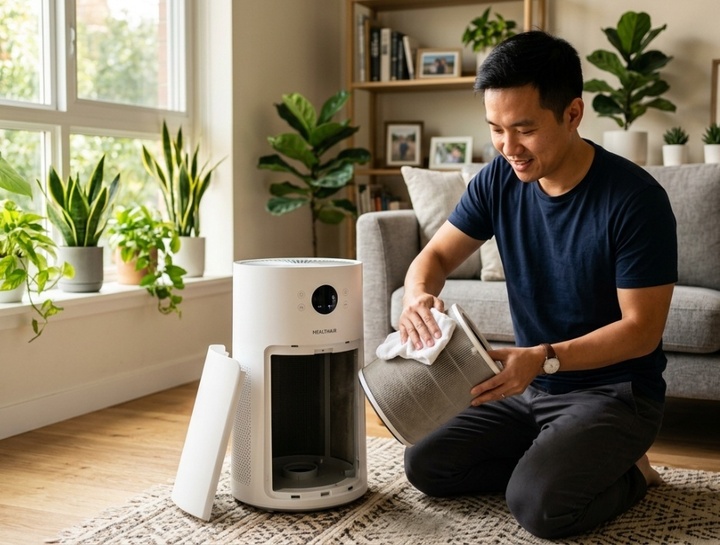
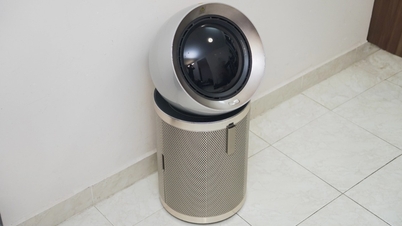
Regular cleaning of your air purifier helps ensure a cleaner and healthier living environment for your family. Photo: WKH
- Pre-filter: Usually made of plastic, metal, or loosely woven fiberglass mesh, it is the outermost layer. Its function is to retain large dust particles, pet hair, and human hair. This is the only filter that can be washed with water.
- Activated carbon filter: Composed of millions of microscopic pores containing carbon, its function is to absorb toxic gases and remove odors. This filter is completely hydrophobic, as water will fill the pores, completely eliminating its odor absorption capacity.
- Fine filter: The heart of the air purifier, made from millions of randomly interwoven glass fibers to block PM2.5 fine dust particles and bacteria. This fiber structure is very fragile and often electrostatically charged. Washing HEPA filters with water will immediately break down the fiber matrix and eliminate the electrostatic attraction, rendering this expensive filter useless.
Steps to clean an air purifier
For safe and effective maintenance, you should move the machine to a well-ventilated area such as a balcony or garden to prevent dust from flying back into the room. Don't forget to wear a medical mask to protect your respiratory system throughout the process.
Step 1: Disconnect the power and disassemble the parts.
Turn off the machine and unplug it to ensure absolute safety. Open the back or front cover of the machine (depending on the manufacturer's design), then gently remove the pre-filter, activated carbon filter, and HEPA filter one by one.
Step 2: Clean the device casing and the dust sensor blind spot.
Use a slightly damp microfiber cloth to wipe clean the entire outer plastic casing, air intake vents, and air outlet vents. In particular, locate the dust sensor, usually on the side or back of the unit, under a small cover. Open the cover and use a dry cotton swab to thoroughly clean the sensor lens. If the sensor is obscured by dust, the unit will display an inaccurate AQI reading and operate inefficiently.
Step 3: Treat the coarse filter membrane with water.
Take the coarse filter into the bathroom and use a moderate-pressure water spray to rinse away any loose hair, lint, and large dust particles. You can use a very soft-bristled brush and a little diluted dish soap to scrub it clean. Afterwards, lay the filter in a well-ventilated area to dry completely.
Step 4: Dry clean the HEPA filter and activated carbon.
For these two types of filters, the only tool you are allowed to use is a handheld vacuum cleaner with a soft brush attachment. Vacuum along the folds of the HEPA filter with moderate suction to remove the dust adhering to the surface. For activated carbon filters, after vacuuming, you should expose them to gentle sunlight for about 1 to 2 hours. The heat and UV rays will help evaporate the trapped toxic gases and moisture, restoring the deodorizing ability of the carbon.
Step 5: Assemble and reset the system.
Once the pre-filter is completely dry, absolutely do not install it while it is still damp to avoid short circuits and mold. Install the filters in the correct original order (HEPA first, activated carbon in the middle, pre-filter on the outside). After plugging in and starting the machine, if the filter replacement indicator light is on, press and hold the "Reset" button for 3-5 seconds to restart the system's timer cycle.
Self-cleaning the air purifier's filters should be done regularly, on a monthly basis, depending on the level of air pollution in your area. However, it's important to emphasize that vacuuming the HEPA filter only removes the thick layer of dust on the surface to restore airflow; it cannot deeply clean the fine PM2.5 particles that have become trapped in the fiberglass core.
Therefore, HEPA filters and activated carbon have a finite physical lifespan. Technical experts recommend completely replacing these two filters every 6 to 12 months.
Source: https://vtcnews.vn/cach-ve-sinh-may-loc-khong-khi-ar1020744.html

![[Photo] Delegation attending the 14th Congress of the Vietnam Trade Union visits the Mausoleum of President Ho Chi Minh.](https://vphoto.vietnam.vn/thumb/1200x675/vietnam/resource/IMAGE/2026/06/03/1780451842301_ndo_br_img-3824-jpg.webp)





















































































Comment (0)