

Representative Do Thi Lan proposed policies to support agencies relocating their offices out of central Hanoi , removing bottlenecks to the capital's development.
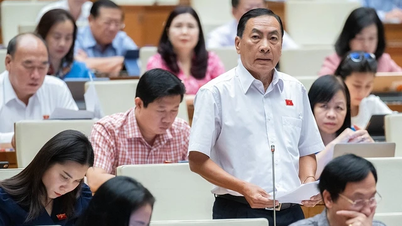
Commenting on the draft revised Law on the Capital City on the morning of November 27th, Deputy Chairwoman of the Social Affairs Committee Do Thi Lan stated that the Prime Minister had issued a decision in 2015 regarding measures and a roadmap for relocating and utilizing land after the relocation of industrial production facilities, hospitals, higher education institutions, vocational training institutions, and agencies and units out of Hanoi's inner city. However, for many years, this has remained unfulfilled.
"If no solution is found, this policy will not be feasible," Ms. Lan said, suggesting that in addition to the State's investment policy, the city should study mechanisms to support and encourage agencies and units to relocate their offices.
Deputy Chairman of the Committee on Culture and Education, Ta Van Ha, stated that Hanoi has many headquarters of central government agencies and organizations. However, coordination between the city and these agencies is not good because "a very small matter, such as relocating headquarters out of the city center to reduce traffic congestion, has not been implemented for many years."
"I suggest that the drafting agency clarify the responsibilities of central agencies located in the area and specify the methods for carrying out this work," he said.
Delegate Nguyen Quoc Luan (Deputy Head of Yen Bai Delegation) also suggested that Hanoi city needs to resolutely relocate polluting facilities, hospitals, and schools out of the inner city; strictly handle violations of construction and urban order; and better manage urban architectural space and landscape.
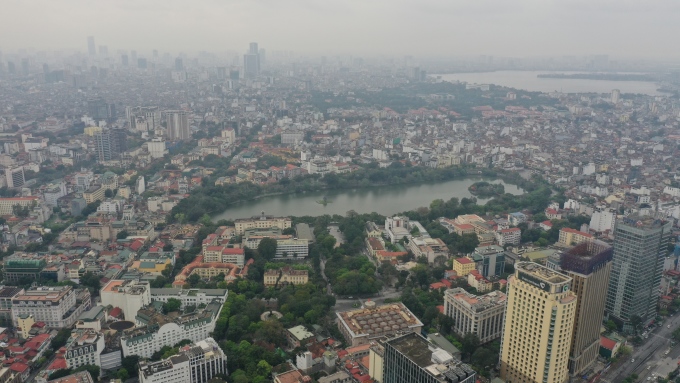
The Hoan Kiem Lake area in Hanoi. Photo: Ngoc Thanh
During a group discussion on October 11th, Hanoi Party Secretary Dinh Tien Dung stated that relocating hospitals and universities is difficult because most operate under an autonomous mechanism. Even after being allocated new land, these institutions lack sufficient resources for construction. Therefore, he proposed that the revised draft of the Capital City Law be developed in a way that grants stronger authority to the city.
Hanoi needs a mechanism to use budget funds to clear land, and even build new headquarters for universities and hospitals. The old facilities could be returned to the city or used for postgraduate training or international research cooperation to reduce population density.
In May, the Party Central Committee issued a directive requiring strict implementation of the plan to relocate the headquarters of state administrative agencies, academies, and universities outside the city center.
In fact, the plan to relocate the headquarters of ministries and agencies from the center of the capital has been in place for many years, and some ministries and agencies have already moved to new headquarters in the western part of the capital. However, besides the obstacle of funding for implementation, one of the issues causing delays in the relocation is that even though land has been allocated for the construction of new headquarters, the ministries and agencies have not handed over their old facilities located in the central districts.
A 2016 report from Hanoi indicated that nine ministries and agencies had relocated from the city center, but seven units continued to retain their old headquarters or handed them over to central government agencies for management; two agencies were approved to convert their land use to invest in the construction of housing and office space for rent.
In late April 2023, the Prime Minister approved the planning scheme for the headquarters of 36 ministries, government agencies, and central agencies of mass organizations in the West Lake area (Tay Ho and Bac Tu Liem districts) and Me Tri area (Nam Tu Liem district). Both areas are located approximately 10 km from the center of Hanoi.
Source link




















































































Comment (0)