


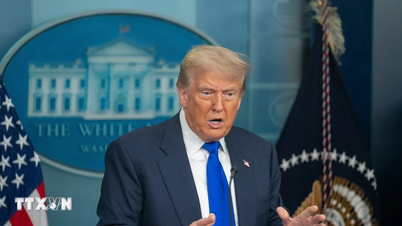
President Trump will attend the Middle East peace summit in Egypt in October 2025. Photo: AFP
Although the Abraham Accords have been joined by the UAE and Bahrain, many leaders were surprised by Trump's proposal during the phone call, particularly those from Saudi Arabia, Qatar, and Pakistan. There was a moment of silence in the conversation, prompting Trump to jokingly ask if they were still on the phone. This awkwardness reflects the reluctance of many Middle Eastern governments to openly discuss normalizing relations with Israel while the conflict in Gaza continues.
Not content with mere encouragement, President Trump posted on his social media platform on May 25th a prerequisite: all countries participating in negotiations for an agreement with Iran must simultaneously ratify the Abraham Accords.
Analysts believe that Trump wants to weaponize the diplomatic process of advancing a potential agreement with Iran as leverage to further expand the Abraham Accords and reshape the geopolitical landscape of West Asia. This is seen as one of the biggest diplomatic gambles in the White House's West Asia strategy.
In the Arab world, Saudi Arabia remains the most important target for expanding the Abraham Accords. It is the country with the largest economy and influence. If Saudi Arabia recognizes the Jewish state, it would fundamentally alter regional politics. Qatar's importance is comparable, as it has skillfully cultivated an image as a regional mediator and avoided establishing formal diplomatic relations with Israel.
However, public opinion in much of the Arab world remains strongly opposed to normalizing relations with Israel as long as the Palestinian issue remains unresolved. The war in Gaza and the large number of civilian deaths have further fueled anti-Israel sentiment in the region.
Saudi Arabia has also repeatedly stated that any diplomatic relations with Israel must be tied to a clear and irreversible path toward the establishment of a Palestinian state. Like Saudi Arabia, Qatar is facing intense public sensitivity regarding the Palestinian issue.
In the Muslim world in general, Pakistan is particularly politically sensitive regarding its relationship with Israel because anti-Israel sentiment remains deeply ingrained in both the public and political circles.
Normalizing relations with Israel is seen as giving Arab and Muslim countries access to advanced levels of economic development, security, and science and technology from their neighbor, but at the same time, it poses a greater risk of domestic political instability.
Regional public opinion suggests that the Abraham Accords were a strategic rearrangement aimed at neutralizing the diplomatic leverage of Arab countries regarding Palestinian self-determination, thereby eliminating pressure on Israel to halt settlement construction or withdraw troops from occupied territories.
DUC TRUNG (According to Axios, Muslim Network TV)
Source: https://baocantho.com.vn/canh-bac-ngoai-giao-cua-ong-trump-a205620.html
![[Photo] Standing Committee member of the Party Central Committee Tran Cam Tu working with the Central Inspection Committee](https://vphoto.vietnam.vn/thumb/1200x675/vietnam/resource/IMAGE/2026/05/28/1779969579668_ndo_br_bnd-2495-jpg.webp)


































































































Comment (0)