

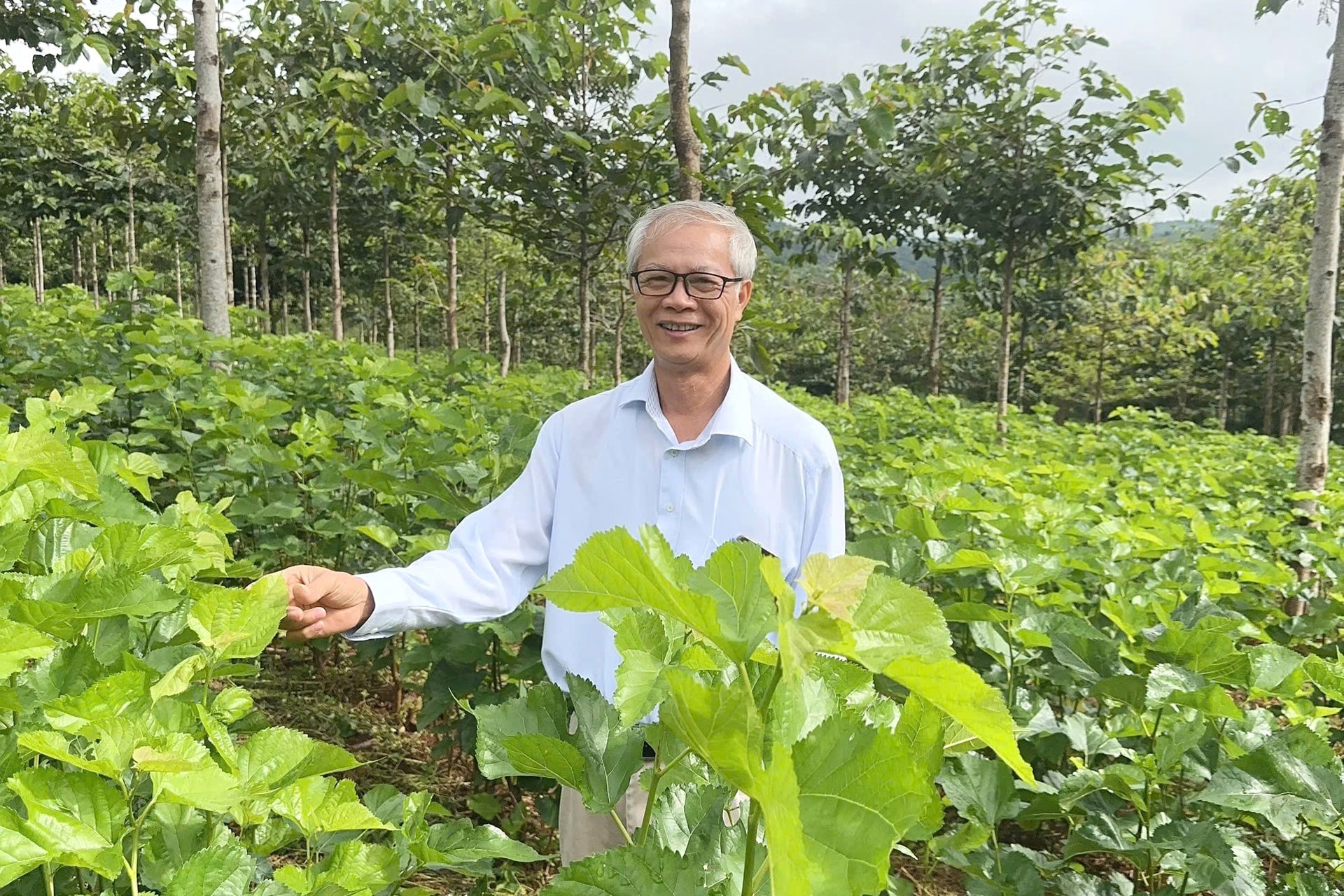
Stabilize the area under coffee and pepper cultivation.
According to the 2025 plan, Duc An commune will cultivate nearly 13,100 hectares of long-term crops, including robusta coffee (7,520 hectares); pepper (nearly 4,150 hectares); durian and passion fruit (404 hectares). The corresponding total production is expected to reach approximately 22,540 tons; 11,614 tons; and 2,152 tons, respectively. The majority of the area and production of these long-term crops will meet or exceed the plan compared to the same period in 2024. This does not include the production of macadamia trees (136 hectares) and other fruit trees (over 890 hectares).
Through the application of new science and technology in farming, Duc An commune has developed nearly 388 hectares of various crops that meet the standards of good agricultural practices certification both domestically and internationally. In particular, the locality has been recognized by the competent authority as a 450-hectare high-tech coffee production area. The People's Committee of Duc An commune assessed: “Agricultural production in the commune in 2025 will focus on leveraging the advantages of each ecological zone, gradually expanding the area of high-tech agriculture, organic agriculture, and smart agriculture; encouraging the development of production linkage models along the value chain linked to market demand…”. Accordingly, with nearly 20 agricultural cooperatives operating in Duc An commune, they have initially linked with member farmers to “update” new specialized and intercropped crop varieties and connect to the consumption market.
"Updating" new varieties of fruit trees and mulberry trees.
For example, the Duc Khoi Green and Clean Agricultural Cooperative has organized the concentrated production of 12 hectares of four-season lemons under a supply chain contract with agricultural cooperatives in the Southwestern region of Vietnam. Mr. Bui Dinh Khoi, Director of the Cooperative, said that the four-season lemon variety was "updated" by member farmers from the Southwestern region and successfully cultivated in Duc An commune for over three years. To date, the total area of four-season lemons entering the production stage is about 7 hectares; the remaining 5 hectares are growing well and are over one year old. These areas were converted from old, low-revenue perennial industrial crops. Through soil improvement and improved production processes according to VietGAP standards, the four-season lemon trees have yielded positive results, with an estimated total production of about 200 tons/7 hectares in 2025. It is predicted that from 2027 onwards, production will increase to 450-500 tons/12 hectares/year.
Significantly, the Duc Khoi Green and Clean Agriculture Cooperative has partnered with the Vietnam Union of Silk and Sericulture Cooperatives and Ecotourism to develop a collaborative model that incorporates new techniques for producing silkworms on 18 hectares of perennial mulberry trees in Duc An commune. By early 2026, the model is expected to produce 200 boxes of silkworm larvae per month, corresponding to over 10 hectares of mulberry trees. All advanced silkworm farming technology is applied synchronously within the model, involving 11 participating farming households. The silkworm cocoons are purchased by a single distributor at a stable price, ensuring annual profits for producers. “Our goal for the next five years is to expand this model to over 100 member households, cultivating approximately 150 hectares of mulberry trees, with an average income of 300 million VND per hectare. This doesn't include income from coffee beans, perennial pepper plants, or the wood of the golden teak trees used for shade and windbreaks for the mulberry trees…”, Mr. Khoi expressed his hope.
The crop structure orientation for Duc An commune, Lam Dong province, until 2030 aims to stabilize the production of industrial crops such as coffee (7,538 hectares) and perennial pepper (4,158 hectares), corresponding to yields of 24,885 tons and 12,823 tons respectively. Simultaneously, 300 hectares of old coffee and 100 hectares of old pepper will be converted to other more profitable perennial crops. Mr. Vo Quoc Tuan, Chairman of the People's Committee of Duc An commune, emphasized that the solution involves strengthening agricultural extension work, diversifying the crop structure, and transferring advanced science , technology, and new technologies to cooperatives, farms, and farmers for application in production to improve the quality and value of agricultural products, meeting the requirements of a competitive and integrated market.
Source: https://baolamdong.vn/cap-nhat-cay-lau-nam-o-duc-an-392841.html


![[Photo] General Secretary and President To Lam presides over a meeting with the Central Organizing Committee.](https://vphoto.vietnam.vn/thumb/1200x675/vietnam/resource/IMAGE/2026/06/03/1780482764658_a1-bnd-4741-3342-jpg.webp)
![[Photo] First session of the 14th Congress of the Vietnam Trade Union](https://vphoto.vietnam.vn/thumb/1200x675/vietnam/resource/IMAGE/2026/06/03/1780465947883_ndo_br_img-3852-jpg.webp)
![[Photo] Secretary of the National Assembly Party Committee, Chairman of the National Assembly presides over the meeting of the Standing Committee and Executive Committee of the National Assembly Party Committee.](https://vphoto.vietnam.vn/thumb/1200x675/vietnam/resource/IMAGE/2026/06/03/1780480353201_ndo_br_bnd-2585-jpg.webp)











































![[Video] Sunset at Lap An Lagoon – Where the sun sets over the fishing nets](https://vphoto.vietnam.vn/thumb/1200x675/vietnam/resource/IMAGE/2026/05/31/1780192137701_beach-landscape-sea-water-nature-grass-745871-pxhere-com.jpeg)































Comment (0)