

 |
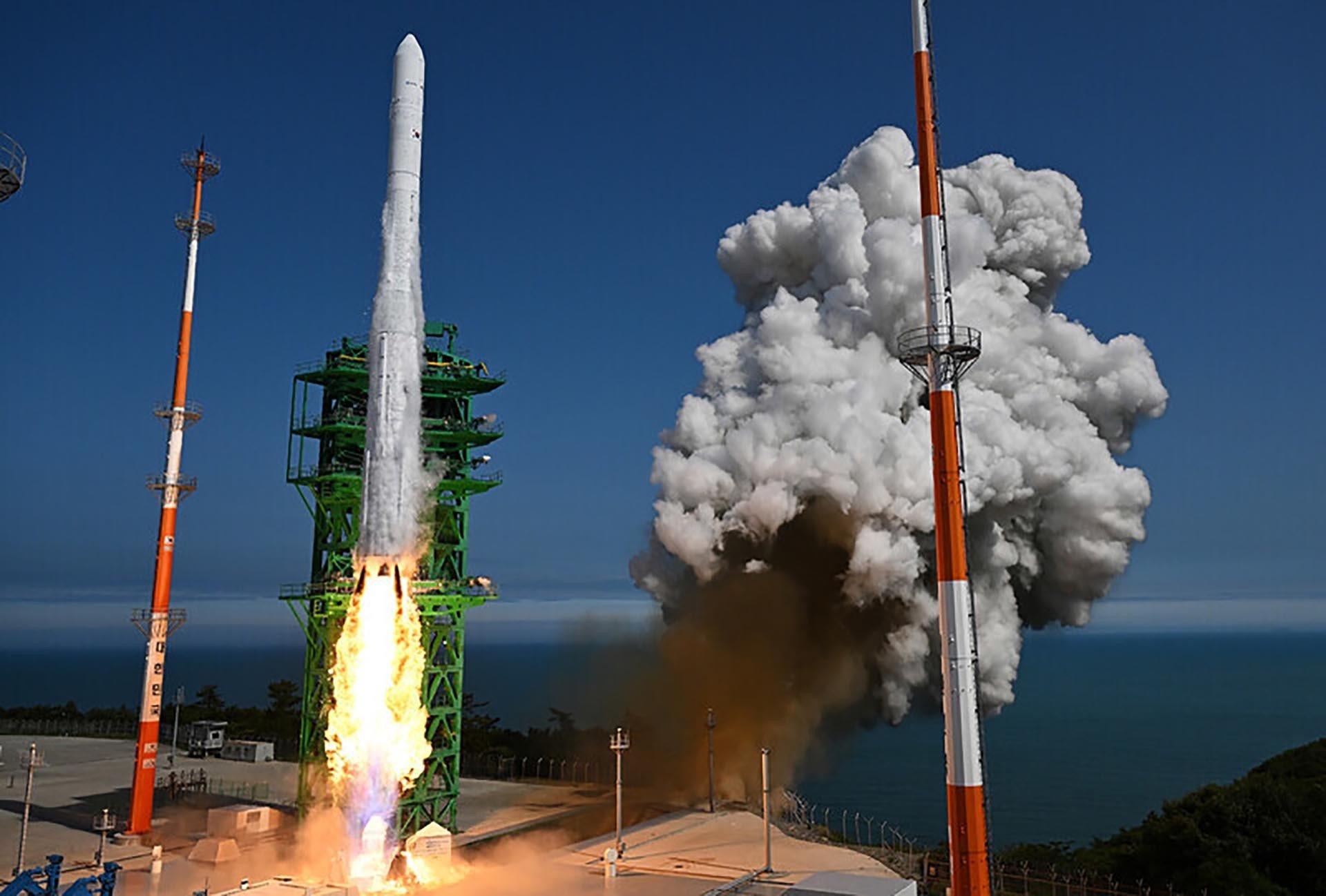
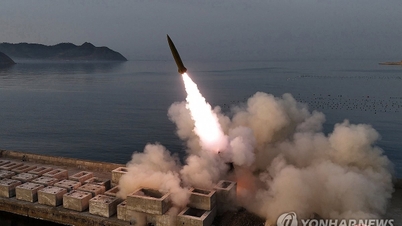
| The Nuri rocket successfully launched from the Naro Space Center in Goheung village, South Jeolla Province, South Korea. (Source: The Hankyoreh) |
On May 25th, South Korea successfully launched the Nuri rocket, putting eight satellites into orbit, marking a significant step forward in the country's space exploration program.
The Nuri rocket is 47.2 meters long, equivalent to a 15-story apartment building, with a diameter of up to 3.5 meters and weighing 17.5 tons. Unlike the first and second launches, which only carried simulated satellites, this third Nuri launch carried eight experimental satellites capable of performing actual missions.
Competitive advantage
South Korean President Yoon Suk Yeol expressed his delight after the successful launch of the Nuri rocket. He emphasized that this milestone places South Korea on the list of seven countries capable of launching satellites into orbit using domestically developed rockets.
"This will change the world's perception of South Korea's space science and advanced industries," President Yoon Suk Yeol affirmed.
The three-stage Nuri missile has been under development for the past decade at a cost of 2 trillion won (over $1.5 billion).
South Korea conducted its first test launch of the Nuri rocket on October 21, 2021. The rocket reached its target altitude of 700 km but failed to put a dummy satellite into orbit due to an earlier-than-expected burnout in its third-stage engine. Last June, South Korea launched another Nuri rocket to put dummy satellites into orbit.
According to Minister of Science and Technology Lee Jong-ho, the success of the third Nuri rocket launch affirms “our potential for various satellite and space exploration activities.” Lee Jong-ho stated that South Korea plans to conduct three more Nuri rocket launches between now and 2027.
The Nuri rocket is considered a cornerstone of Seoul's ambitious space exploration plans, including a mission to send spacecraft to the moon by 2032 and to Mars by 2045.
The "heat" from China
Since the early 21st century, China has made significant strides in the field of space exploration. Thanks to abundant resources and well-structured policies, China has successfully built a network of information and space exploration infrastructure.
In 2020, China successfully launched the final satellite in its Beidou navigation network. At that time, according to CNN , the world only had four major global navigation satellite networks: the US GPS, Russia's GLONASS, the European Union's Galileo, and now China's Beidou. It is projected that by 2025, China's Beidou navigation system will generate annual revenue of up to $156.22 billion.
According to the Global Times , China conducted 64 satellite launches in 2022. Many private companies in China are developing satellite launch vehicles, and some have begun conducting satellite launches into orbit.
In March 2022, Beijing-based startup GalaxySpace launched six communications satellites into low Earth orbit, while its domestic rival Galactic Energy launched five satellites last January.
Japan restarts
Not only the US, Russia, and the EU, but many other countries are also feeling the "heat" from China's space program. Japan is no exception. Tokyo has begun to allocate resources to restart its own space program.
Japan was one of the earliest Asian nations to launch a space exploration program, becoming the fourth country to launch a satellite into Earth orbit. However, over the years, Tokyo has fallen behind many other nations. On average, the country spends $3 billion annually on space exploration, compared to $36 billion for the US and $4.9 billion for China.
Speaking to Nikkei , Asai Yosuke, Director of the Space Industry Office under Japan's Ministry of Economy, Trade and Industry, said that Japan's space industry is 90% dependent on the government. "By increasing public funding in this sector, Tokyo wants to encourage space companies to develop the capacity to meet civilian needs both domestically and internationally."
Nakamura Yuya, director of Axelspace, a satellite design and manufacturing company in Japan, told the Financial Times : “Just a decade ago, the government showed no interest in private companies in the space sector. But since former Prime Minister Abe Shinzo promised to help Japan’s space industry reach a total value of $21 billion by 2030, private businesses like ours have begun to receive financial and expert support from the government.”
India is not far behind.
Meanwhile, India is emerging as a reliable provider of satellite launch services for potential customers.
Developing the space sector is a key plan in Prime Minister Narendra Modi's "Made in India" campaign, which aims to position the world's fifth-largest economy as a leading destination for technological innovation.
In recent years, India has focused on developing its space industry to gain a larger share of a market estimated to reach $600 billion by 2025.
NewSpace India is helping India compete in the space race. In October 2022, the company successfully launched 36 satellites for the British company OneWeb. NewSpace is ramping up production of India's largest satellite launch vehicle, the LVM3.
Neil Masterson, CEO of OneWeb, believes NewSpace India has a real opportunity to become a major global provider of commercial satellite launch services.
In the last financial year, NewSpace India achieved revenue of 17 billion Rupees (US$210 million) and a profit of 3 billion Rupees (US$41 million). The company is currently providing satellite launch services to 52 international clients.
The space science race is underway in Asia. Space exploration and space technology are bringing significant benefits to several Asian powers, particularly in establishing their place on the map of nations with a stake in space…
Source


































































































Comment (0)