

(PLVN) - On the morning of November 19th, in Hanoi, the Ministry of Agriculture and Rural Development organized a forum titled "Improving the effectiveness of information and warning systems, ensuring safe operation of dams and reservoirs in the new situation." The event highlighted the urgent issues facing the irrigation system of reservoirs and dams, which are shouldering many crucial national responsibilities.
(PLVN) - On the morning of November 19th, in Hanoi , the Ministry of Agriculture and Rural Development organized a forum titled "Improving the effectiveness of information and warning systems, ensuring safe operation of dams and reservoirs in the new situation." The event highlighted the urgent issues facing the irrigation system of reservoirs and dams, which are shouldering many crucial national responsibilities.
Key features of reservoirs and irrigation dams
Currently, the system of reservoirs and irrigation dams bears the burden of many crucial tasks such as supplying water for agricultural production, industry, and daily life, combined with flood control; serving multiple purposes such as water supply for power generation, creating space for solar power development, aquaculture, and tourism development... Vietnam's reservoirs and dams are facing many challenges related to climate change and structural degradation.
According to Mr. Luong Van Anh, Deputy Director of the Department of Irrigation, the country currently has more than 7,300 irrigation dams and reservoirs (592 diversion dams and over 6,700 reservoirs) with a total storage capacity of approximately 15.2 billion cubic meters. Of these, the Ministry of Agriculture and Rural Development is responsible for managing 4 particularly important reservoirs and 1 inter-provincial reservoir. The remaining 8 inter-provincial irrigation reservoirs are managed by local authorities.
Local authorities manage over 6,700 reservoirs. Of these, 63 provincial-level units manage the technical aspects of over 2,300 large, medium, and small reservoirs (accounting for 34%). District and commune-level units manage the technical aspects of over 4,200 reservoirs (of which 64% are small reservoirs).
 |
Mr. Luong Van Anh - Deputy Director of the Department of Irrigation, Ministry of Agriculture and Rural Development. |
Regarding the reservoir and downstream areas of the dams, many reservoirs have only cleared land up to the normal water level, not up to the design flood level. Numerous violations, such as building houses and planting trees, reduce the storage space and flood discharge capacity of some large reservoirs like Nui Coc, Vuc Mau, Ayun Ha, La Ring, and Dau Tieng. Human activities within the reservoir area put pressure on reservoir operation.
Legally, irrigation reservoirs must be operated according to established, approved, and publicly announced operating procedures (OPPs). However, currently only 28% of reservoirs have established OPPs (including 213 reservoirs with sluice gates and 1,600 reservoirs with free-flow spillways).
Current operation of the reservoir management system relies primarily on predicted weather conditions (predicted rainfall), due to a lack of rain gauges in the reservoir catchment area. Some tasks are limited due to insufficient funding, particularly in the group of medium and small reservoirs, such as: emergency response plans (28%); safety inspections (9%); reservoir management (28%); installation of specialized hydrological monitoring equipment (17%); installation of equipment and monitoring of structures (10%); maintenance, repair and upgrading (27%); and construction of downstream flood maps (5%).
Synchronizing solutions to ensure the safety and effectiveness of irrigation reservoirs and dams.
In the context of climate change increasingly impacting Vietnam, the safety of reservoirs and irrigation dams is becoming a top priority in the country's water resource management. To ensure safety and effectiveness, a comprehensive approach is needed, including technological improvements, enhanced management and operation capabilities in real time, and the refinement of mechanisms and policies appropriate to the new context.
 |
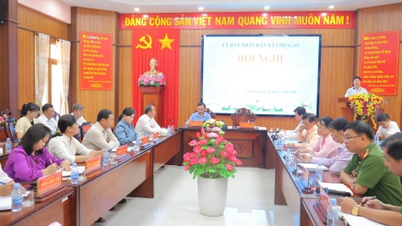
| The forum's view. |
At the forum, Director of the Institute of Water Resources Planning Do Van Thanh stated that many dams and reservoirs in Vietnam, built over 30 years ago, have suffered damage, degradation, and sedimentation. Many reservoirs have been converted to multi-purpose use, requiring a recalculation of their functions and design parameters.
Furthermore, while flood maps have been developed for some large reservoirs, their downstream flood discharge capacity has not been assessed; many small reservoirs lack plans to ensure dam safety and prevent downstream flooding. The downstream flood discharge corridors of some large reservoirs are encroached upon, the flow narrows, failing to ensure designed flood discharge, causing downstream flooding during flood release operations. Forecasting and warning of rainfall, floods, and water inflow to reservoirs are still limited. In addition, the organizational structure for management and operation; the modernization of management, operation, and dam safety are still limited…
To ensure the safe operation of dams, Mr. Hoang Van Thang, former Deputy Minister of Agriculture and Rural Development and Chairman of the Vietnam Large Dams and Water Resources Development Association, believes that first and foremost, it is necessary to ensure that each project has a "owner," along with regulations, standards, and financial solutions for dam management. Furthermore, it is crucial to improve the capacity of management staff, focusing on monitoring and analyzing measurement data to detect risks early. Dams need investment, upgrading, and improved flood discharge capacity to ensure safe operation in the new situation.
At the same time, comprehensive solutions are needed regarding policy development and improvement. The system of technical regulations, standards, and economic-technical norms serving the surveying, design, construction, and operation management of dams and reservoirs should be reviewed and improved to suit the new situation. The application of new technologies such as automated monitoring systems and operational decision-making support tools should be promoted…
In particular, it is necessary to enhance information, warning, and forecasting capabilities, and build monitoring systems in upstream areas and reservoirs to support hydrological analysis. Developing supporting tools and applying technological advancements and AI in decision-making for safe dam and reservoir operation is essential to proactively forecast and warn about water resources and develop appropriate flood control and release scenarios, ensuring safety for downstream areas.
Source: https://baophapluat.vn/chi-co-28-ho-thuy-loi-duoc-lap-quy-trinh-van-hanh-post532269.html
![[Photo] Standing Committee member of the Party Central Committee Tran Cam Tu working with the Central Inspection Committee](https://vphoto.vietnam.vn/thumb/1200x675/vietnam/resource/IMAGE/2026/05/28/1779969579668_ndo_br_bnd-2495-jpg.webp)






































































































Comment (0)