

As artificial intelligence (AI) technology boomed, many businesses saw it as an opportunity to cut costs, increase productivity, and automate repetitive tasks. But after the testing phase, the financial picture began to become more complex. AI is not just a software tool that can be turned on and used immediately; it entails costs for infrastructure, data, security, and operational personnel.
In some cases, the computing costs for AI have exceeded the cost of paying employees. Bryan Catanzaro, vice president of applied deep learning at Nvidia, said there are groups where computing costs are "much higher" than employee salaries. This doesn't mean AI will always be more expensive than humans, but it shows that the promise of "AI reducing costs" is no longer as simple as it was in the beginning.
The hidden costs behind AI systems
One of the most expensive components is the computing cost. Modern AI models require significant processing power, especially when businesses frequently use them for customer service, programming, data analysis, or internal document processing. The more users and tasks involved, the higher the operating costs.
For businesses, the cost of AI doesn't stop at renting models or paying API fees. To integrate AI into real systems, they must clean data, connect with internal software, establish access permissions, protect sensitive information, and build output control processes. These are tasks that require the collaboration of technical, cybersecurity, legal, and operations teams.

The larger the AI deployment, the more costs businesses must factor in for infrastructure, data, security, and supervisory personnel.
PHOTO: CREATED BY AI
AI generation is not yet stable enough to automatically handle everything without human intervention. This technology can still provide incorrect answers, fabricate facts, or misinterpret context. Therefore, many businesses must maintain personnel to review, correct, and ultimately take responsibility. In customer-related, financial, healthcare , legal, or data-sensitive fields, this layer of oversight is almost indispensable.
This means that in many cases, AI does not completely replace labor but creates a new layer of cost. Businesses still pay for the technology, while still needing people to ensure the system operates correctly and safely.
The infrastructure race among major tech companies also reflects the enormous costs behind AI. Microsoft announced plans to invest AUD 25 billion, equivalent to USD 17.9 billion, in Australia by 2029 to expand its AI capabilities, cloud computing, cybersecurity, and skills training. Such investments demonstrate that AI is not just about software, but also about data centers, processing chips, power, and large-scale operational networks.
The cost of AI is not simply a technological issue.
As costs rise, the question businesses are asking changes. Previously, many companies felt pressured to have an AI strategy to avoid being seen as lagging behind. Now, the focus is shifting to a more practical question: what value does AI create, and how long will it take to recoup the investment?
Research firm Gartner forecasts global IT spending to reach $6.31 trillion in 2026, a 13.5% increase from 2025. The growth is driven by AI infrastructure, cloud computing, and software. This indicates that AI is triggering a new cycle of technology spending, rather than simply replacing existing expenditures.
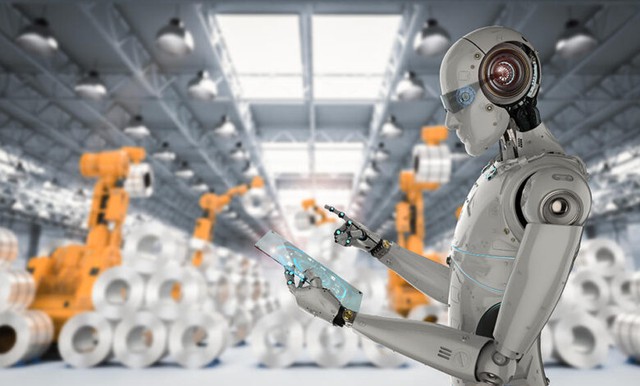
AI is only truly valuable when the investment in the technology translates into measurable operational efficiency.
PHOTO: SCREENSHOT FROM ROBOTMAGAZINE
The pressure to recoup investment is therefore becoming increasingly evident. Consulting firm Deloitte predicts that AI investment will continue to increase, but the returns are not always easy to measure. For more complex projects, businesses need a longer timeframe to assess effectiveness, rather than simply looking at the number of tasks automated.
This shift is forcing companies to be more pragmatic. Instead of aiming for widespread human replacement, many businesses are choosing to use AI to support specific tasks such as summarizing documents, suggesting customer responses, writing code, categorizing requests, or detecting errors. This approach reduces risk and makes cost control easier.
AI may still become cheaper over time for individual tasks, especially as models become more efficient and competition among vendors increases. But at the enterprise level, total costs could continue to rise as usage scales up, security requirements increase, and operational processes become more complex.
Therefore, the current debate is no longer about whether AI is absolutely expensive or cheap. What matters is which problems businesses use AI for, at what scale, and whether the effectiveness can be measured. The promise of cost savings only becomes convincing when AI demonstrates concrete value in real-world operations.
Source: https://thanhnien.vn/chi-phi-ai-khong-con-re-nhu-loi-hua-ban-dau-185260427153301634.htm
![[Image] Pleasant weather helps students enter the 10th grade entrance exam with confidence.](https://vphoto.vietnam.vn/thumb/1200x675/vietnam/resource/IMAGE/2026/05/29/1780034401612_ngay-1-thi-lop-10-minh-duy-8-5009-jpg.webp)




![[Photo] Ba Lang An Lighthouse - the "eye of the sea" amidst the "rock museum" of Quang Ngai province.](https://vphoto.vietnam.vn/thumb/1200x675/vietnam/resource/IMAGE/2026/05/29/1780038698840_anh-man-hinh-2026-05-29-luc-14-10-42.png)




































































































Comment (0)