

Removing the price cap on domestic airfares at this time would leave the State without a regulatory tool and reduce people's access to affordable airfares, according to the Government .
The proposal to remove the price ceiling on airfares has been raised many times before by experts and businesses. Earlier this year, they once again proposed changing the mechanism for managing domestic airfares, including increasing and eventually removing the price ceiling.
In its report explaining the amended Law on Prices submitted to the National Assembly on May 17, the Government stated that some opinions suggested removing price ceilings for seaport services and air tickets, and some even proposed setting a floor price for air tickets.
However, the government stated that the Civil Aviation Law and the draft Law on Prices will complete the mechanism for pricing air tickets, shifting from a price range to a minimum price, thus abolishing the price floor regulation. This aims to encourage competition to reduce service prices, protect consumer interests, especially those with low incomes, and ensure their access to services.
"Removing the price ceiling would lead to the loss of a tool for regulating prices for domestic air transport services," the government's explanatory report stated.
Furthermore, domestic air travel is an essential service that impacts people's lives, production, and businesses. If price caps are removed, airlines will charge very high fares, especially on some competitive routes, which will limit ticket availability during peak periods. This could affect consumer rights and have negative social impacts.
"Given the current average income of Vietnamese people, a significant increase in airfares would reduce people's access to air travel services. Therefore, without assessing the impact, there is insufficient basis to abolish the airfare price ceiling," according to the government report.
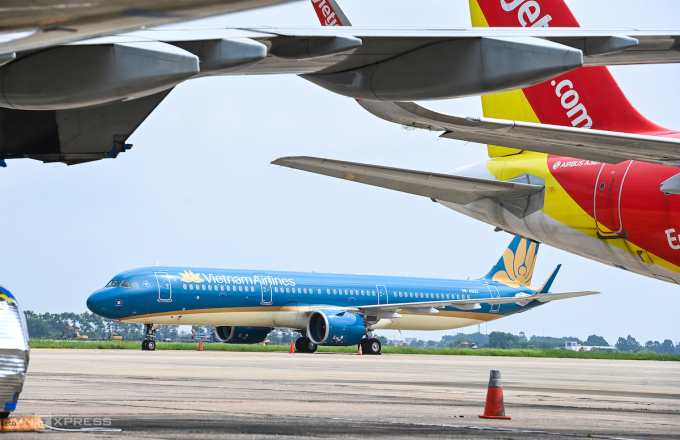
Aircraft of various airlines are parked at Noi Bai Airport. Photo: Giang Huy
Currently, each country has a different way of managing airfare prices. For example, China regulates prices indirectly and directly through air services. Indonesia sets a maximum price, while some countries allow the market to regulate prices.
In the long term, according to the government, when the market has many participating airlines, genuine competition based on low fares and service quality, and passengers have the right to choose prices according to their needs and ability to pay, only then will it be appropriate to remove the fare ceiling.
The ceiling price for domestic airfares has remained unchanged for the past 8 years. The Ministry of Transport plans to increase the ceiling from the second or third quarter, with an average increase of 3.75% compared to the current price.
Besides wanting to maintain the ceiling on airfares, the government also wants to retain the Fuel Price Stabilization Fund, despite many arguing that it should be abolished. This is because the Fuel Price Stabilization Fund is one of the tools for regulating domestic prices; it is an economic measure, not an administrative intervention.
"In the current context, abolishing this fund is inappropriate because the petroleum market in Vietnam is not yet operating according to market principles, but is still regulated by the State; the domestic price adjustment cycle is still long and the reserves are thin," the Government stated.
In fact, when world oil prices fluctuate, the Price Stabilization Fund has played a regulating role, contributing to reducing the frequency and magnitude of price increases, reducing the amplitude of fluctuations, and mitigating negative impacts on production and business.
According to the government, public opinion on this fund is currently diverse, with some wanting to abolish it while others support it. Meanwhile, the views of ministries, sectors, and associations are all in favor of maintaining the fund. Therefore, the Ministry of Industry and Trade will evaluate and revise the regulations on the fund during the process of amending Decree 95/2021, assessing and amending the regulations on the fund to suit the reality.
The Law on Prices (amended) is expected to be discussed for the second time by the National Assembly at its opening session on May 22nd.





























![[Photo] Reception to welcome General Secretary and President To Lam and his wife on their State visit to the Philippines](https://vphoto.vietnam.vn/thumb/1200x675/vietnam/resource/IMAGE/2026/06/01/1780295488620_vna-potal-chieu-dai-chao-mung-tong-bi-thu-chu-tich-nuoc-to-lam-va-phu-nhan-tham-cap-nha-nuoc-toi-philippines-8798060-7855-jpg.webp)































































Comment (0)