

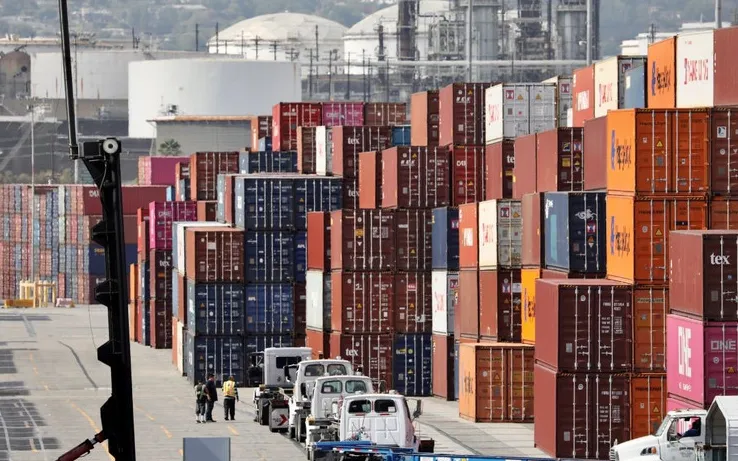
Long Beach cargo port, USA. (Photo: THX/VNA)
The U.S. Department of Justice (DOJ) is approaching its first major legal deadline after the U.S. Supreme Court ruled that the tariffs imposed by President Trump under the International Emergency Economic Powers Act (IEEPA) were unlawful.
As required by the court, the DOJ must provide a response by February 27 (US time) at the latest regarding one of its first cases seeking a tariff refund, in which the plaintiffs are requesting a simplified procedure for receiving the refund through the US International Trade Court (CIT) – an agency that has long specialized in handling tariff-related disputes.
Trade lawyers say there are now more than 2,000 business-initiated lawsuits at CIT seeking tax refunds. Previously, in December 2025, CIT temporarily suspended consideration of these cases pending a final ruling from the Supreme Court.
Trade and customs experts estimate that around 300,000 shipping companies have paid taxes under the IEEPA scheme. The total potential refunds could reach $175 billion. Following the Supreme Court ruling, the number of companies filing lawsuits continues to increase, including a new case filed by FedEx last week.
Currently, the lawsuit filed by the Small Business Organization (VOS) is being considered a model "precedent." If the court approves transferring the case to CIT for a quick ruling, this process will become a reference framework for thousands of other lawsuits, helping to expedite the payment of interest to affected businesses.
Although the legal basis for the tax refund is clear, the method and timing of its implementation are becoming a hot topic of debate. President Donald Trump, at a press conference last weekend, stated that the proceedings could drag on for years. Meanwhile, Democratic lawmakers in the U.S. Congress are repeatedly urging the government to release a refund plan soon, arguing that the White House has had months to prepare for an unfavorable ruling.
US Treasury Secretary Scott Bessent noted that the litigation process and tax refund payments, if any, could drag on for years, warning that it risks becoming a form of "corporate subsidy."
Observers believe that the Justice Department's response on February 27 will be the first signal indicating whether the Trump administration intends to cooperate or continue to seek ways to prolong the legal process regarding this massive compensation claim.
Source: https://vtv.vn/chinh-phu-my-doi-mat-ap-luc-hoan-thue-hang-tram-ty-usd-100260227145747337.htm
![[Image] Hanoi Police officially crowned champions of V-League 2025/2026](https://vphoto.vietnam.vn/thumb/1200x675/vietnam/resource/IMAGE/2026/05/31/1780244769054_ndo_br_039d561b692be875b13a-jpg.webp)
![[Photo] Admire the coral "masterpiece" amidst the million-year-old heritage of Dak Lak province.](https://vphoto.vietnam.vn/thumb/1200x675/vietnam/resource/IMAGE/2026/05/31/1780221235105_anh-man-hinh-2026-05-31-luc-16-53-27.png)
![[Photo] The General Secretary, President and his wife begin their state visit to the Philippines.](https://vphoto.vietnam.vn/thumb/1200x675/vietnam/resource/IMAGE/2026/05/31/1780230559452_anh-man-hinh-2026-05-31-luc-19-28-11.png)


![[Photo] Solemn bathing ceremony and Buddha procession in Hue](https://vphoto.vietnam.vn/thumb/1200x675/vietnam/resource/IMAGE/2026/05/31/1780228263543_1-jpg.webp)


















![[Video] Sunset at Lap An Lagoon – Where the sun sets over the fishing nets](https://vphoto.vietnam.vn/thumb/340x192/vietnam/resource/IMAGE/2026/05/31/1780192137701_beach-landscape-sea-water-nature-grass-745871-pxhere-com.jpeg)









































![[Photo] Admire the coral "masterpiece" amidst the million-year-old heritage of Dak Lak province.](https://vphoto.vietnam.vn/thumb/402x226/vietnam/resource/IMAGE/2026/05/31/1780221235105_anh-man-hinh-2026-05-31-luc-16-53-27.png)

































Comment (0)