


The Ho Chi Minh City Party Committee organized a conference to review one year of implementing the overall organizational model of the political system and the two-tiered local government model.
On the morning of May 28th, the Ho Chi Minh City Party Committee held a conference to review one year of implementing the overall organizational model of the political system and the two-tiered local government model. The conference was held in a combination of in-person and online participation from communes, wards, and special zones. Comrade Tran Luu Quang, Member of the Political Bureau and Secretary of the Ho Chi Minh City Party Committee, chaired the conference.
The conference was co-chaired by comrades: Le Quoc Phong, Member of the Central Committee of the Party, Standing Deputy Secretary of the Ho Chi Minh City Party Committee; Nguyen Van Duoc, Member of the Central Committee of the Party, Deputy Secretary of the Ho Chi Minh City Party Committee, Chairman of the Ho Chi Minh City People's Committee; Van Thi Bach Tuyet, Deputy Secretary of the Ho Chi Minh City Party Committee; and Dang Minh Thong, Deputy Secretary of the Ho Chi Minh City Party Committee.
Promote decentralization and delegation of authority, and improve service quality.
Reporting at the conference, Deputy Secretary of the Ho Chi Minh City Party Committee Van Thi Bach Tuyet stated that after one year of operating the overall organizational model of the political system and the two-tiered local government model, Ho Chi Minh City has achieved many important results.
The quality of essential public services at the commune level has been basically maintained at a stable level. Areas such as education , health, environmental sanitation, culture, sports, and the handling and processing of administrative procedures are ensured; social welfare work is carried out effectively.
The decentralization, delegation of authority, and streamlining of administrative procedures have been implemented smoothly. Based on 1,065 tasks decentralized in 28 government decrees, the city has issued numerous decisions on decentralization and delegation of authority in various fields. Specifically, the city has decentralized and delegated 900 tasks from departments and agencies, and 108 tasks from the People's Committee and the Chairman of the People's Committee of Ho Chi Minh City to the commune level, creating conditions for the grassroots level to be more proactive in performing its functions and duties.
According to Comrade Van Thi Bach Tuyet, the majority of tasks that have been decentralized, delegated, and assigned authority have proven effective, contributing to increased initiative at the grassroots level, shortening processing times, and improving the quality of service to citizens and businesses.
In addition, the Standing Committee of the Ho Chi Minh City Party Committee focuses on leading the strict implementation of personnel restructuring; arranging, assigning, transferring, and rotating personnel according to proper procedures and standards; reviewing and supplementing personnel planning, training, and fostering cadres in line with political tasks and the city's development orientation.
Ho Chi Minh City is also strengthening various solutions to support localities in carrying out their tasks, such as seconding specialized staff from departments and agencies to the grassroots level to carry out compensation and land clearance work, planning, and ensuring construction order; and promoting training and development of cadres and civil servants, especially at the commune level.
The city is implementing a "one-stop shop - one decision - one point of responsibility" model for comprehensive and interconnected online public services, allowing citizens and businesses to submit, track, and receive application results online.
At the same time, Ho Chi Minh City is implementing a system for handling applications across administrative boundaries, allowing citizens to complete procedures anywhere in the city regardless of their place of residence. This significantly reduces time and costs, demonstrating a commitment to building a service-oriented administration.
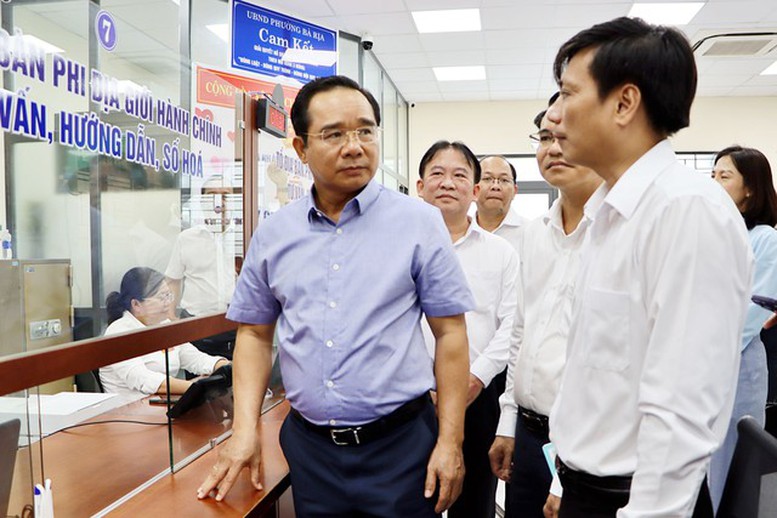
Chairman of the Ho Chi Minh City People's Committee Nguyen Van Duoc inspects the implementation of non-administrative boundary procedures in the locality.
Many pilot models continue to be implemented to facilitate citizens, such as "Digital Citizen Stations," the application of robots, and smart kiosks at Public Administrative Service Centers and in neighborhoods and hamlets, in order to evaluate effectiveness and scale them up.
Regarding administrative reform, Ho Chi Minh City handles a large volume of administrative procedures with an on-time processing rate of over 99.5%; the rate of online applications is over 88%; the satisfaction level of citizens and businesses is over 96%; and 100% of documents are exchanged electronically.
Priority is given to recruiting personnel with specialized expertise.
Besides the achievements, Comrade Van Thi Bach Tuyet stated that the Standing Committee of the City Party Committee also acknowledges some limitations and shortcomings that need to be addressed.
Specifically, the staff still suffers from both surplus and shortage; some have not yet met the job requirements. The city still lacks experienced officials, civil servants, and public employees in key areas such as Party building, information technology, finance and accounting, land management, construction and transportation, health, culture, and education...
This is coupled with the pressure of overload in densely populated areas. The workload is increasing rapidly while the prescribed staffing levels are not commensurate with the population size, area, and characteristics of the locality. The large disparity in the number of Party organizations and Party members between commune and ward Party committees also creates significant pressure in task implementation, affecting the proactiveness and quality of public service delivery.
To overcome these limitations, in the coming period, Ho Chi Minh City will continue to reorganize and streamline the organization and operation of villages and residential areas; assign cadres, civil servants, and public employees to meet job requirements, prioritizing the addition of highly specialized personnel for the fields of information technology, finance and accounting, land, construction, health, agriculture, and environment.

Ho Chi Minh City is stepping up the implementation of digital government and digital citizenship to better serve its citizens and businesses.
Improving institutions and promoting double-digit growth.
Comrade Van Thi Bach Tuyet emphasized that in the coming period, Ho Chi Minh City will continue to focus on implementing many key tasks and solutions; including effectively implementing Resolution No. 09-NQ/TW of the Politburo on building and developing Ho Chi Minh City in the new era.
The city is also researching, developing, and submitting for promulgation a Law on Special Urban Areas to create a synchronized institutional framework, a suitable, open, and stable legal framework, becoming a "breakthrough of breakthroughs," creating conditions for Ho Chi Minh City to maximize its potential and advantages, and effectively mobilize all resources for rapid and sustainable development.
In addition, Ho Chi Minh City continues to effectively implement its socio-economic development plan, aiming for double-digit growth.
The city is also finalizing plans for rearranging public offices, assets, and administrative centers in accordance with regulations; prioritizing the allocation of funds and accelerating the construction, upgrading, and expansion of schools to ensure the teaching and learning needs of the locality are met.
Linh Anh
Source: https://baochinhphu.vn/chinh-quyen-hai-cap-tai-tphcm-hieu-qua-gan-dan-sat-dan-102260528123108007.htm
![[Photo] Solemn bathing ceremony and Buddha procession in Hue](https://vphoto.vietnam.vn/thumb/1200x675/vietnam/resource/IMAGE/2026/05/31/1780228263543_1-jpg.webp)
![[Photo] The General Secretary, President and his wife begin their state visit to the Philippines.](https://vphoto.vietnam.vn/thumb/1200x675/vietnam/resource/IMAGE/2026/05/31/1780230559452_anh-man-hinh-2026-05-31-luc-19-28-11.png)
![[Photo] Admire the coral "masterpiece" amidst the million-year-old heritage of Dak Lak province.](https://vphoto.vietnam.vn/thumb/1200x675/vietnam/resource/IMAGE/2026/05/31/1780221235105_anh-man-hinh-2026-05-31-luc-16-53-27.png)




![[Video] Weather forecast for tonight and tomorrow, June 1st, 2026: Northern Vietnam experiences rising temperatures, Southern Vietnam continues to have thunderstorms.](https://vphoto.vietnam.vn/thumb/402x226/vietnam/resource/IMAGE/2026/05/31/1780232471628_thumb-toi-3105-png.webp)






![[Video] Sunset at Lap An Lagoon – Where the sun sets over the fishing nets](https://vphoto.vietnam.vn/thumb/340x192/vietnam/resource/IMAGE/2026/05/31/1780192137701_beach-landscape-sea-water-nature-grass-745871-pxhere-com.jpeg)





































![[Photo] Admire the coral "masterpiece" amidst the million-year-old heritage of Dak Lak province.](https://vphoto.vietnam.vn/thumb/402x226/vietnam/resource/IMAGE/2026/05/31/1780221235105_anh-man-hinh-2026-05-31-luc-16-53-27.png)
































Comment (0)