

After more than 9 days of disruption to the North-South railway line caused by a landslide at Bai Gio tunnel (a railway tunnel through Deo Ca Pass), the construction units have now rectified the problem, allowing trains to pass through the tunnel.
On the afternoon of April 21st, after a freight train successfully completed trial runs through the Bai Gio tunnel (the railway tunnel through Deo Ca Pass) at various speeds, the railway industry officially allowed trains to travel through the tunnel.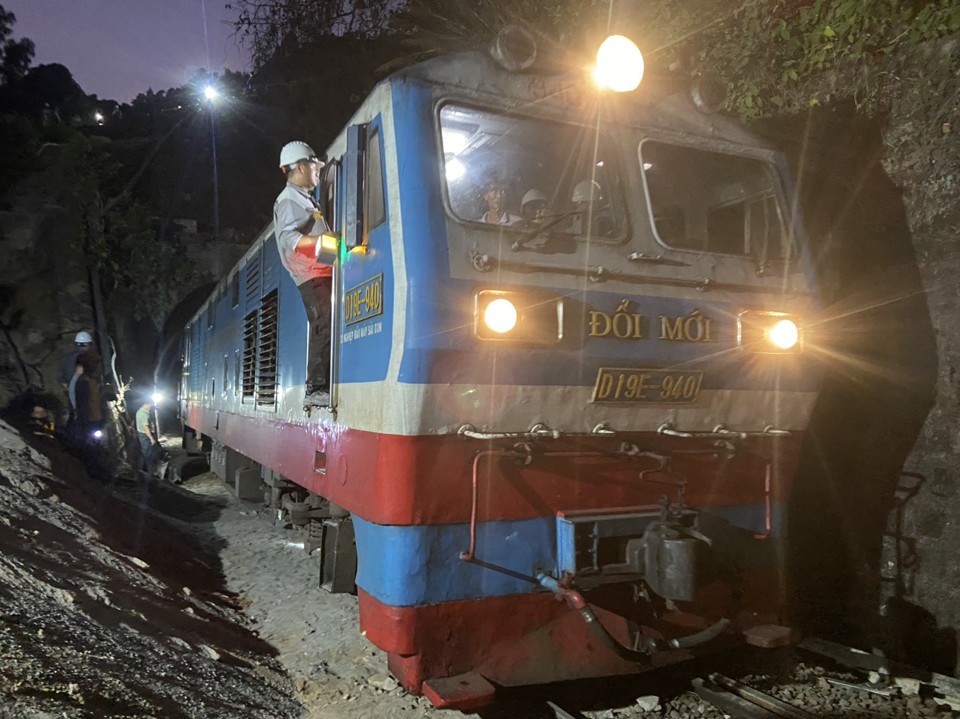
Thus, after more than 9 days since the landslide at Bai Gio tunnel disrupted the North-South railway line, the entire railway line has now been repaired and is open again.
Mr. Tran Thien Canh, Director of the Vietnam Railway Department, said that the unit has coordinated with the Vietnam Railway Corporation and the two provinces of Phu Yen and Khanh Hoa to organize traffic diversion through Deo Ca Pass.
According to Mr. Canh, since the incident occurred, the unit has established a field task force, and the basic work has now been completed.
“We have completed approximately 30-31 meters of concrete and installed 22 anchors to ensure structural stability. Before the official handover, we will conduct trial runs of the train at different speeds. The tunnel is open, but the road remains closed to cars as safety checks are underway for vehicles traveling on the tunnel entrance. The National Highway 1 pass is expected to reopen on April 22nd,” Mr. Canh informed.
Previously, on April 12th, a landslide occurred at the Bai Gio tunnel on the North-South railway line through Ca Pass (Van Ninh district, Khanh Hoa province), with hundreds of cubic meters of soil and rocks completely blocking the tunnel entrance.
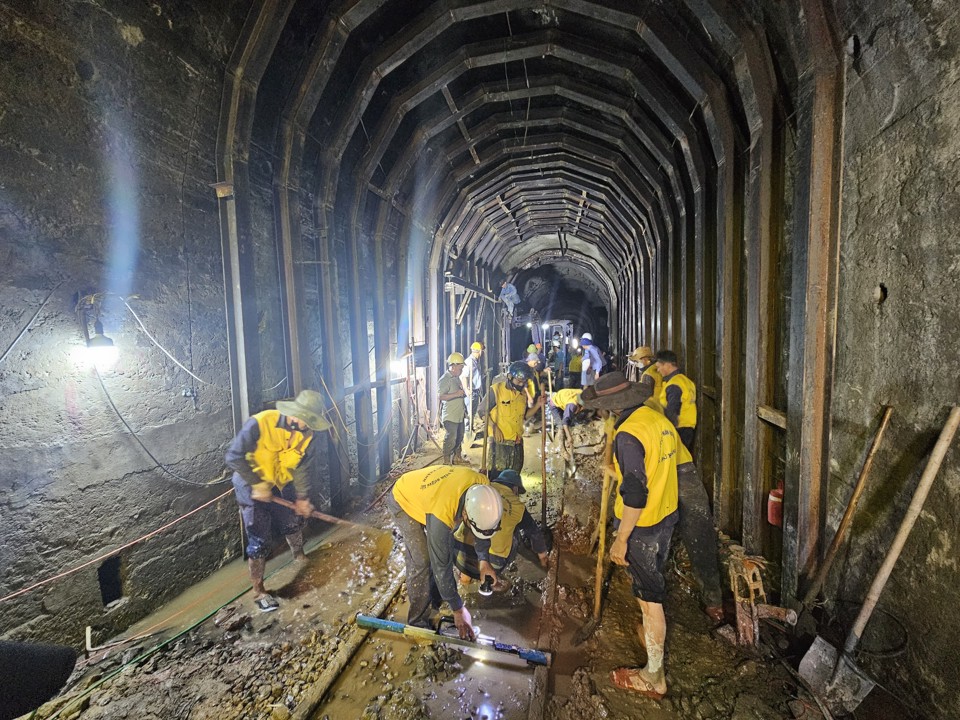
To resolve the issue, the construction units drilled two boreholes on the mountaintop and 37 boreholes inside the tunnel to create anchors, and injected concrete to bond and fix the tunnel lining.
Simultaneously, approximately 250 workers and engineers were mobilized to the construction site, divided into several teams working urgently to complete the tunnel as soon as possible. By nearly 5 PM on April 21st, workers were carrying out the final stages to prepare for load testing.
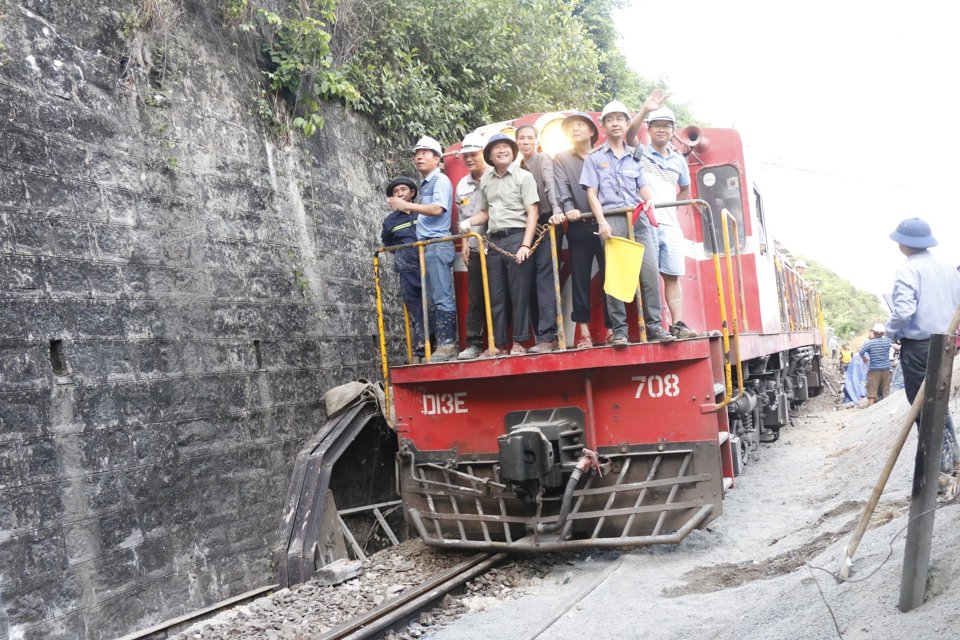
The test train successfully passed through the Bai Gio tunnel. (Photo: Trung Nhan)
According to Mr. Tran Viet Tung, Director of the Nha Trang Railway Transport Branch, since the incident occurred, the unit has had to transfer 110 passenger trains carrying approximately 30,000 passengers from Gia Station (Van Ninh District) to Tuy Hoa Station (Phu Yen Province) and vice versa to continue their journey.
At the same time, the railway industry transports 20-22 container trucks daily from Hoa Huynh station (Ninh Hoa town) to Dieu Tri station (Binh Dinh province) and vice versa, carrying thousands of tons of cargo.
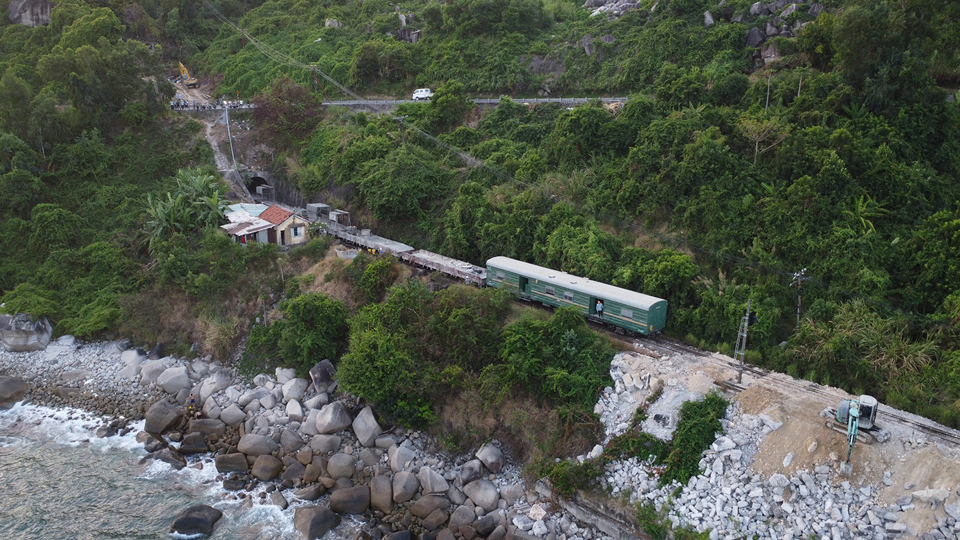
A cargo ship undergoing testing passes through the Bai Gio tunnel. (Photo: Trung Nhan)
According to the Director of the Vietnam Railway Department, the Bai Gio tunnel, built by the French from 1930 to the present day, has undergone many changes due to the impact of water and the design process.
“The survey cross-section cannot fully anticipate all weak points. The recent incident occurred in a location that was not explored through drilling. From this, we have learned a lesson and will apply new tunnel lining reinforcement methods to prevent future landslides. We will continue to improve speed and ensure national safety, continuously checking the geometric elements of the route as well as the tunnel lining structure and related works, so that all trains can pass through at a speed of 15 km/hour. Currently, we are considering reinforcing other tunnels along the entire route," Mr. Canh informed.


![[Photo] Standing Committee member of the Party Central Committee Tran Cam Tu working with the Central Inspection Committee](https://vphoto.vietnam.vn/thumb/1200x675/vietnam/resource/IMAGE/2026/05/28/1779969579668_ndo_br_bnd-2495-jpg.webp)
























































































Comment (0)