


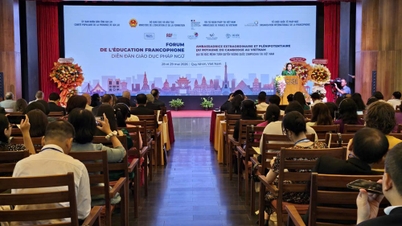
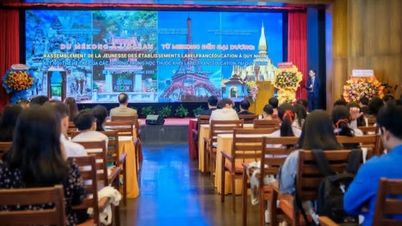
Against the backdrop of the International Centre for Interdisciplinary Science and Education (ICISE) hosting the Francophone Education Forum in Quy Nhon Nam ward, Gia Lai province, a reporter from the Vietnam News Agency (VNA) had an interview with Mr. Nicolas Mainetti, Director of the Francophone University Organization (AUF) for the Asia-Pacific region, about the major developments in Francophone education in the region, as well as the increasing status of French as a language of knowledge, science, innovation, and career opportunities for young Vietnamese people.
Sir, the Francophone Education Forum in Quy Nhon is taking place against the backdrop of Vietnam asserting its position as one of the major centers of Francophone education in Asia, particularly with the continent's first LabelFranceÉducation network. How does AUF view this development momentum of Vietnam within the current Francophone landscape of the region?
Vietnam holds a special position, and AUF monitors this process with close attention, as AUF is also one of the entities that contributed to laying the foundation for that development.
As early as 1992, AUPEL-UREF – the predecessor of AUF – collaborated with the Vietnamese Ministry of Education and Training to implement the first pilot bilingual classes in Ho Chi Minh City and later in Hanoi. By 1994, a long-term cooperation agreement helped to structure the model of enhanced French language training and teaching in French. This model reached its peak in the early 2000s with over 18,000 students enrolled in more than 700 classes.
In parallel, AUF also developed university programs taught in French to train Vietnamese science teachers to teach in French, thereby creating a genuine link between secondary and university education.
The LabelFrance Éducation program, initiated by France in 2012, is a direct continuation of that pioneering spirit. France is now a key partner, through its Ministry of Europe and Foreign Affairs and its diplomatic network, and directly coordinates the implementation of this program in Vietnam.
Vietnam's possession of the largest accredited network in Asia is therefore no coincidence. It is the result of over 30 years of continuous cooperation between Vietnamese authorities and Francophone partners.
It is this historical depth that has helped Vietnam become a pillar of Francophone education in Asia and one of the strongest bases in our regional network.
The forum in Quy Nhon will pay special attention to the project on teaching subjects in French. According to you, what strategic advantages does teaching science, technology, or medicine in French currently offer to Vietnamese youth?
Teaching science, technology, or medicine in French is not simply about learning a foreign language. It's about learning how to think, produce, and disseminate knowledge using that language. And that's what transforms language proficiency into professional and scientific competence.
However, I also want to realistically address one of the limitations of the current system. The interconnectedness and integration between bilingual secondary school programs and university programs taught in French are not yet fully guaranteed.
Currently, French-language university programs do not fully utilize the recruitment potential of students who have previously studied French. Conversely, many students from bilingual classes within the LabelFrance Éducation network do not continue to pursue university programs in French.
By focusing on developing a few strategic areas – where scientific and economic needs are highest – we can strengthen this entire training ecosystem, while simultaneously enhancing the local employment opportunities for Vietnamese youth. This is also one of the priorities we hope to implement with our partners in the near future.
AUF is also supporting the digital transformation process in Vietnamese higher education, particularly through the ACCEES project (Accélération du développement de l'écosystème numérique dans l'enseignement supérieur vietnamien - Promoting the development of a digital technology ecosystem in higher education in Vietnam). According to him, how can we reconcile digital transformation, pedagogical innovation, and the promotion of French language learning in Vietnamese universities?
Digital transformation in higher education is currently a major priority for Vietnam, and AUF is making very concrete contributions to this process.
Through the ACCEES project, funded by the European Union under the Erasmus+ program, we support Vietnamese universities in enhancing the digital capacity of their faculty, researchers, and administrators.
The workshop held last April at Can Tho University helped transform a set of digital competency standards into specific training modules, tailored to the practices of Vietnamese higher education institutions.
In such a project, the added value of AUF lies not in the language of instruction, but in the expertise of the Francophone scientific community and the organization's networking strength: the ability to mobilize experts, connect universities in many countries, share proven methods, and build a sustainable foundation for international cooperation. It is this "networking technique" that is directly benefiting Vietnamese universities.
This expertise also allows us to collaborate with the Vietnamese Ministry of Education and Training on its strategic priorities. Recently, AUF participated in a Ministry research group on open educational resources – an area closely aligned with the new policy directions that Vietnam is implementing.
Digital transformation, open resources, innovative teaching methods: AUF is present on all these fronts, supporting Vietnam's public policies.

He often emphasized the connection between the Francophone community and employment opportunities. In the context of today's Asia-Pacific labor market, what specific advantages could a French-language university program offer to young Vietnamese people?
A French language training program offers two advantages: it is both practical and strategic.
First, there's the concrete advantage. French is the common language of the Francophone world, with over 90 countries and governments that are members of the International Organization of Francophonie (OIF), where many businesses have a presence in Vietnam as well as throughout the region.
For Vietnamese youth, this means direct access to a vast academic network. AUF alone currently has over 1,000 member institutions in 120 countries, making it the world's largest university network.
Proficiency in French, alongside English and Vietnamese, is a key factor that helps young people stand out in a fiercely competitive job market, opening up opportunities that very few candidates can obtain.
Next is the strategic advantage. French language training helps develop interdisciplinary skills that are highly sought after today: analytical thinking, the ability to work in multilingual and multicultural environments, and an international mindset.
That is precisely the purpose of the Francophone Employment Support Centers that AUF is implementing. These centers provide students with tools, resources, and direct support to assist in their professional integration process, both in Vietnam and internationally.
Multilingualism is not a barrier, but a real asset for Vietnamese youth.
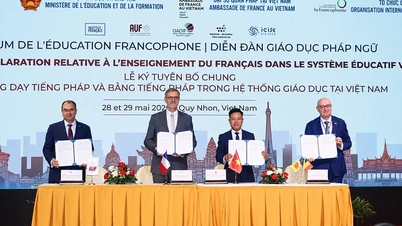
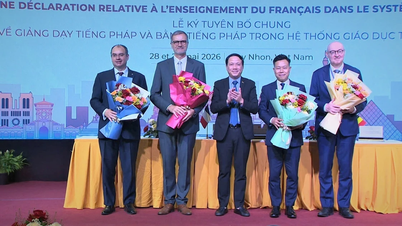
A joint statement on teaching French and using French in the Vietnamese education system was signed on the sidelines of the Forum between Vietnamese and Francophone Partners. What concrete progress do you expect to see in the coming years regarding university cooperation, academic exchange, and teacher training?
AUF is a multilateral organization with a mission to promote development through education and knowledge. We are not an external agent. AUF's goal is to put its Francophone scientific network and expertise to the forefront of Vietnam's public policies.
The joint statement signed in Quy Nhon is entirely in that spirit. This is not just another formal declaration, but a document establishing concrete commitments shared by all parties. I particularly expect some significant progress.
First and foremost, we need to strengthen initial and ongoing training for teachers – a core element of the entire system. Because without a well-trained teaching staff, no program can develop sustainably.
In this field, AUF possesses proven experience through our coordinated Apprendre program, which supports numerous Ministries of Education in the Francophone space in enhancing the professionalism of their teaching practices. This is precisely the expertise we aspire to bring to Vietnam.
Next, support is provided to young people's job-seeking abilities through a combination of language skills, soft skills, and career integration, particularly through the network of Francophone Job Support Centers.
In addition, there is the expansion of international exchange programs, allowing international volunteers to participate in teaching French and other language subjects, and to support the training of Vietnamese teachers.
This collaboration also directly aligns with the strategic directions that Vietnam has set for itself, particularly Resolution No. 57 of the Politburo – which identifies science, technology, innovation, and digital transformation as the driving force for national development – and Resolution No. 59, which places international integration at the center of the country's development strategy, emphasizing the improvement of human resource quality as well as professional skills, foreign language proficiency, and intercultural skills.
Our role is to bring the networks and expertise of the Francophone scientific community to serve those national priorities: connecting Vietnamese researchers with international networks, enhancing the visibility of Vietnamese scientific publications, and supporting capacity building for academic administrators.
What's changing now is the approach: we're moving from fragmented initiatives to a coordinated, sustainable, and genuinely partnership-based approach.

Vietnam is currently seen as a dynamic "laboratory" for Francophone education in Southeast Asia. In your opinion, could the Vietnamese model inspire other countries in the region to develop bilingual programs and Francophone training?
Yes, and that is one of the reasons why we are following Vietnam's experience with particular interest.
Vietnam has demonstrated that a policy of developing bilingual programs, implemented consistently and with full articulation to the university level, can produce outstanding results and take deep root in the national education system.
This experience is not an isolated case. In Laos and Cambodia – where AUF is present – similar bilingual training models are being developed following closely related logic.
Of course, the Vietnamese model cannot be copied exactly, as each country has its own history and priorities. But Vietnam offers very valuable methodological lessons: the importance of teacher training, the need for a connection between secondary education and university, and the link between language and employability.
The role of AUF, as a regional network, is to promote the dissemination of these best practices among our 91 member institutions in 17 Asia-Pacific countries.
This regional dynamic is particularly significant this year. In November 2026, the Francophone Summit will take place in Phnom Penh, Cambodia. This will be only the second time the summit has been held in Asia, nearly 30 years after the historic summit in Hanoi in 1997.
The 1997 event brought together more than 90 delegations and marked a significant institutional turning point for the Francophone community.
The return of the Francophone community to Southeast Asia – from Vietnam of yesterday to Cambodia of tomorrow – demonstrates the vibrant energy of our region. With its solid historical foundation and experience, Vietnam has the potential to become an inspiring "laboratory" for the entire Asia-Pacific region.
Finally, what message would he like to convey to young Vietnamese people who are still hesitant about choosing to study French-language programs in their academic and career paths?
I want to tell young people that choosing French doesn't mean giving up anything else, but rather adding an advantage to your own life.
Today, English is no longer the only requirement in the job market. Major Asian languages are also becoming increasingly important, and competition among job applicants is intensifying.
In this context, it is the complementary, rare, and distinctive skills that create an advantage. And French possesses an advantage that very few languages have: along with English, it is the only working language present on all five continents.
French is truly a global language, present in diplomacy, international organizations, research, and business—from Africa and the Americas to Europe and the Asia-Pacific region.
Choosing a French-language program means opening the door to a global academic and professional environment, accessing prestigious universities, scholarships, and international exchange programs.
But beyond career opportunities, studying in a French-speaking environment is also a way of thinking, a gateway to other cultures, and the ability to engage in dialogue with the world.
Today, many generations of Vietnamese alumni who graduated from French-language programs hold important positions in universities, businesses, diplomacy, and scientific research.
You will not be alone. You will join a network, a community, and receive support from AUF throughout your journey. So, don't hesitate any longer. Turn your multilingual skills into an advantage for your future.
Thank you very much, sir!
Source: https://baotintuc.vn/giao-duc/chon-tieng-phap-la-mo-them-canh-cua-ra-the-gioi-20260529173129379.htm


![[Image] Nearly 125,000 Hanoi students completed the Literature exam for the 10th grade entrance exam.](https://vphoto.vietnam.vn/thumb/1200x675/vietnam/resource/IMAGE/2026/05/30/1780117233041_ndo_br_thiet-ke-chua-co-ten-2-png.webp)









































































Comment (0)