

In 1862, high-ranking officials Phan Thanh Giản and Lâm Duy Thiếp, representing the Nguyễn dynasty, signed a peace treaty with Major General Bonard, representing France. According to the treaty, Vietnam ceded the three provinces of Biên Hòa, Gia Định, and Định Tường to France, and granted French warships free access to the Mekong River. Just five years later, in 1867, France seized Vĩnh Long, An Giang , and Hà Tiên. Having stabilized the situation in Southern Vietnam, France marched north and signed a peace treaty in 1874 granting them numerous advantages. In 1882, France launched a second invasion of Northern Vietnam and signed the Treaty of Giáp Thân in 1884 (the Patenôtre Treaty): Vietnam was effectively placed under French protection. The first action taken by France was to melt down the imperial seal of the Qing dynasty and grant it to the Vietnamese king, signifying that Vietnam was no longer subservient to China.
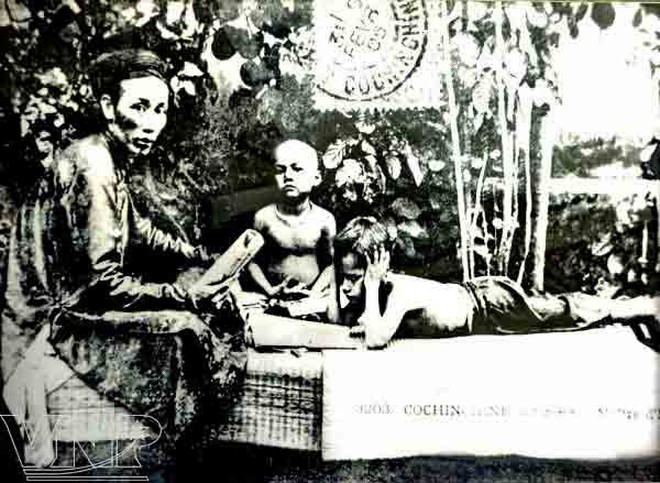
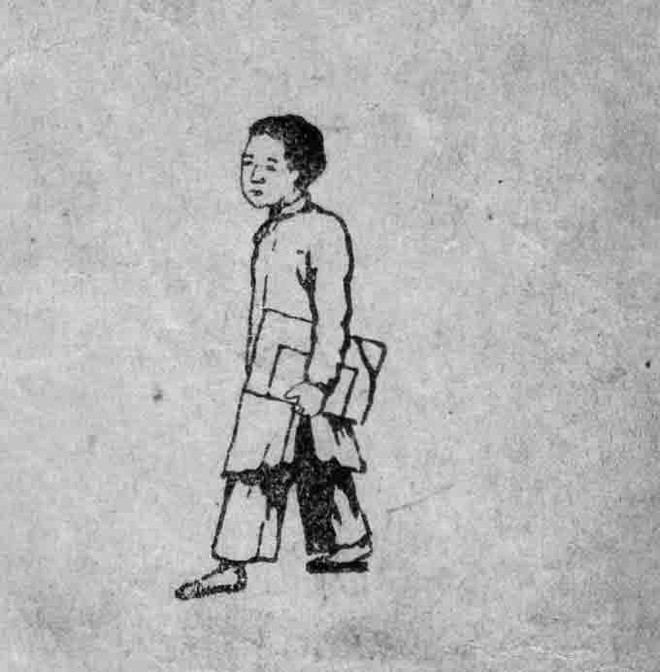
Village teacher and student in Southern Vietnam in the early 20th century.
PHOTO: ARCHIVE OF LE MINH QUOC
When the soldiers completed their mission, the invaders had to think about "civilizing" the local population. The first problem was how to establish contact and communication when both sides had a language barrier. There were two ways: either they diligently learned the spoken and written Vietnamese language (but Chinese characters and Nôm script were not easy to learn, and mastering them would take a very long time); or they taught the Vietnamese to learn and speak French (but the existing teaching staff was insufficient). Thus, neither of these solutions could be easily implemented quickly or overnight.
Ultimately, they chose the solution of both sides "cooperating" to use the Vietnamese script written in the Latin alphabet (Quốc ngữ), which had been established by the missionary Alexandre de Rhodes and several other missionaries in the 16th century. However, the immediate task was to have intermediaries to help both sides understand each other. Therefore, in Southern Vietnam, on September 21, 1861, they established the French-Vietnamese High School named after d'Adran (Pigneau de Béhaine (1741-1700), also known as Bá Đa Lộc); in Northern Vietnam, in January 1886, they also established an interpreter school on Jean Dupuis Street (Vietnamese name: Đồ Phổ Nghĩa), later moved to Yên Phụ.
During this period, on July 16, 1864, the French colonial authorities issued a decree establishing several primary schools in the provinces to teach the Vietnamese Quốc ngữ script and mathematics. However, in the villages, schools teaching Chinese characters and Nôm script still existed, and especially in the minds of the people, these were the scripts of "loyalty to the king and love for the country," and therefore, no one could erase them. Most people believed that learning the Quốc ngữ script or French was "following the enemy," so no one wanted their children to study; if forced, they would pay someone else to study on their behalf! But then, no one could stop the trend of the times, and the Quốc ngữ script and French gradually prevailed, completely replacing Chinese characters in the education system, starting with the 1919 imperial examination.
"A tiny, insignificant part" of the Vietnamese Quốc Ngữ script.
On April 6, 1878, the Governor of Cochinchina, J. Lafont, issued a decree stating that from January 1, 1882, all official documents must be written and published in the Vietnamese Quốc ngữ script. From then on, the appointment and promotion of officials required the candidate to be proficient in Quốc ngữ. Also from January 1, 1882, to January 1, 1886, local dignitaries and officials would receive a reduction in head tax if they knew Quốc ngữ. This was also the time when the French established the first Franco-Vietnamese education program and set up the Department of Education to gradually phase out Chinese characters: in Cochinchina on March 17, 1879, in Tonkin in 1904, and in Annam in 1906.
Of course, even though these decrees had been issued, schools teaching Chinese characters still existed in villages and communes – considered an expression of patriotism. It wasn't until June 14, 1919, when the Nguyen dynasty issued a decree declaring the complete abolition of these schools and their replacement with a Franco-Vietnamese education system, that the French colonial "reform" truly completed its mission – albeit only in official and legal terms.
At that time, how was the Franco-Vietnamese education system structured across different levels?
Regarding this matter, researcher Le Nguyen stated: "In the early period of the Franco-Vietnamese education system (the late 19th and early 20th centuries), the foundation was the Vietnamese Quốc ngữ script. Learning was divided into three levels: 1. Elementary school from the Kindergarten to the third grade (now grades 1 to 3): students who completed this level took an exam to obtain an Elementary school diploma; 2. Elementary school: the second grade (including the one-year and two-year second grades, equivalent to grade 4 today) and the first grade (grade 5 today). Students who completed this level took an exam to obtain an Elementary school diploma; 3. Higher Elementary school: including the first, second, third, and fourth years (equivalent to grades 6-9 today). Students who completed this level took an exam to obtain a Higher Elementary school diploma, later called the Thành Chung or Đíp-lôm diploma."
And, this was also the first time students were exposed to a completely new educational program, such as learning French grammar; practicing reading the Vietnamese Quốc ngữ script; basic arithmetic (addition, subtraction, multiplication, division), geometry, geography, and drawing; and a measurement system that included a comparison of the French and Vietnamese measurement systems… After years of diligent study, students who passed the exams could be appointed as interpreters, secretaries, or native professors…
Researcher Bang Giang later made a painful observation: "According to the Decree of March 17, 1879, of the Governor-General of Southern Vietnam, from the 1879-1880 school year, 4/5 of the curriculum was in French for 10 years across three levels of education. The little time remaining to be devoted to the Vietnamese Quốc ngữ script was merely 'a tiny bit of insignificant.' As for Chinese characters, 'scholars are good, those who don't are good' ( Mist over the works of Truong Vinh Ky - Literature Publishing House 1994, p. 151)." (to be continued)
Source: https://thanhnien.vn/chu-quoc-ngu-vao-truong-hoc-ra-sao-185260515203038003.htm

![[Photo] First session of the 14th Congress of the Vietnam Trade Union](https://vphoto.vietnam.vn/thumb/1200x675/vietnam/resource/IMAGE/2026/06/03/1780465947883_ndo_br_img-3852-jpg.webp)
![[Photo] General Secretary and President To Lam presides over a meeting with the Central Organizing Committee.](https://vphoto.vietnam.vn/thumb/1200x675/vietnam/resource/IMAGE/2026/06/03/1780482764658_a1-bnd-4741-3342-jpg.webp)

![[Photo] Secretary of the National Assembly Party Committee, Chairman of the National Assembly presides over the meeting of the Standing Committee and Executive Committee of the National Assembly Party Committee.](https://vphoto.vietnam.vn/thumb/1200x675/vietnam/resource/IMAGE/2026/06/03/1780480353201_ndo_br_bnd-2585-jpg.webp)





















































![[Video] Sunset at Lap An Lagoon – Where the sun sets over the fishing nets](https://vphoto.vietnam.vn/thumb/1200x675/vietnam/resource/IMAGE/2026/05/31/1780192137701_beach-landscape-sea-water-nature-grass-745871-pxhere-com.jpeg)







































Comment (0)