

Currently, there are over 300,000 active business households in the capital city. By 2025, total revenue from this sector is expected to reach nearly 5,970 billion VND - a remarkable figure.
However, there is still enormous potential if business operations are made more transparent and managed more systematically. In this context, the shift of household businesses to declaring and paying taxes based on actual revenue represents a change in mindset: from business based on experience to management based on data; from "small-scale business" to gradually approaching the standards of the formal market.
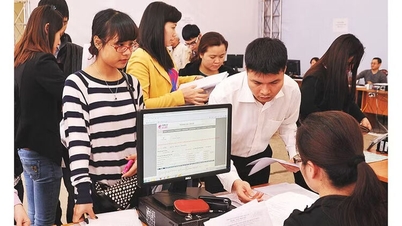
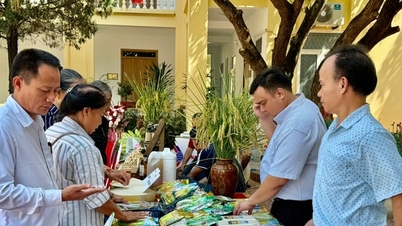
A highlight of this process is the substantial and close collaboration of the tax authorities and all levels of government in the city during 2025 and the first few months of 2026. Besides extensive public awareness campaigns, the tax sector has deployed numerous task forces to local areas to support and guide individual households on how to maintain accounting records, use electronic invoices, and file tax returns digitally. This approach not only helps remove technical barriers but also builds trust among taxpayers.
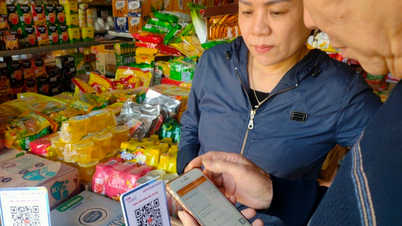
Notably, collaboration with technology companies, service providers, and banks has created a practical support ecosystem. Many businesses have access to free or low-cost accounting and electronic invoicing software; they have also received guidance on opening accounts and making cashless payments. As a result, the transition process is no longer a burden but an opportunity to standardize business operations.
In practice, financial transparency is the "ticket" for household businesses to enter broader development spaces. With clear accounting records and complete invoices, household businesses can easily access credit, sign contracts with large partners, participate in supply chains, or e-commerce platforms. However, some household businesses are still hesitant to change due to old habits or limited skills. This shows that the transformation process needs to continue with stronger and more flexible solutions.
For the shift from lump-sum tax to declaration-based tax to truly become a driving force for upgrading the household economy , Hanoi needs to move from a "persuasion" approach to building a systematic and long-term "support ecosystem".
Firstly, continue to maintain and expand the "hands-on" support model, considering it a proactive public service rather than a temporary solution. Tax officials should closely monitor the local area and accompany business households throughout the transition process, especially small-scale households with limited access to technology.
Secondly, institutionalize and expand collaborative programs with technology companies, service providers, and banks to offer comprehensive support solutions, from accounting software and electronic invoices to digital payments, at low or no cost in the initial phase. This is the "soft leverage" that helps create momentum for transformation.
Thirdly, continue to simplify the tax declaration process towards automation, user-friendliness, and ease of use; develop online support platforms so that business households can access them anytime, anywhere.
Fourth, link the tax declaration process with the household economic development strategy, through management skills training, market connection support, and promoting conversion to enterprises when conditions are met. In this way, tax declaration becomes both an obligation and an integral part of the development roadmap.
Finally, strengthen discipline and ensure fairness in fulfilling tax obligations. When a transparent business environment is established, honest businesses will be protected and have more motivation to develop.
When household businesses are properly placed on a transparent path and receive appropriate support, they not only fulfill their tax obligations but also become an important and sustainable growth engine for the capital city in this new development phase.
Source: https://hanoimoi.vn/chuan-hoa-hoat-dong-kinh-doanh-744973.html



![[Photo] First session of the 14th Congress of the Vietnam Trade Union](https://vphoto.vietnam.vn/thumb/1200x675/vietnam/resource/IMAGE/2026/06/03/1780465947883_ndo_br_img-3852-jpg.webp)


















































































Comment (0)