


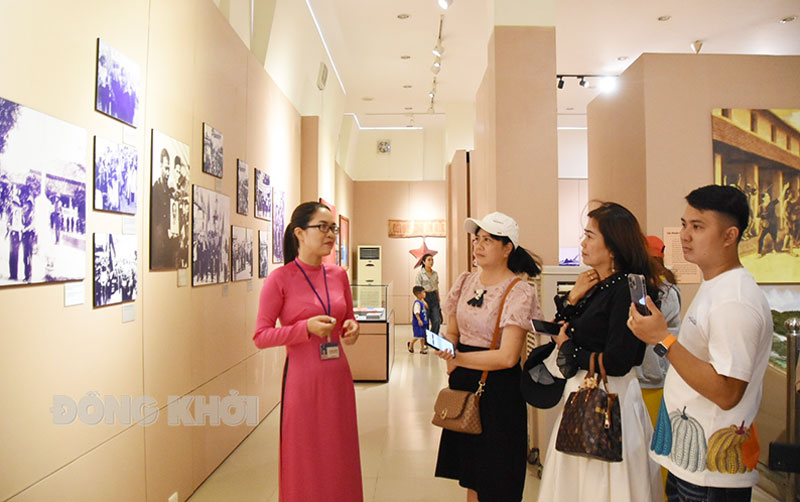
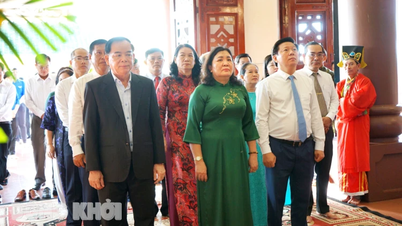
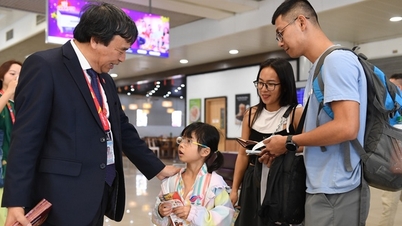
The delegation from the Ben Tre Journalists Association listened to a presentation about the return of Con Dao prisoners and the story of wanting to bring a portrait of President Ho Chi Minh to the Con Dao Museum. Photo: Cam Truc
“Turning misfortune into fortune, our comrades took advantage of their time in prison to hold meetings and study theory. Once again, this proved that the enemy's extremely brutal policy of terror not only failed to stop the progress of the revolution, but on the contrary, it became a test of fire, forging the revolutionaries to become even stronger, and as a result, the revolution won and the imperialists lost…”
(President Ho Chi Minh )
Unwavering faith in the Party and President Ho Chi Minh
Visiting Con Dao in mid-May 2023, also the 133rd anniversary of President Ho Chi Minh's birth, we felt a sense of joy, as if we were "returning to the past," reliving moments from years ago, to remember and reminisce about the unwavering resilience and indomitable struggle for the greatest goal: the determination to win independence and freedom for the nation and to preserve the homeland, under the leadership of the Party and President Ho Chi Minh, and of the political prisoners here.

Con Dao Island (Ba Ria - Vung Tau province) was where the French colonialists and American imperialists imprisoned and tortured hundreds of thousands of revolutionary fighters and patriots from many generations during their rule (1862-1975). They turned Con Dao into a notorious "hell on earth." Not only was it a place of isolation, imprisonment, terror, exile, and murder as during the French colonial period, but the American-backed regime transformed Con Dao prison into a place for carrying out the most sophisticated, insidious, and brutal methods of anti-communist persecution and extermination. They spared no means, such as brutal terror, prolonged exile, unlimited beatings, starvation, dehydration, and the most savage tortures… making the lives of revolutionary prisoners worse than death, causing physical pain, agonizing suffering to the bone marrow and nerves, and leading to slow, agonizing deaths.
However, the prisoners of Con Dao Island upheld their integrity and loyalty to the Party by bravely facing the enemy and enduring relentless physical torture, while inwardly nurturing and strengthening their fighting spirit, an indomitable will to fight to the death for the Fatherland and an undying belief in national liberation.
Upon hearing the news that Saigon had been liberated, the prisoners of Con Dao Island rose up in self-liberation. The uprising to liberate Con Dao was a complete victory on the night of March 30th and the morning of May 1st, 1975. The prisons had lost all communication lines with the mainland, but fortunately, on May 2nd, 1975, the radio station was successfully repaired, and one prisoner from Con Dao Island managed to connect with the Saigon-Gia Dinh City Party Committee. When asked what Con Dao needed for immediate support from the mainland, the representative, along with the political prisoners on Con Dao Island, choked back tears and replied, "We need a picture of Uncle Ho." Although they were severely lacking in medicine and food, the political prisoners on the island only needed a picture of Uncle Ho – it was their greatest wish.
In the early morning of May 4, 1975, a naval ship from the mainland docked at Con Dao Island, carrying 500 photographs of President Ho Chi Minh. The prisoners, who just days before had been political prisoners, were now free, and their first wish was to receive the portraits of President Ho and the liberation flag in their respective camps. Many wept with joy at the reunification of the country.
That was one of the most moving moments, demonstrating faith, pride, and belief in the path of national liberation, as well as the leadership of President Ho Chi Minh. Even in their final moments, the prisoners on Con Dao Island still wished to see a picture of Uncle Ho.
To preserve all the precious moments of that time, the Con Dao Museum still displays a portrait of President Ho Chi Minh, the liberation flag, along with other incredibly moving photographs that hold historical value for the national liberation struggle.
The statue of President Ho Chi Minh from Con Dao prison.
The touching story of the statue of President Ho Chi Minh in Con Dao prison, his journey to France, and his return to Vietnam has evoked deep emotion and profound admiration in today's young generation.
The story goes that in the 1940s, out of reverence for the great leader, revolutionary fighters exiled to Con Dao Island carved a statue of Ho Chi Minh from memory and did everything possible to protect and hide it from the strict control of the prison. The communist fighters secretly kept the statue of President Ho Chi Minh in Con Dao prison. The small statue vividly depicted the President's face with his expressive, direct gaze, high forehead, and silver beard. Whenever they secretly raised the flag, held Party membership ceremonies, or participated in Party branch meetings, the communist fighters placed the statue in front of them with solemnity.
For the prisoners, despite the harsh prison conditions, the image and belief in President Ho Chi Minh's leadership were a great source of encouragement. It even impressed the French prison warden, Paul Antoine Miniconi, who admired the shining, noble values within the prison walls.
Sent to Vietnam as a prison warden at Con Dao prison from 1920 to 1952, during his time there, he noticed "unusual behavior" among the prisoners and suspected they were trying to hide weapons. Warden Miniconi conducted an inspection and search of the prisoners' quarters. As a result, he recovered a bust of President Ho Chi Minh, the leader beloved and respected by the communists.
Prison guard Miniconi decided to secretly keep the statue for himself. After his time working in Con Dao, in 1952, Miniconi returned to live on the island of Corsica (France). He also brought the memento of President Ho Chi Minh with him as a souvenir of his years working in Vietnam, and he cherished it for many years at his home before handing it over to his son, Paul Miniconi, for safekeeping.
In accordance with his father's wishes, on December 1, 2019, Paul Miniconi, along with French historian Frank Senateur, handed over the bust of President Ho Chi Minh, made by the prisoners of Con Dao prison, to the Vietnamese Ambassador to the Republic of France, Nguyen Thiep. The bust was then transferred to the Ho Chi Minh Museum for preservation, safekeeping, and promotion of its value to this day.
Like us, many tourists visiting Con Dao during the April 30th and May 1st holidays in 2023, especially on the occasion of the birthday of the great President Ho Chi Minh on May 19th, were deeply moved and filled with national pride when they heard stories full of courage and immense historical significance at this once-unique "hell on earth." Most touching was hearing and learning about the story of the statue of President Ho Chi Minh and the moment when Con Dao prisoners joyfully received his portrait on the day of the complete liberation of the South, the reunification of the country, and their return to the mainland.
Cam Truc - Quang Khoi
Source link
![[Photo] General Secretary To Lam attends the opening session of the Peace Council on Gaza.](https://vphoto.vietnam.vn/thumb/1200x675/vietnam/resource/IMAGE/2026/02/19/1771516865192_tbttolam5-jpg.webp)

































Comment (0)