

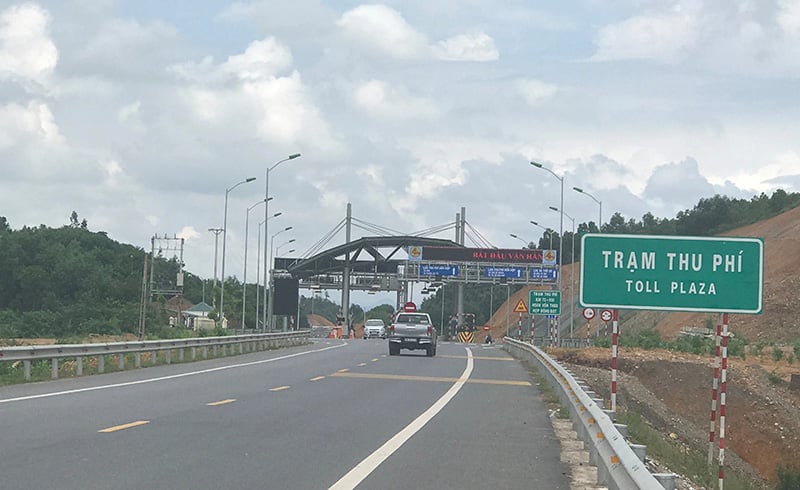
 |
| A section of the Thai Nguyen - Cho Moi BOT road. |
Consider the loan interest rate option.
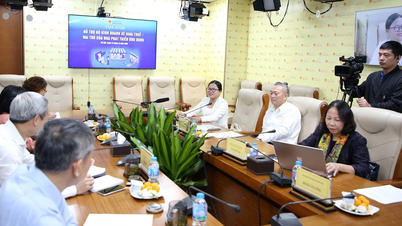
The urgency is evident in the latest directive from Deputy Prime Minister Tran Hong Ha at the conclusion of the meeting on the Draft Decree detailing the handling of obstacles in BOT transport projects, held on December 8, 2025.
In Notice No. 685/TB-VPCP dated December 12, 2025, Deputy Prime Minister Tran Hong Ha stated that difficulties and obstacles facing some BOT (Build-Operate-Transfer) transportation projects have arisen and persisted for many years. Since 2017, the National Assembly, the Government, and the Prime Minister have issued numerous directives to the Ministry of Transport (now the Ministry of Construction ), the Ministry of Planning and Investment (now the Ministry of Finance), and other relevant agencies and units to promptly find solutions to resolve these issues definitively.
“This is an issue that impacts many stakeholders (the State, investors, project enterprises, credit institutions, the people, etc.); resolving difficulties and obstacles in BOT projects will help unlock investment capital for infrastructure development through the PPP method and improve the investment environment. At the ninth session, the National Assembly amended the Law on Investment under the PPP method, which includes provisions for resolving obstacles in BOT transportation projects that signed contracts before January 1, 2021,” the Deputy Prime Minister assessed.
According to the Ministry of Construction's report, the draft Decree has been fully implemented by the Ministry in accordance with legal procedures and has a political basis for resolving the difficulties of BOT transport projects that signed contracts before January 1, 2021. Currently, there are still differing opinions regarding the method of calculating interest on loans during the operation and business phase when determining compensation costs and early contract termination.
In Notice No. 685/TB-VPCP, Deputy Prime Minister Tran Hong Ha instructed the Minister of Construction to direct the study, acceptance, and full explanation of the opinions of relevant ministries and agencies, as well as the recent opinion of Vietnam Technological and Commercial Bank (Techcombank), in order to compile and report fully on the results of working with commercial banks and credit institutions related to the projects currently facing difficulties.
The Ministry of Construction is responsible for leading and coordinating with the State Bank of Vietnam to thoroughly assess the impact of the proposed options, and based on that, propose a feasible option that complies with legal regulations; preventing negative consequences, complaints, and losses of state assets; and clearly affirming that the proposed option is in accordance with legal regulations as reported at the meeting.
"The Government Office, based on the documents submitted by the Ministry of Construction, is tasked with gathering opinions from Government members and compiling a report to the Prime Minister by December 15, 2025, as directed by the Prime Minister," Deputy Prime Minister Tran Hong Ha instructed.
Previously, at the end of November 2025, Techcombank - a co-financing unit of the Thai Nguyen - Cho Moi Road Construction Project - proposed a plan for the State to pay interest costs during the operational phase at an interest rate of approximately 4% per year (while the actual interest rate under the BOT contract is 9 - 10.14% depending on the phase), in order to partially offset the interest costs of raising capital from the public (according to Techcombank's report, the cost of raising capital is no less than 6% per year).
Techcombank stated that due to difficulties in fee collection, the project's revenue was insufficient to cover interest and principal payments as per the signed loan agreement, resulting in the debt being reclassified as a Group 5 non-performing loan. "Therefore, the State's payment of construction investment costs and operating costs helps the bank recover the full principal loan amount, and the investor recovers their invested equity capital, ensuring the principle of balanced benefits and shared risks," a Techcombank representative stated.
Benefits are balanced, risks are shared.
It is understood that, during the drafting process of the Decree detailing the handling of difficulties in BOT projects, the Ministry of Construction developed a draft and sought opinions from relevant ministries, sectors, localities; investors; project enterprises and banks providing capital on three options for calculating interest on loans during the operational phase of BOT projects facing difficulties.
Option 1: The total loan amount under the PPP project contract multiplied by a defined interest rate of 4% per year; the period for calculating interest expense is from the time the project is put into operation until the time the competent authority decides to terminate the contract prematurely.
Option 2: The total interest expense paid by the investor or project enterprise to the credit bank up to the time the competent authority decides to terminate the contract prematurely.
Option 3: Do not include interest expenses incurred during the operational phase in the compensation costs for early termination of the contract.
Notably, among the 11 banks that participated in the consultation, 5 banks provided feedback on the interest calculation method; of which 3 banks chose option 1 (Bao Viet Bank, HDBank, Techcombank) and 2 banks chose option 2 (SHB, BIDV).
According to Report No. 95/TTr-BXD submitted to the Government at the end of August 2025, the Ministry of Construction stated that, out of a total of 140 BOT projects, a list of 11 projects with quantified obstacles and several projects with potential obstacles has been identified. Based on this list, the Ministry of Construction has coordinated with the State Bank of Vietnam and relevant localities to negotiate with investors and project enterprises, agreeing on two groups of solutions to resolve the issues.
Group 1 involves the State sharing the costs to continue implementing the contract, expected to apply to 5 out of 11 BOT projects, with preliminary cost sharing of approximately 8,890 billion VND.
Group 2 involves the State paying compensation costs for early contract termination, which is expected to apply to 6 out of 11 BOT projects.
Preliminary estimates of total compensation and contract termination costs for projects in Group 2 under Option 1 are approximately 5,900 billion VND; Option 2 is approximately 5,960 billion VND; and Option 3 is approximately 4,520 billion VND.
The Ministry of Construction affirms that the above figures are only preliminary estimates; the application and determination of the specific value of state capital to resolve issues in these projects will be based on the audit results of the State Audit Office and the decision of the competent authority in accordance with the law.
Previously, on April 11, 2024, Prime Minister Pham Minh Chinh chaired a meeting of the Government Standing Committee on the Project and issued conclusions in Notice No. 270/TB-VPCP dated June 22, 2024.
According to the conclusions of the Government Standing Committee, in cases where a proposal is made to use state budget funds to pay investors upon early termination of a contract, the value of the state's responsibility, the source of funds used, and the decision-making authority must be clearly defined; the parties are responsible for sharing risks to the maximum extent possible according to the principle of "harmonious benefits, shared risks".
“The Ministry of Transport (now the Ministry of Construction - PV) and the State Bank of Vietnam worked with investors, businesses, and capital providers to negotiate in a way that eliminates equity returns and does not include interest on loans in the proposed payment value,” Notice No. 270/TB-VPCP clearly stated.
The difficulties and obstacles have been quantified for 11 projects.
The Viet Tri - Ba Vi bridge construction project, connecting National Highway 32 with National Highway 32C, is being implemented under the BOT (Build-Operate-Transfer) model.
The project involves the construction of the Thai Ha bridge over the Red River, connecting Thai Binh and Ha Nam provinces with the Cau Gie - Ninh Binh expressway, Phase I, under a BOT (Build-Operate-Transfer) contract.
The project to invest in the construction of road tunnels through Deo Ca Pass (including Deo Ca Tunnel, Co Ma Tunnel, Cu Mong Tunnel, and Hai Van Tunnel) is implemented under a BOT contract.
The project involves the construction of the Bac Giang - Lang Son City expressway section from Km45+100 to Km108+500, combined with the upgrading of the surface of National Highway 1 section from Km1+800 to Km106+500, in Bac Giang and Lang Son provinces, under a BOT (Build-Operate-Transfer) contract.
The project involves the construction of National Highway 1 bypass around Thanh Hoa city under a BOT (Build-Operate-Transfer) contract.
The project involves the construction of the Thai Nguyen - Cho Moi (Bac Kan) road and the renovation and upgrading of National Highway 3, section Km75 - Km100, under a BOT (Build-Operate-Transfer) contract.
The project to upgrade and expand the Ho Chi Minh Highway (National Highway 14) section from Km1738+148 to Km1763+610 in Dak Lak province is implemented under a BOT (Build-Operate-Transfer) contract.
The project involves the construction and upgrading of National Highway 91, section from Km14+000 to Km50+889, under a BOT (Build-Operate-Transfer) contract.
The project involves the investment and construction of works to renovate and upgrade the Saigon River channel section from Binh Loi railway bridge to Ben Suc port under the BOT contract form.
The project to renovate and upgrade Road 39B, specifically the bypass section around Thanh Ne town in Kien Xuong district and the section from the road leading to Thai Binh Power Center to Diem Dien bridge in Thai Thuy district, Thai Binh province, is implemented under a BOT (Build-Operate-Transfer) contract.
The tourism infrastructure investment project for the coastal road from Doc Lap - Long Thuy - Ganh Da Dia (including the construction of An Hai bridge under the BOT model).
BOT projects face potential obstacles:
The investment in the Gia Nghia - Chon Thanh expressway will affect the revenue of the two BOT projects on National Highway 14;
Investing in the Khanh Hoa - Buon Ma Thuot expressway, in accordance with Resolution No. 58/2022/QH15 of the National Assembly, will affect the revenue of the BOT National Highway 26 Project;
Investing in the Quy Nhon - Pleiku expressway will affect the revenue of the National Highway 19 BOT project…
Source: https://baodautu.vn/chuyen-bien-trong-viec-xu-ly-vuong-mac-tai-du-an-bot-gap-kho-d461577.html
![[Photo] Prime Minister Pham Minh Chinh attends the Conference on the Implementation of Tasks for 2026 of the Industry and Trade Sector](/_next/image?url=https%3A%2F%2Fvphoto.vietnam.vn%2Fthumb%2F1200x675%2Fvietnam%2Fresource%2FIMAGE%2F2025%2F12%2F19%2F1766159500458_ndo_br_shared31-jpg.webp&w=3840&q=75)















































































Comment (0)