

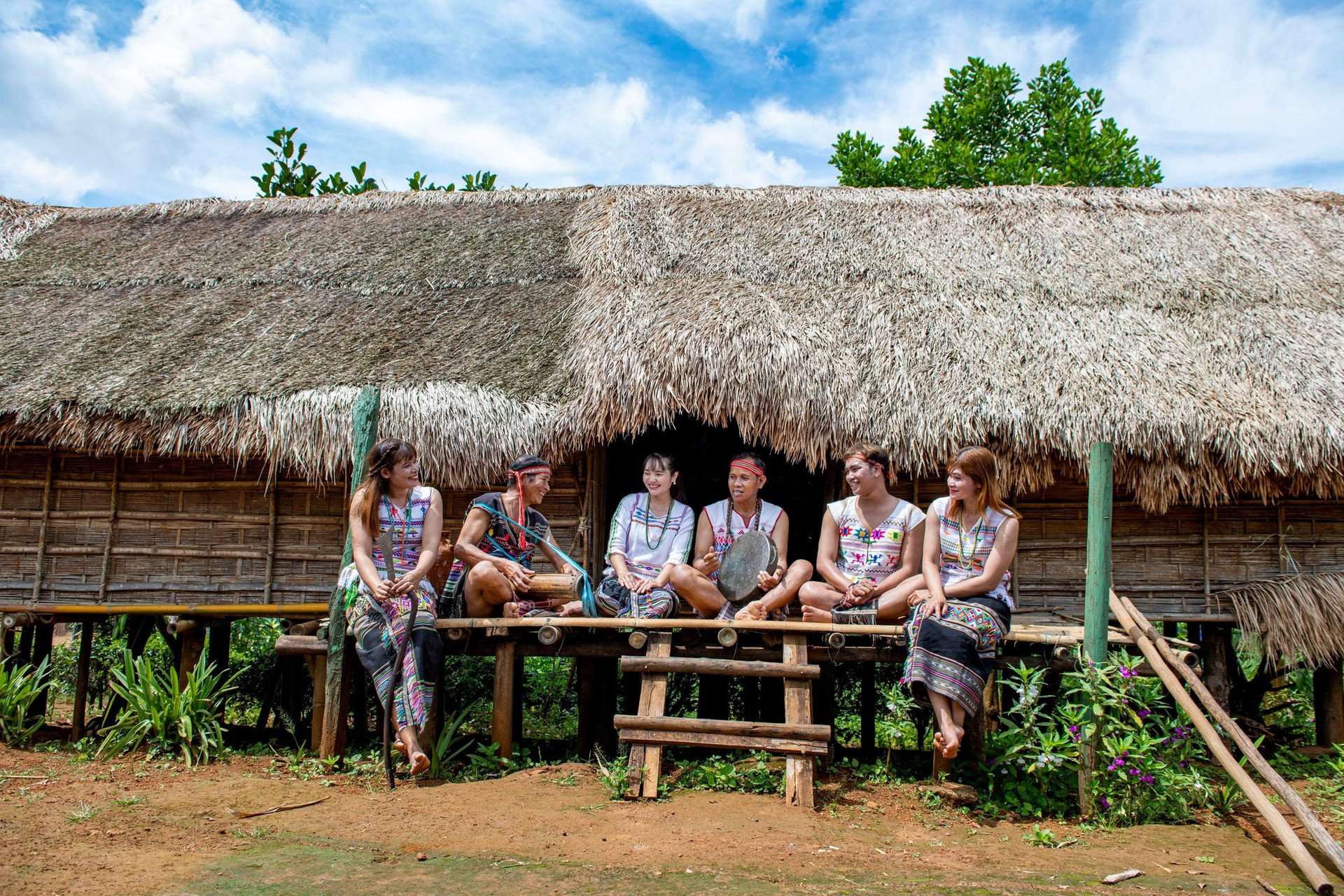
Once upon a time, there were only two men on this earth. One had a wife, and the other did not. The man with a wife had three children: two daughters and one son. No one in the family owned a single piece of metal. To weed the rice paddies, they had to use a buffalo rib. The ground was so hard that the rib broke, forcing the women to weed with their hands. Their hardship and poverty only worsened. They didn't even have a proper bowl to eat from; they had to eat from small containers woven from grass. They had to hollow out the base of a banana tree to hold water and wine. And they had no clothes to wear; they had to strip the bark from the Yar tree to cover themselves.
It's so hard, so incredibly poor!
One day the sisters were talking to each other:
– There's nothing to eat here; we'll starve to death.
The eldest sister, Ka Rum, said:
"Each person goes their own way, seeking sustenance and survival…" Ka Rút, the younger sister, continued.
"Wherever you go, wherever you stay, you must keep each other informed," the younger brother added.
How can we trust each other? Ka Rum asked.
"That's too difficult!" Ka Rut wondered.
The mountains and forests were silent. After a long while, the younger brother spoke:
– That's right! We mark the leaves, the buffalo hide… and let the wind and water… transmit the marks to each other…
– Yes, that's right! Everyone laughed, chatted happily, and left.
Ka Rút and her younger brother followed the stream into the forest. They traveled by day and slept by night. They dug up wild yams and other tubers, broke off rattan shoots, and burned cogon grass roots to make salt to sustain themselves. The dense forest, high mountains, and deep streams allowed the sisters to overcome their hardships. One afternoon, they encountered a fast-flowing stream at the headwaters, which they could not cross. Ka Rút and her brother had no choice but to stop and build a village, have children, clear land for farming, and raise buffalo, goats, pigs, and chickens.
The Ma village originated from that.
Shortly afterwards, remembering Ka Rum, Ka Rut told his younger brother to take a piece of buffalo hide and draw a message about the new village, about the forest land, about living conditions, and about the health of Ka Rut and his brother, who had settled down at the headwaters, where Mr. Yut and Mr. Lang Bian lived…
The streams of Da Lach, Da Me, Teh, Da Nga… carried the buffalo hides marked with messages from the Ka Rut sisters to their sister Ka Rum downstream. The hides hadn't traveled far before fish and crows, eager to eat them, pecked at them and carried them away. That's why, even today, the Ma people don't have their own written language.
As for the eldest sister, Ka Rum, she had to trudge along alone, on and on the flat road. But eventually, the road ended because she encountered the sea. Ka Rum had to stop and build a Vietnamese village.
Remembering their old promise, Ka Rum used a dried banana leaf to write the good news and asked the wind to carry it up to the forest to visit Ka Rut and her sisters. From then on, the Vietnamese people had their own writing system.
Although they are sisters, Viet is literate while Ma is not, due to reasons that occurred long ago.
And since ancient times, the Ma people have passed down a saying to their descendants:
“Choong, Bang Kon Jon; Toong, Tang Kon chau bal kon me rung”. This means: Choong and Bang are Kinh people, Toong and Tang are ethnic minorities, but they are all children of the same mother.
Source




![[Photo] General Secretary and President To Lam presides over a meeting on preparations for the review of one year of operation of the three-tiered government system.](https://vphoto.vietnam.vn/thumb/1200x675/vietnam/resource/IMAGE/2026/06/02/1780391821195_a1-bnd-4595-9717-jpg.webp)














































































Comment (0)