

Despite the 1986 international ban, large numbers of whales are still hunted for commercial purposes each year, including endangered species listed in the Red Book.
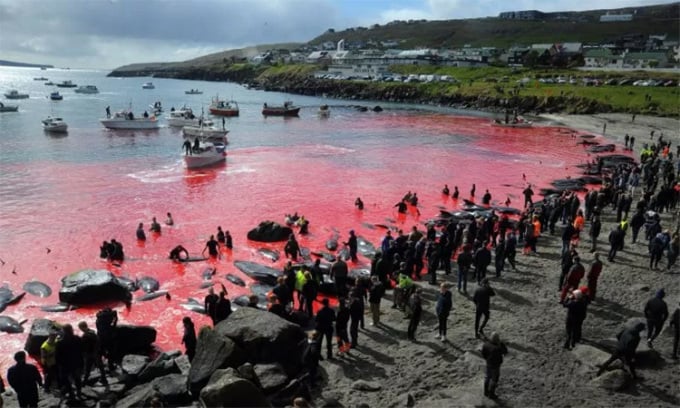
Many people gather on the beach during a whale and dolphin hunt in the Faroe Islands on May 29, 2019. Photo: Andrija Ilic/AFP
Last week, Svandís Svavarsdóttir, Iceland's Minister of Food, Agriculture and Fisheries, announced a temporary halt to whaling after a report from the Food and Veterinary Authority found that the whaling was not in compliance with the country's Animal Welfare Act. Iceland is one of the few countries that still actively hunts whales, along with Japan and Norway, despite an international ban imposed by the International Whaling Commission (IWC) in 1986, Newsweek reported on June 24.
Whaling is permitted in indigenous communities in Denmark (Faroe Islands and Greenland), Russia (Siberia), Saint Vincent and the Grenadines (Bequia Island), and the United States (Alaska). In some places, this activity is conducted under the guise of " scientific whaling".
According to IWC data, before the ban, humans killed approximately 6,000 to 7,000 whales annually. In 2021, 1,284 whales were killed worldwide , 881 of which were for commercial purposes. The remainder were hunted under "special permits," including for scientific research, and by indigenous communities. In 2020, the numbers for whaling and commercial killing were 1,204 and 810, respectively.
Many consider the methods used by whaling fishermen to be inhumane. For example, whalers sometimes hurl explosive harpoons at whales. According to a 2006 report on Norwegian whaling, this method doesn't always kill whales instantly and often requires multiple attempts to subdue the animal. Additionally, some whales drown because their heads are submerged while being towed onto whaling vessels. In Taiji, Japan, and the Faroe Islands, dolphins and juvenile whales are herded onto beaches or inlets, then slaughtered.
During the 1800s and 1900s, millions of whales were hunted for their oil, spermaceti (the waxy substance in the head of sperm whales), ambergris, and baleen plates (bone-like filters that whales use to filter food). An estimated 3 million whales were killed in the 20th century alone. The wax was used to make soap and candles, whale oil for fuel, and baleen plates for corsets.
Nowadays, whale hunters primarily hunt whales for their meat, oil, blubber, and cartilage. These are used in pharmaceuticals and health supplements, mainly in Japan, as some people believe whale products can prevent dementia.
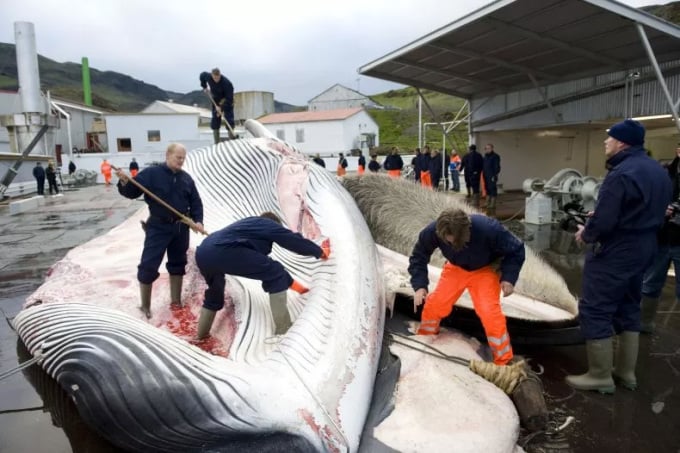
Whalers gut a fin whale in Iceland on June 19, 2009. Photo: Halldor Kolbeins/AFP
Japan, Norway, and Iceland have killed nearly 40,000 big whales since 1986, according to the Whale and Dolphin Conservation Society. Japan alone kills 300-600 whales annually, mostly Bryde's whales, minke whales, and sei whales. In Iceland, fin whales are hunted for export to Japan, while minke whales are hunted for their meat. Norway also primarily hunts beaked whales for their meat. In addition, hunters there target fin whales and sei whales for export to Japan.
Seiwhales are classified as endangered in the International Union for Conservation of Nature (IUCN) Red List, while fin whales are classified as near-threatened.
Thu Thao (According to Newsweek )
Source link
![[Photo] General Secretary and President To Lam presides over a meeting on preparations for the review of one year of operation of the three-tiered government system.](https://vphoto.vietnam.vn/thumb/1200x675/vietnam/resource/IMAGE/2026/06/02/1780391821195_a1-bnd-4595-9717-jpg.webp)









































































































Comment (0)