

Although considered a promising alternative to lithium-ion battery technology due to its potential for safety and lower material costs, undesirable reactions at the interface between solid-state magnesium battery components lead to reduced performance and shortened battery life.

The industry is working to make electric vehicle batteries safer and more durable.
PHOTO: REUTERS
A research team at Tohoku University (Japan) has found a way to transform chemical reactions that typically degrade battery performance into mechanisms that improve stability and ion transport. They discovered that these junction reactions don't necessarily need to be eliminated; instead, carefully controlling them can improve the mobility of magnesium ions within the battery while maintaining long-term stability.
The research team developed a magnesium-tin (Mg-Sn) alloy anode electrode to balance chemical reactivity and ion transport. By tuning the surface and internal structure of the anode, they created conditions that supported more uniform magnesium deposition and smoother ion movement during charging and discharging.
Professor Hao Li at the Institute for Advanced Materials Research at Tohoku University said: "For a long time, interface reactions were considered something to be avoided. But our research shows that when these reactions are carefully regulated rather than suppressed, they can help solid-state magnesium batteries operate much more efficiently."
Video shows testing of "battery firing" technology on electric cars in China.
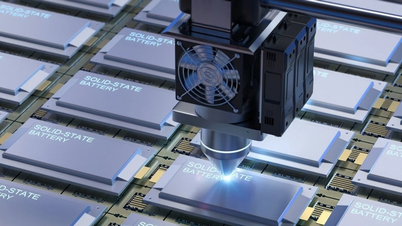
The key to advancing solid-state magnesium battery technology.
To fabricate the improved anode, the research team incorporated tin into magnesium, forming a stable compound Mg₂Sn , which helps regulate the reactions within the battery. The team tested various magnesium-based alloys with different subphases to determine the composition that yielded the best electrochemical performance, then evaluated the materials under battery operating conditions, measuring factors such as ion transport, interface stability, and cycle behavior.
The results showed that the optimized Mg-Sn alloy delivered the strongest overall performance, maintaining stable operation for over 1,300 hours during solid-state battery testing. This alloy also demonstrated a charge/discharge cycle performance 400 times longer than pure magnesium, proving significant improvements in battery lifespan.
Researchers suggest that future battery development should focus not only on improving ion conductivity but also on controlling the chemical reactions occurring at these interfaces. Their findings indicate that simultaneously balancing reactivity and ion transport could provide a novel design strategy for future solid-state battery systems.
Source: https://thanhnien.vn/cong-nghe-pin-moi-giup-xe-dien-an-toan-hon-185260527143149412.htm
![[Photo] Standing Committee member of the Party Central Committee Tran Cam Tu working with the Central Inspection Committee](https://vphoto.vietnam.vn/thumb/1200x675/vietnam/resource/IMAGE/2026/05/28/1779969579668_ndo_br_bnd-2495-jpg.webp)

















![[GALLERY] A "billion-dollar" game that hasn't even been released yet is already driving gamers crazy.](https://vphoto.vietnam.vn/thumb/402x226/vietnam/resource/IMAGE/2026/05/28/1779977371733_goi-3-png.webp)




















































































Comment (0)