

Berkshire Hathaway, owned by billionaire investor Warren Buffett, recorded a record $157 billion in cash reserves in the third quarter.
Berkshire Hathaway announced on November 4th that its third-quarter operating profit reached $10.8 billion, a 40% increase compared to the same period last year. The company's cash and cash equivalents also reached a record high of over $157 billion, up from $147.4 billion in the previous quarter.
The majority of Berkshire's cash is held in short-term investments in U.S. government bonds. In its report, the company said its interest income increased by $1.3 billion in the third quarter compared to the same period last year, mainly due to rising short-term interest rates.
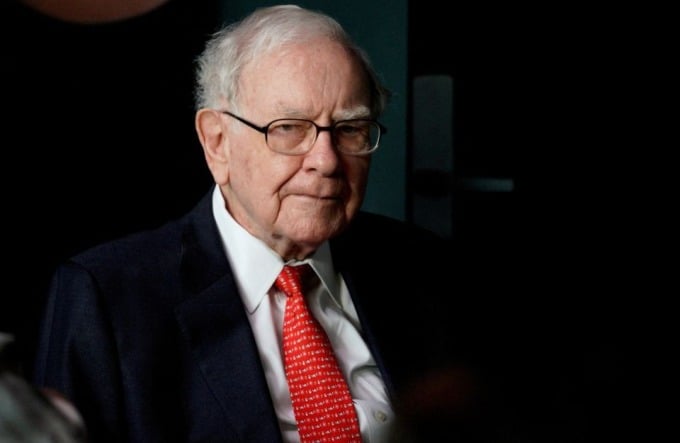
Warren Buffett at the Berkshire Hathaway shareholders' meeting. Photo: Reuters
Berkshire has been actively buying US government bonds this year, despite Fitch Ratings downgrading the US credit rating from AAA to AA+. On August 3rd, Warren Buffett, Chairman and CEO of Berkshire, told CNBC that they had bought $10 billion worth of US government bonds that week alone. "The only question for next Monday is whether we'll buy $10 billion in 3-month or 6-month bonds," he said.
The enormous amount of cash raises questions about whether Buffett will find an attractive business to acquire. Charlie Munger, Berkshire's vice chairman, said in a recent Wall Street Journal interview that the likelihood of Berkshire making a major M&A deal while both he and his boss are still in office is "at least 50%".
Nevertheless, Berkshire posted a net loss of $12.8 billion, significantly higher than the $2.8 billion loss in the same period last year. Losses from investments totaled $23.5 billion last quarter, up from $10.4 billion in the same period last year.
Buffett stated that operating profit more accurately reflects the company's business performance. This is because, according to accounting rules, Berkshire must recognize estimated gains/losses from its portfolio when reporting net profit. Therefore, a declining stock market puts pressure on overall business results, regardless of whether Berkshire's core segments are performing well.
The upward momentum of the US stock market stalled in the third quarter, as soaring government bond yields offered investors better opportunities for profit. The S&P 500 index fell 3.6% in the third quarter.
Apple's largest stock investments also lost value. Apple fell 12% in the third quarter. American Express lost 14%, Coca-Cola dropped 7%, and Bank of America declined 4.6%.
Conversely, Berkshire's insurance segment generated a profit of $2.4 billion. Last year, this segment lost $1.1 billion. Rising auto insurance premiums and a decrease in claims helped the segment become profitable.
Berkshire also bought back $1.1 billion worth of its own shares in the third quarter, bringing the total number of shares repurchased since the beginning of the year to $7 billion.
Ha Thu (according to WSJ)
Source link

![[Photo] Ba Lang An Lighthouse - the "eye of the sea" amidst the "rock museum" of Quang Ngai province.](https://vphoto.vietnam.vn/thumb/1200x675/vietnam/resource/IMAGE/2026/05/29/1780038698840_anh-man-hinh-2026-05-29-luc-14-10-42.png)

![[Image] Pleasant weather helps students enter the 10th grade entrance exam with confidence.](https://vphoto.vietnam.vn/thumb/1200x675/vietnam/resource/IMAGE/2026/05/29/1780034401612_ngay-1-thi-lop-10-minh-duy-8-5009-jpg.webp)































































































Comment (0)