

Kinhtedothi - Urban reconstruction is one of the important contents emphasized in the 2024 Law on the Capital City. Besides inheriting some old regulations, the Law adds many contents suitable to the specific characteristics of Hanoi , creating great momentum for the construction and development of the Capital City in the new situation.
To celebrate the Lunar New Year 2025 (Year of the Snake), Economy & Urban Affairs had a conversation with Professor Dr. Dang Hung Vo, former Deputy Minister of Natural Resources and Environment , regarding the 2024 Law on the Capital City. He believes that the 2024 Law on the Capital City has a groundbreaking vision, is practical, and is no longer vague or ambiguous, thus creating a legal basis for Hanoi to carry out urban reconstruction.

Realizing the vision, developing the Capital City.
Professor Dang Hung Vo, as an expert who has always paid special attention to Hanoi, how do you assess the 2024 Law on the Capital City?
- Hanoi is a special city with a historical tradition of over a thousand years of civilization, heroism, and creativity… its status has been defined since the 1946 Constitution and is clearly stated in the current Constitution (2013): "The capital of the Socialist Republic of Vietnam is Hanoi".
Throughout its development, Hanoi has always received attention, guidance, and a special legal framework from the Party, the National Assembly , and the State. In November 2012, the National Assembly passed and promulgated the Law on the Capital City (Law on the Capital City 2012). On June 28, 2024, at the 7th Session of the 15th National Assembly, the amended Law on the Capital City (Law on the Capital City 2024) was passed.
Objectively speaking, the fact that Hanoi has its own law demonstrates the great concern of the Party, the State, and the people of the whole country for the development of the capital city of Hanoi. Around the world, no more than 10 countries have separate laws for their capitals.
Therefore, the 2024 Capital City Law, once passed, serves as a guiding principle for Hanoi to make significant breakthroughs in the coming period. This is because formulating a law specifically for a locality is very difficult, while a national law already exists.
While planning itself is one thing, creating a legal framework for planning within the new law is crucial. I highly appreciate the 2024 Law on the Capital City. This law has specific content and objectives, establishes connections with the general legal system, and opens up a good mechanism for the development of the capital city.
In other words, the 2024 Capital City Law has realized the vision and aspirations for development that the people of Hanoi and the entire country have longed for, something that the 2012 Capital City Law failed to achieve.
As you just assessed, the 2024 Capital City Law serves as a guiding principle for Hanoi's strong breakthroughs. So, what is the basis for your confidence in this?
- There are four factors that the 2024 Capital City Law has achieved that give me confidence. The first and most important factor, which is the backbone of the law, is that it has legalized the mechanism for urban development based on the public transport system (TOD).
Specifically, Article 31 regulates urban development oriented towards public transport, including aspects such as planning urban rail systems and hub areas, investment in urban rail development, and mechanisms for collecting value-added fees from land in hub areas. This helps create a solid legal basis for urban rail projects.
Simply put, whatever you do, you must build a public transportation system. To do that, you must plan the urban transportation system. From this transportation system plan, you then plan the locations of traffic junctions, and then other plans based on the public transportation system and those junctions to develop around them, such as planning residential areas, commercial areas, tourist areas, public utility systems, entertainment areas, etc.
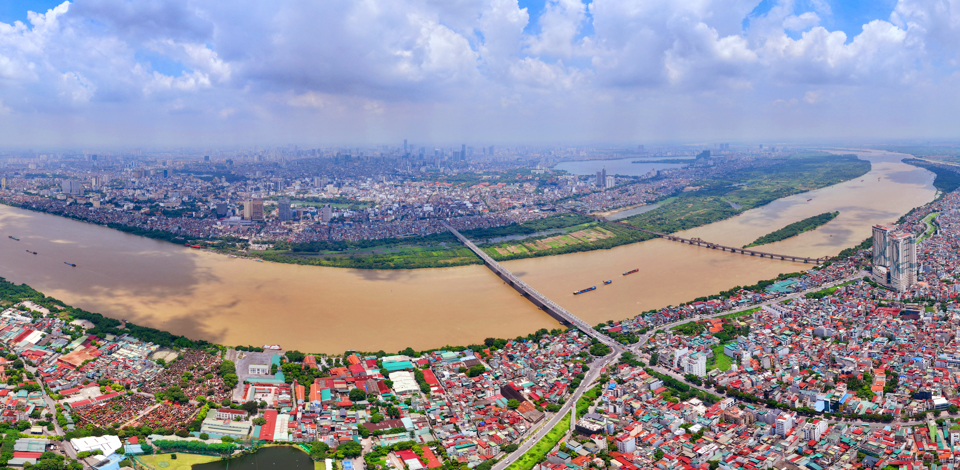
To develop the economy, developing transportation is a natural consequence. Previously, Hanoi's transportation development was haphazard, lacking the potential for geo-economic connectivity, resulting in a chaotic situation that failed to fully utilize the potential of the capital city as a megacity.
In fact, developed countries around the world have shown that TOD (Transit-Oriented Development) is not just a modern planning solution, but a key strategy to promote the development of modern, high-density urban areas that remain scenic cities. This policy not only helps optimize land use, but also reduces traffic congestion, decreases emissions, and improves the quality of public spaces.
TOD (Transit-Oriented Development) is also key to unlocking hidden economic potential, increasing land value, and facilitating the development of major economic centers. This policy will create favorable conditions for the development and revitalization of key areas within the city through enhanced planned land use and urban economic activities, while upgrading public infrastructure, especially building a "Smart City."
Four key points, but the issue of conflicting interests needs to be addressed.
Three more elements are still missing, sir?
- The second important element of the 2024 Capital City Law is raising awareness and responsibility for environmental protection. A highlight is that the Law proposes solutions to support organizations and individuals in transitioning from fossil fuel-based vehicles to clean energy vehicles; investing in the development of clean energy transportation infrastructure; including provisions to restrict the use of vehicles that emit pollutants; and designating low-emission zones (areas designated to restrict vehicles that cause environmental pollution).
The law emphasizes the responsibilities and specifies the powers of state agencies in protecting the environment; it clarifies regulations on waste management, air and water pollution, and the protection of urban ecosystems.
This aligns with the urgent needs in the context of Hanoi's rapid urbanization today. Another very important point is that the 2024 Capital City Law creates conditions for people to participate in environmental protection activities, raising community awareness and civic responsibility towards the living environment.
Encouraging the application of new technologies in environmental management and smart urban development helps minimize negative impacts on the environment. This is extremely important because environmental protection cannot be achieved solely by the government; effective results require the participation of the people.
Thirdly, the 2024 Capital City Law stipulates that urban construction and reconstruction must adhere to the principle of not affecting cultural values. Specifically, Article 20 clearly states: “Urban renovation and beautification in the city must conform to planning, architectural management regulations, and urban design; protect cultural, historical, natural, and architectural landscape heritage of the Capital City; ensure compliance with construction, fire prevention, and firefighting standards; enhance urban amenities and improve the living environment for residents in the renovated and beautified areas.”
This is precisely the unique aspect of the 2024 Capital City Law. Hanoi, with over 1000 years of civilization, boasts numerous historical and cultural relics of Thang Long and Dong Do. Urban reconstruction must preserve and maintain the cultural soul of Hanoi. This cultural soul is a crucial factor in retaining and attracting high-quality human resources. Now, consider this: if Hanoi no longer possessed its distinctive cultural identity, how many people would want to visit as tourists?
The fourth point I want to mention is that the 2024 Capital City Law has concretized the spirit of Resolution 18/NQ-TW, mobilizing resources from the people in the reconstruction area to participate in urban reconstruction through contributions of land, houses, and initiatives (proposing planning options, creating land for urban reconstruction in each area). This shows that the 2024 Capital City Law is realizing President Ho Chi Minh's great idea: all development is the work of the people; the people are the foundation; the people are the driving force for development.
With the four key points of the 2024 Capital City Law that you highlighted, and arguing that these are the essential foundations for the capital city's breakthrough, what do you think needs to be done to ensure these key points of the Law are effectively implemented?
- In reality, all conflicts stem from issues of self-interest. Therefore, for the law to be effectively implemented, I believe that those enforcing the law must control their greed, anger, and delusion; they must prioritize the common good over personal interests.
There must be a common good before there can be individual interests. Because if only individual interests are pursued, then even if the law and planning are sound, people will still distort and manipulate them according to their own self-interest, and ultimately, the results will be meaningless.
However, I am confident because of the "aspiration for progress" set forth by General Secretary To Lam, and I hope there will be no "pieces of cheese" for those opportunists who profit from policies that hinder the development of the capital city.
Thank you very much, sir!
The 2024 Capital City Law comprises 7 chapters with 54 articles (compared to the 2012 Capital City Law, which has 3 more chapters and double the number of articles). The 2024 Capital City Law features many innovative points and a groundbreaking vision, creating a legal basis for Hanoi to implement superior, unique mechanisms and policies, mobilize all resources, and effectively exploit the potential and strengths of the capital city. The law takes effect from January 1, 2025, except for 5 provisions which take effect from July 1, 2025.
Source: https://kinhtedothi.vn/luat-thu-do-sua-doi-2024-cu-hich-lon-cho-tai-thiet-do-thiha-noi.html





![[Photo] Standing Committee member of the Party Central Committee Tran Cam Tu working with the Central Inspection Committee](https://vphoto.vietnam.vn/thumb/1200x675/vietnam/resource/IMAGE/2026/05/28/1779969579668_ndo_br_bnd-2495-jpg.webp)





































































































Comment (0)