

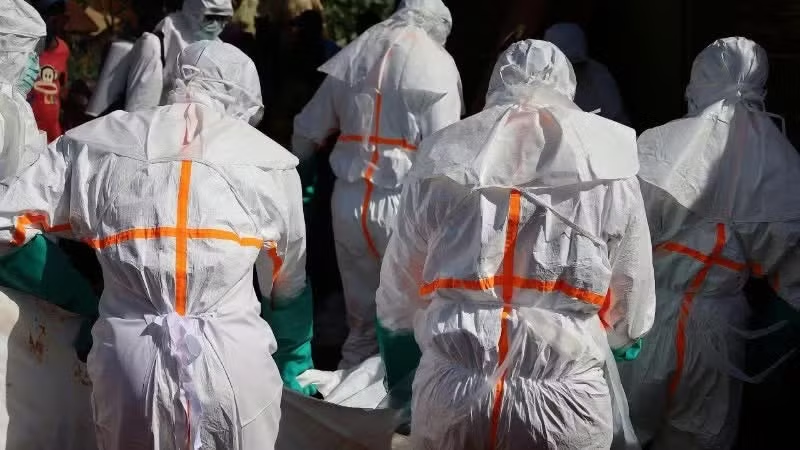
The number of infections is rising rapidly, reaching over 1,000, and the death toll has exceeded 200. Countries outside the region, such as the US, Canada, and Europe, are scrambling to find ways to prevent the disease from spreading.
The Ebola outbreak is believed to be beyond control, and healthcare systems in the affected areas are under immense pressure due to the escalating number of infections. Worryingly, the strain of Ebola currently detected in Congo and Uganda has no vaccine or specific treatment. The scale of the outbreak could be much larger, as experts believe the virus may have been circulating in the community for some time before detection.
The current outbreak involves the Bundibugyo virus strain – a rare variant for which there is currently no vaccine or specific treatment – raising concerns in the international community. Health experts warn that controlling this outbreak will be more difficult than previous ones.
International scientists are racing against time to develop a vaccine against the Bundibugyo strain because no vaccine is currently available to protect against this virus.
International scientists are racing against time to develop a vaccine against the Bundibugyo strain, as no vaccine is currently available to protect against this virus. Researchers are now faced with two difficult choices.
Firstly, efforts are being made to adapt existing vaccine technologies to combat the Bundibugyo strain. This is considered a faster solution because it can leverage existing scientific and technological infrastructure for production.
Secondly, several other research groups are seeking to replace the surface protein of the old Ebola vaccine with Bundibugyo-specific glycoprotein to activate the immune system against the new virus. However, experts acknowledge that there is still a long way to go from the laboratory to practical implementation.
Meanwhile, time is of the essence. Even in the most favorable scenario, it is difficult to have a vaccine licensed for widespread use in less than a year. This means that traditional measures such as isolating cases, contact tracing, and raising public awareness remain the primary line of defense at this stage.
Given the complex developments of this latest outbreak of the rare Bundibugyo strain of the Ebola virus, the African Union (AU), the East African Community (EAC), and many governments have issued urgent warnings.
With the WHO declaring this outbreak a Public Health Emergency of International Concern (PHEIC) and international aid being drastically cut, African health systems are facing immense pressure.
Limited technological and financial resources have hampered the fight against the epidemic. While African countries are calling for concentrated efforts to combat the disease and urging increased self-reliance in epidemic prevention capabilities across the continent, the WHO and international partners are also working to control the outbreak. The international community has pledged nearly $500 million in emergency support to strengthen response capabilities and prevent the spread of Ebola.
The race to contain and control the Bundibugyo strain of Ebola is not only a scientific challenge, but also a test of the world's preparedness for future pandemics.
After Covid-19, many hoped humanity had entered an era of rapid response to new viruses. However, what is happening in the Democratic Republic of Congo shows that when a little-noticed pathogen emerges, gaps in vaccines and research can still leave the world unprepared.
This Ebola outbreak also highlights a familiar reality in global medicine: diseases that primarily appear in poorer countries often don't receive adequate research investment until a crisis occurs.
The Bundibugyo strain was once considered relatively rare and not a top priority for pharmaceutical companies. It seems the world is essentially starting from scratch in the fight against Ebola.
Source: https://nhandan.vn/cuoc-chien-chong-ebola-post965537.html

![[Video] Sunset at Lap An Lagoon – Where the sun sets over the fishing nets](https://vphoto.vietnam.vn/thumb/1200x675/vietnam/resource/IMAGE/2026/05/31/1780192137701_beach-landscape-sea-water-nature-grass-745871-pxhere-com.jpeg)










![[Video] Sunset at Lap An Lagoon – Where the sun sets over the fishing nets](https://vphoto.vietnam.vn/thumb/800x450/vietnam/resource/IMAGE/2026/05/31/1780192137701_beach-landscape-sea-water-nature-grass-745871-pxhere-com.jpeg)






![[Infographic] Key points from the opening remarks of General Secretary and President To Lam at the Shangri-La Dialogue](https://vphoto.vietnam.vn/thumb/402x226/vietnam/resource/IMAGE/2026/05/31/1780196272740_anh-man-hinh-2026-05-31-luc-09-55-34.png)





































![[Video] Sunset at Lap An Lagoon – Where the sun sets over the fishing nets](https://vphoto.vietnam.vn/thumb/402x226/vietnam/resource/IMAGE/2026/05/31/1780192137701_beach-landscape-sea-water-nature-grass-745871-pxhere-com.jpeg)






























Comment (0)