


Behind that seemingly impossible dream lies not just a football story, but also a journey of searching for identity, roots, and pride for a small community amidst the currents of globalization.
The Cinderella of all Cinderella stories.
Behind that World Cup dream is not simply about the matches or the results on the field.
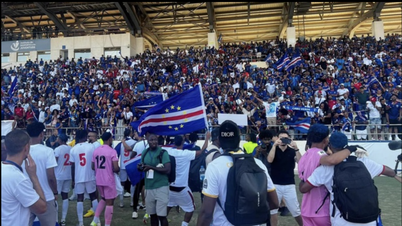
On the day Curaçao moved closer to the World Cup with a courageous 0-0 draw against Jamaica, frenzied celebrations erupted across the Caribbean island nation. The heroes of Curaçao football returned home to a warm welcome from their people.
The team was expected to land in the late afternoon, but from midday onwards, large crowds of people had already lined the streets to welcome them. Curaçao Football Federation President Gilbert Martina recalled that moment with "tears of happiness".
"Like a Cinderella story," he said. But Curaçao is perhaps even the Cinderella of Cinderella stories.
For decades, the World Cup for the people of Curaçao was a story of Brazil, Argentina, or the Netherlands. Each World Cup, the yellow and green flags of Brazil or the orange flags of the Netherlands would appear in front of houses on the island. At that time, Curaçao had no place on the world football map.
That's not surprising for a country where baseball is the number one sport . Per capita, Curaçao is considered to produce more players for Major League Baseball than any other country.
For many years, the island's greatest sporting icon wasn't football star Patrick Kluivert, but baseball legend Andruw Jones.
Curaçao football was once so small that the federation struggled to cover travel costs for international matches. The national league also faced numerous crises, at one point being suspended for two and a half years.
But it is precisely in this context that football has become a unifying force for the Curaçao community around the world.
Most of the current Curaçao players were born and raised in the Netherlands, possessing a dual cultural identity. They grew up within the European football training system, but still maintain deep connections to their parents' and grandparents' Caribbean homeland.
"You have to have a heart for this island," said veteran goalkeeper Eloy Room when talking about convincing players of Curaçao origin to represent the national team.

No one was forced. There were no promises of money or fame. What kept them together was a sense of belonging.
Curaçao Football Federation President Gilbert Martina recounts that every Christmas and summer, many players return to the island to celebrate with their families. These return trips, he says, speak volumes more than any slogan about love of homeland.
Most of the players in the decisive match against Jamaica were born in the Netherlands. But in that historic moment, they chose to represent Curaçao.
It's no longer simply about football; it's a story of memories, roots, and cultural identity.
A small "family" steps onto the world's biggest stage.
If the World Cup is often seen as a stage for footballing power and superpowers, then Curaçao has emerged as an emotional exception.
They didn't have a strong league. They didn't possess top European stars. Some players were even unemployed before qualifying for the World Cup. Goalkeeper Eloy Room and striker Jurgen Locadia later found their places at Miami FC.
But that small team formed a special collective. The players called each other "family." They prayed together before every training session and match, not in a religious sense, but simply so that "everyone could look in the same direction," according to the President of the Curaçao Football Federation, Gilbert Martina.
That bond became even stronger during the most difficult times. Before the crucial match against Jamaica, coach Dick Advocaat was forced to return to the Netherlands to be with his seriously ill daughter.
At 78 years old, the Dutch strategist also became the oldest coach in World Cup history. The players went into the match with the mindset of "fighting for him".
Luck was also on Curaçao's side as Jamaica hit the post three times and were awarded a penalty in injury time before VAR overturned the referee's decision. But sometimes, football rewards teams that fight as a true collective.
What's remarkable is that Curaçao's journey wasn't built on unrealistic dreams. They understood their position very well. Data company Opta even assessed Curaçao's chances of winning the World Cup as almost zero.

However, what the people of this small island were probably always searching for was more than just the gold trophy.
After years of standing on the sidelines and cheering for other nations' flags, Curaçao now has its own national team at the World Cup.
It was a moment when a small nation saw itself on the world football map; a moment when football became the language to tell the story of national pride and cultural connection.
From streets once covered in the colors of Brazil or the Netherlands, the people of Curaçao can now finally cheer for their own national team.
Source: https://baovanhoa.vn/the-thao/curacao-tu-hon-dao-treo-co-brazil-den-giac-mo-world-cup-232780.html

![[Image] Nearly 125,000 Hanoi students completed the Literature exam for the 10th grade entrance exam.](https://vphoto.vietnam.vn/thumb/1200x675/vietnam/resource/IMAGE/2026/05/30/1780117233041_ndo_br_thiet-ke-chua-co-ten-2-png.webp)










































































Comment (0)