

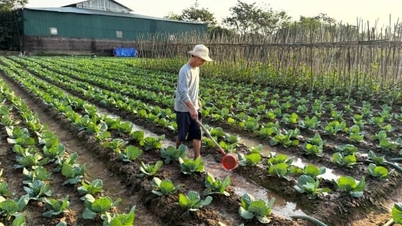
After many years of monoculture of one crop on an area of 5 hectares, Mrs. Nguyen Thi Thanh's family (Hoa Le commune) switched to a mixed agricultural model: Growing durian and early-ripening lychee; cultivating nearly 1 hectare of rice to increase income; growing mulberry to raise silkworms. Currently, this mixed agricultural model brings Mrs. Thanh's family a profit of more than 1.2 billion VND/year.
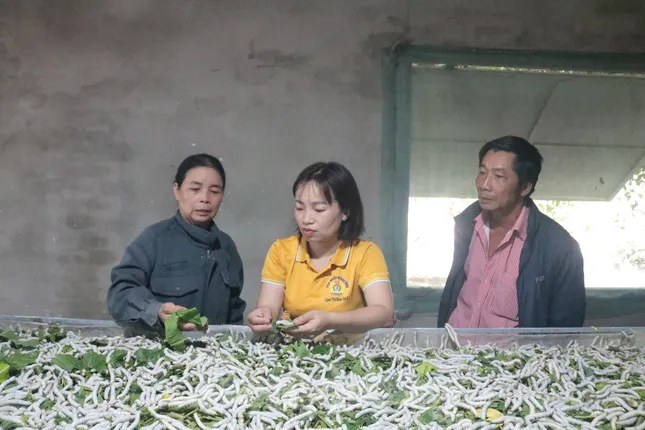 |
The silkworm breeding house of Mrs. Thanh's family. |
According to Ms. Thanh, at first she only tried raising 1-2 boxes of silkworms per batch. Realizing that growing mulberry and raising silkworms brought high profits, Ms. Thanh continued to invest in expanding the scale of farming. Up to now, Ms. Thanh's family's mulberry growing area is 3.5 hectares and has a 280m2 silkworm house. Not only developing the family economy , Ms. Thanh also lent capital to 5 poor households in the village, supported seeds and techniques to grow mulberry and raise silkworms. Creating regular jobs for 7-9 local workers.
In Krông Bông district, there are many successful agricultural production and business models that yield high economic returns. A prime example is the two-crop ST rice cultivation model of Ms. Phạm Thị Hà's family (Hòa Lễ commune), which generates nearly 500 million VND per year. Ms. Hà actively applies scientific advancements and machinery to rice cultivation, such as drone spraying, sowing, plowing, and harvesting. Another example is the pineapple and durian cultivation model of Mr. Trần Duy Tư's household (Cư Drăm commune), which generates over 900 million VND per year. Mr. Y Đê Kuan's household (Ea Trul commune) earns over 300 million VND per year from a crop farming model (coffee, rice, peanuts) combined with confined cattle farming.
 |
Many production models implemented by farmers in Krông Bông district have yielded high economic returns. |
Recently, many young people in Krong Bong district have boldly converted crops and livestock to develop the economy.
On 3 hectares of upland crops such as corn and cassava of Mr. Y Hai Nie's family (born in 1992, Yang Mao) were only enough to cover the family's expenses. After completing his military service, Mr. Y Hai boldly borrowed money to convert to a multi-crop, multi-animal model. He replaced the ineffective crop area with coffee growing. He converted the land near the stream to grow wet rice, planted eucalyptus, hybrid acacia, green elephant grass, purple elephant grass, and used dry straw to raise crossbred cows... He worked hard to visit and learn many effective economic models of people in the districts.
This economic model brings his family an income of more than 200 million VND/year. Thanks to that, his family has escaped poverty, built a new, spacious house, and bought machinery for production.
Mr. Le Van Thuat, Chairman of the Krong Bong District Farmers' Association, said that in recent times, farmers' associations at all levels in the district have implemented many activities to support members and farmers in developing their economy, such as: training in transferring scientific and technical knowledge in crop cultivation and livestock farming; visiting and learning from effective economic models inside and outside the province; helping access loan sources to invest in production and business...
In addition, support and guidance have been provided for the construction and development of linkage and cooperation models along the value chain, and agricultural production models that leverage the potential and advantages of the locality to improve economic efficiency. During the period 2017-2024, Krông Bông district has developed and replicated 73 exemplary economic models.
Source: https://tienphong.vn/da-cay-da-con-giup-ba-con-vung-sau-phat-trien-kinh-te-post1751893.tpo
![[Photo] Prime Minister Pham Minh Chinh holds a phone call with the CEO of Russia's Rosatom Corporation.](/_next/image?url=https%3A%2F%2Fvphoto.vietnam.vn%2Fthumb%2F1200x675%2Fvietnam%2Fresource%2FIMAGE%2F2025%2F12%2F11%2F1765464552365_dsc-5295-jpg.webp&w=3840&q=75)

![[Photo] Closing Ceremony of the 10th Session of the 15th National Assembly](/_next/image?url=https%3A%2F%2Fvphoto.vietnam.vn%2Fthumb%2F1200x675%2Fvietnam%2Fresource%2FIMAGE%2F2025%2F12%2F11%2F1765448959967_image-1437-jpg.webp&w=3840&q=75)






































![[OFFICIAL] MISA GROUP ANNOUNCES ITS PIONEERING BRAND POSITIONING IN BUILDING AGENTIC AI FOR BUSINESSES, HOUSEHOLDS, AND THE GOVERNMENT](https://vphoto.vietnam.vn/thumb/402x226/vietnam/resource/IMAGE/2025/12/11/1765444754256_agentic-ai_postfb-scaled.png)







































Comment (0)