

According to SCMP , a group of zebrafish spent 43 days living on China's Tiangong space station, nearly three times the previous record set by a similar experiment on the International Space Station (ISS).
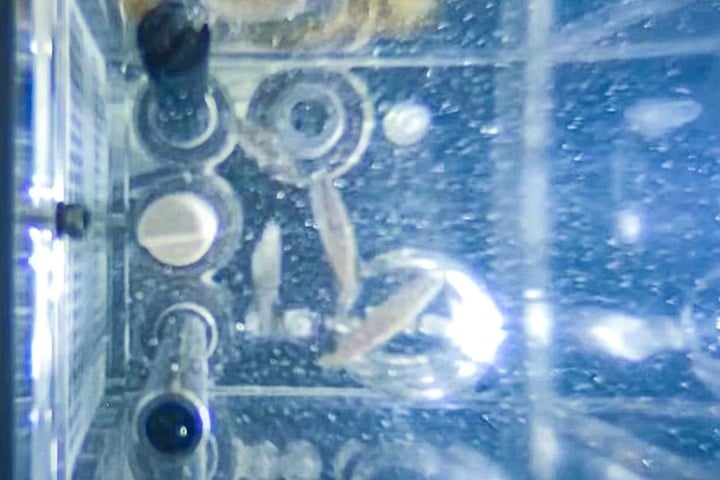
Zebrafish swim inside a closed underwater ecosystem at China's Tiangong space station. (Photo: CCTV)
A group of four zebrafish, along with a colony of hornworts, were launched into orbit aboard the Shenzhou-18 spacecraft on April 25th as part of a project to create a self-sustaining ecosystem to study the effects of microgravity and radiation on the species' development and growth.
According to an article published in The Innovation , zebrafish go through their natural developmental stages – from growth and development to reproduction – in 43 days, setting a record for ecological experiments in space.
“This milestone not only marks progress in China’s space ecosystem technology but also provides valuable data and technical support for closed ecosystems in space missions,” the authors said.
This achievement was made possible thanks to the innovative Closed-Water Ecosystem (CAES) on the Tiangong station, which includes a biological regeneration life support system, a gas balance control system, and a microbial treatment system.
Intelligent and automated control systems within the closed ecosystem, such as installed sensors, monitor water quality parameters like pH and conductivity to ensure a safe and sustainable underwater living environment. CAES also incorporates a fluid pump to enhance the exchange of substances between the fish and plant chambers.
Developing advanced life support systems is a necessary step for future space exploration . “This advance will undoubtedly pave the way for humans to live and function in space for extended periods, bringing the vision of long-term life and survival in space closer to reality,” the researchers concluded.
The survival time of the Chinese zebrafish group surpassed the previous record held by a team of German scientists , who kept a swordtail fish alive in a closed, balanced aquatic system during the STS-90 Neurolab mission on NASA's Space Shuttle Columbia in 1998 – a cutting-edge project to study the effects of space flight on the nervous system.
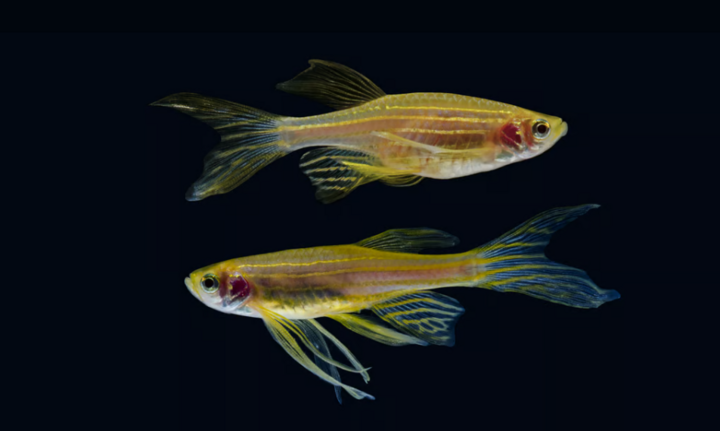
Zebrafish have many unique characteristics and their genome is over 70% similar to that of humans. (Photo: Shutterstock)
Zebrafish are widely studied in life sciences and biomedical science because of their unique advantages, including having a genome that is over 70% similar to that of humans. Their short reproductive and developmental cycles, along with their transparent eggs, also allow scientists to study internal characteristics as they grow.
As scientists delved deeper into the various effects of microgravity on the human body—from bones to the heart and brain—researchers found zebrafish to be an ideal biological model for such experiments.
Space studies of zebrafish began in the 1970s, when they were first launched into space on Russia's Salyut 5 space station mission.
Several other fish species are also being studied in space. Japanese scientists have been studying how reduced gravity affects tissue structure and bone remodeling by observing genetically modified squirrel fish in space. Their results, published in the scientific journal Scientific Reports in 2015, showed that the mineral density of the squirrel fish's pharyngeal bones and teeth decreased after 56 days on the ISS.
Although zebrafish on the Tiangong space station can survive for a long time, they exhibit unusual orientation behaviors in microgravity conditions, such as swimming upside down, spinning, and swimming in circles, according to the Shenzhou-18 crew.
On November 4th, astronauts Ye Guangfu, Li Cong, and Li Guangsu returned to Earth after 192 days in orbit, along with dozens of scientific experiment samples, including microorganisms, alloy materials, and nanomaterials that are difficult to manufacture on Earth.
They also returned water samples containing fish eggs and other specimens, along with video recordings of the zebrafish's spatial behavior.
According to Xinhua News Agency , scientists hope to use the material samples to learn more about the impact of the space environment on the growth, development, and behavior of vertebrates, and to support research on material cycles in enclosed space ecosystems.
Source
![[Image] Pleasant weather helps students enter the 10th grade entrance exam with confidence.](https://vphoto.vietnam.vn/thumb/1200x675/vietnam/resource/IMAGE/2026/05/29/1780034401612_ngay-1-thi-lop-10-minh-duy-8-5009-jpg.webp)
![[Photo] Ba Lang An Lighthouse - the "eye of the sea" amidst the "rock museum" of Quang Ngai province.](https://vphoto.vietnam.vn/thumb/1200x675/vietnam/resource/IMAGE/2026/05/29/1780038698840_anh-man-hinh-2026-05-29-luc-14-10-42.png)





























































































Comment (0)