

At the invitation of Klaus Schwab, Founder and Chairman of the World Economic Forum (WEF), Hungarian Prime Minister Viktor Orbán, and Romanian Prime Minister Ion-Marcel Ciolacu, Prime Minister of the Socialist Republic of Vietnam Pham Minh Chinh and his wife, along with a high-level Vietnamese delegation, departed to attend the 54th Annual Meeting of the WEF in Davos, Switzerland, and to pay official visits to Hungary and Romania.

Prime Minister Pham Minh Chinh, Founder and Chairman of the World Economic Forum (WEF) Klaus Schwab, Hungarian Prime Minister Viktor Orbán and Romanian Prime Minister Ion-Marcel Ciolacu (from left to right).
This year's WEF Davos conference is the largest since the Covid-19 pandemic, with over 2,600 delegates attending, including leaders from nearly 70 countries and international organizations, marking an even higher attendance rate than before the Covid-19 pandemic. Prime Minister Pham Minh Chinh's attendance at the WEF Davos 2024 conference is an important opportunity to showcase Vietnam's dynamic and positive development achievements to the international community.
Prime Minister Pham Minh Chinh's official visit to Hungary marks the first exchange of delegations at the Prime Minister level between the two countries in seven years, and is of significant importance in further deepening the Vietnam-Hungary Comprehensive Partnership.
For Romania, this visit by Prime Minister Pham Minh Chinh marks the first exchange of delegations at the Prime Minister level between the two countries in the past five years, helping to create momentum for promoting bilateral cooperation in areas where Romania has strengths and which are in line with Vietnam's development needs.

Promoting cooperation in a fragmented world.
The World Economic Forum (WEF), a non-profit organization operating on a public-private partnership model, was founded in 1971 by Professor Klaus Schwab and is headquartered in Geneva, Switzerland. The WEF currently has approximately 700 partners, including leaders of leading global corporations across various sectors. The WEF was also one of the first forums to discuss the Fourth Industrial Revolution and is currently implementing several specific initiatives related to this issue.
The most important event of the WEF is its annual meeting, held every January in Davos, Switzerland. In addition, there are regional forums such as the WEF Tianjin (or Dalian, China) Conference, the WEF ASEAN Conference, etc. WEF events attract leading political, business, cultural, social, and academic leaders from around the world to shape agendas at the regional and global levels.

The 54th annual WEF Davos conference, themed “Rebuilding Trust,” will be held from January 15-19, 2024, in Davos, Switzerland. The conference will focus on discussing and proposing solutions to four key areas: (i) Promoting security and mutually beneficial cooperation in a fragmented world; (ii) Developing economic policies suitable for the new era; (iii) Long-term strategies for climate, nature, and energy; and (iv) Artificial intelligence as a driver of economic and social development.
The relationship between Vietnam and the WEF is developing well.
Since Vietnam and the World Economic Forum (WEF) established relations in 1989, cooperation between the two countries has been actively promoted and developed in many areas by leaders from both sides. Vietnam has attended the WEF Davos Annual Meeting four times at the Prime Minister level and the WEF ASEAN Meeting four times at the Prime Minister level.
Leaders from both sides also intensified high-level contacts and exchanges, particularly between Prime Minister Pham Minh Chinh and WEF Founder and Executive Chairman Klaus Schwab at the WEF Tianjin Conference (June 2023), the 41st ASEAN Summit (November 2022), and the 43rd ASEAN Summit (September 2023).

On the occasion of attending the 43rd ASEAN Summit and related meetings in Indonesia, on the afternoon of September 5, 2023, Prime Minister Pham Minh Chinh met with WEF Founder and Chairman Klaus Schwab. (Photo: VNA)
Vietnam and the World Economic Forum (WEF) have jointly organized many important conferences. The first Vietnam-WEF Strategic Dialogue (CSD) (held in October 2021) was held in a hybrid format, combining in-person and online participation, with the theme “Strengthening Public-Private Partnerships: Key Drivers of Comprehensive Recovery and Sustainable, Inclusive, and Innovative Development” . This dialogue was considered the most successful strategic dialogue that the WEF has organized in collaboration with a country, in terms of participation levels, content, timing, and organization. At the WEF Tianjin Conference 2023, Prime Minister Pham Minh Chinh co-chaired the second Strategic Dialogue (held in June 2023) with the theme “Promoting New Growth Drivers to Build the Future of the Nation”.
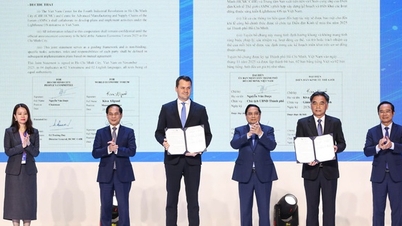
On June 26, 2023, at the WEF Tianjin Conference, Vietnam and the WEF signed a Memorandum of Understanding on Vietnam-WEF cooperation for the period 2023-2026, witnessed by Prime Minister Pham Minh Chinh and Professor Klaus Schwab. This serves as an important foundation for promoting bilateral cooperation in the new phase.
Vietnam's active cooperation, participation in conferences, and successful organization of several WEF events have contributed to boosting investment attraction, promoting the country's image, and strengthening relations with global corporations.

Prime Minister Pham Minh Chinh and WEF Founder and Chairman Klaus Schwab witnessed the signing of the Vietnam-WEF Memorandum of Understanding for the period 2023-2026. (Photo: VNA)


As a member of numerous regional and international organizations, Hungary's foreign policy prioritizes comprehensive integration and engagement with the EU; at the same time, it strongly pursues an Eastward-looking policy, promoting relations with Asia, especially with China, South Korea, Japan, and Vietnam.
Vietnam and Hungary established diplomatic relations on February 3, 1950. Hungary has shown Vietnam great affection, support, and valuable assistance in the past struggle for national liberation and reunification, as well as in the current process of national construction and development. The upgrading of relations to a Comprehensive Partnership during General Secretary Nguyen Phu Trong's visit to Hungary in 2018 demonstrates the determination of the leaders of both countries to promote bilateral relations.
Regarding economic and trade cooperation, the Vietnam-Hungary Joint Committee on Economic Cooperation has played a significant role in promoting bilateral cooperation. The Committee's first meeting took place in Budapest (December 2005). In Southeast Asia, Vietnam is the only country exporting to Hungary in large quantities, reaching nearly US$1 billion in 2020. This demonstrates the Hungarian market's great potential and numerous development opportunities. Our main export items include textiles, footwear, computers, electronic products and components, transportation vehicles and parts, etc.

On December 1, 2023, while attending the COP28 summit in the UAE, Prime Minister Pham Minh Chinh met with Hungarian President Katalin Novak. (Photo: VGP)
Calculate To date, Hungary has 15 active FDI projects in Vietnam with a total registered capital of US$50.66 million, ranking 55th among all countries and territories with direct investment in Vietnam.
Regarding investment, among the 15 Hungarian projects, 3 are in the manufacturing sector with a total investment of $41.82 million. Second is the media sector with 3 projects and a total investment of $5.87 million. The real estate business sector ranks third with 1 project and a total investment of $2 million. The remaining projects are in other sectors.
Regarding development cooperation, since 2003, Hungary has included Vietnam on its list of priority recipients of Official Development Assistance (ODA). Hungary is the largest provider of ODA to Vietnam in the Central and Eastern European region. In 2009, Hungary committed 60 million euros in concessional credit for the construction of the Can Tho City Oncology Hospital, with a capacity of 500 beds. By January 2016, the two sides had signed a Financial Cooperation Agreement worth 60 million euros for the construction of the Can Tho City Oncology Hospital. In January 2017, the two sides signed a Framework Agreement on Credit Cooperation worth 440 million euros between the Government of Vietnam and the Government of Hungary.
During the peak of the Covid-19 pandemic, Hungary was one of the first countries to support Vietnam with over 200,000 doses of vaccine and various medical equipment, and also ceded over 400,000 doses of vaccine, contributing to Vietnam's early recovery from the pandemic.

On the afternoon of November 15, 2023, in Hanoi, Prime Minister Pham Minh Chinh received Hungarian Minister of Justice Tuzson Bence, who was visiting and working in Vietnam. (Photo: Nhan Dan Newspaper)
Education and training is a traditional area of cooperation between Vietnam and Hungary. In the past, Hungary helped Vietnam train thousands of experts and engineers. Currently, Hungary is the EU country that provides the most scholarships to Vietnam.
The Vietnamese community in Hungary currently numbers around 6,000 people, mainly concentrated in Budapest. They enjoy relatively stable lives and have a positive image in the country. The community remains united and oriented towards their homeland.
Against the backdrop of flourishing bilateral relations, the official visit of Prime Minister Pham Minh Chinh and his wife to Hungary is of significant importance in further deepening the Vietnam-Hungary Comprehensive Partnership, especially in the areas of economics, education and training, and pharmaceutical technology. Furthermore, with Hungary assuming the rotating presidency of the EU Council for the last six months of 2024, the visit provides an opportunity for Vietnam to strengthen coordination with the EU on regional and global issues, particularly in promoting the ratification of the Vietnam-EU Investment Protection Agreement (EVIPA).

In its foreign policy, Romania prioritizes enhancing its position and role within the EU and NATO, strengthening its strategic alliance with the US, and promoting relations with the Asia-Pacific region, with Vietnam being one of the top priorities.
Vietnam and Romania have a long-standing tradition of good relations and cooperation with a history spanning over 70 years. Vietnam established diplomatic relations with Romania on February 3, 1950.
The two countries regularly exchange delegations at all levels, including high-level ones. Romanian leaders have consistently affirmed that Vietnam is a leading partner in Southeast Asia. During its six-month rotating presidency of the EU Council in 2019, Romania actively supported and promoted the signing of the Vietnam-EU Free Trade Agreement (EVFTA) and was one of the first three EU member states to ratify the EVFTA.

Prime Minister Pham Minh Chinh meets with Romanian President Klaus Iohannis at the United Nations Headquarters in New York, September 2023. (Photo: VNA)
Economic and trade relations between Vietnam and Romania have developed well. Since 1990, the two sides have signed many documents creating a legal framework for cooperation in the new phase. Vietnam's main export items include coffee, seafood, pepper, textiles, leather shoes, and computer components. Since 2010, Romania has been ranked among Vietnam's major seafood export markets (approximately 12,000 tons/year).
Regarding investment, as of the end of 2022, Romania had 5 active direct investment projects in Vietnam with a total registered investment capital of US$1.56 million, ranking 42nd among countries and territories investing in Vietnam.
Regarding education and training, Romania restarted providing scholarships to Vietnamese students in 1992. In 1995, the two countries signed an Agreement on cooperation in the fields of culture, science, education, and sports, under which Romania annually grants Vietnam 20 undergraduate and postgraduate scholarships. Currently, the two sides have signed a new Education Program for the period 2023-2027.
In the labor sector, there are currently about 4,000 Vietnamese workers in Romania employed in construction, shipbuilding, garment manufacturing, food processing, and other fields. The number of Vietnamese workers in Romania is expected to continue increasing in the future due to Romania's labor needs. In December 2018, Vietnam and Romania signed an MOU on labor cooperation.

On the afternoon of November 15, 2023, in Hanoi, Prime Minister Pham Minh Chinh received Hungarian Minister of Justice Bence Tuzon, who was visiting and working in Vietnam. (Photo: VNA)
The Vietnamese community in Romania is primarily involved in the garment business at the Dragon Shopping Center in Bucharest. The community has established the Vietnamese Association and the Vietnamese Business Association in Romania. They remain united and steadfastly connected to their homeland.
Building on the positive results of cooperation achieved by the two countries in the past, the official visit of Prime Minister Pham Minh Chinh and his wife to Romania is of great significance in further deepening the traditional friendship and multifaceted cooperation between Vietnam and Romania, creating momentum to promote bilateral cooperation; and at the same time contributing to facilitating relations between Vietnam and the EU.
 Directed by: BICH HANH - TRUONG SON Content: MINH HANG - NGUYEN HA Presentation: HOANG HA Materials: Ministry of Foreign Affairs of Vietnam
Nhandan.vn
Source link


![[Photo] Prime Minister Pham Minh Chinh attends the Conference on the Implementation of Tasks for 2026 of the Industry and Trade Sector](/_next/image?url=https%3A%2F%2Fvphoto.vietnam.vn%2Fthumb%2F1200x675%2Fvietnam%2Fresource%2FIMAGE%2F2025%2F12%2F19%2F1766159500458_ndo_br_shared31-jpg.webp&w=3840&q=75)




































































Comment (0)