

Besides vocational schools, production and training facilities are also very effective places for vocational training and attract many students. Especially in recent years, with economic development and the increasing demand for beauty services, the number of beauty service establishments has grown significantly, leading to a surge in demand for beauty-related vocational training. These beauty establishments, which both serve customers and provide training for those seeking vocational skills, have contributed positively to the transformation of vocational training – ensuring that teaching and learning are increasingly aligned with market demands.
Mr. Tran Duc Cuong's Anh Cuong hair salon at 151 Tran Hung Dao Street, Phu Ly City, is always busy. It's also a popular training center for those seeking to learn hairdressing.
Tran Duc Cuong said that his hometown is Vinh Tru town, Ly Nhan district. After graduating from junior high school, like many other young people, he took the entrance exam for high school, but after half a semester in 10th grade, he decided not to continue and preferred to learn a trade. After studying and working at a hair salon in Hanoi for a while, he realized he had a talent and love for the profession, so he decided to pursue it. After starting his own family, he and his wife opened a hair salon in Vinh Tru town. There, he both serves customers and accepts apprentices who want to learn hairdressing. In his 8 years of working in Vinh Tru town, he has trained about 10 people each year.
In 2022, he moved to Phu Ly to open a hair salon and continued to serve customers while also providing hairdressing training for those interested. It's noteworthy that, despite conducting training at his workplace, Mr. Cuong invested in complete equipment and teaching materials, with a systematic training process no different from a vocational school. Specifically, he has a dedicated training room with tables, chairs, a whiteboard, markers, and teaching aids. Before officially beginning their training, students receive instruction on ethics and professional hairdressing culture.
Mr. Cuong said: "Before officially teaching, I always emphasize to my students that they must clearly define their mindset when learning this profession. This is a beauty profession, so you must have a heart for it. If you have a heart, you will be careful in identifying the customer's face, advising on suitable hairstyles, and being dedicated throughout the process to achieve the desired hairstyle. Furthermore, this is a service profession, so you must always have a cheerful attitude towards customers, know how to listen, and be patient. I also make it clear to my students that this profession requires both technical skill and creativity and inspiration. Therefore, if you want to go far in this profession, you must hone your dexterity, develop an artistic eye, and have love and passion for the job."
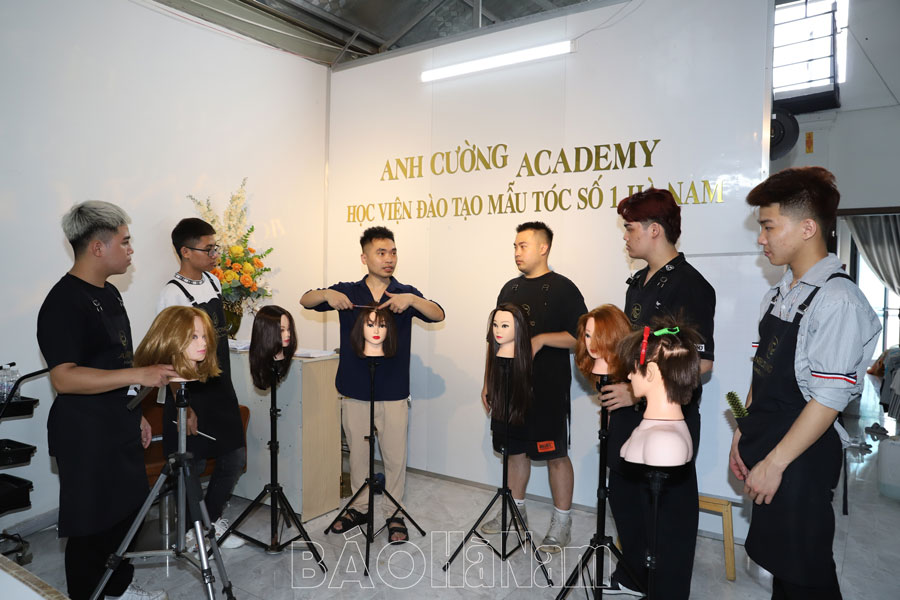
After assessing the trainees' mindset, they learn the theory (just a few pages of large print, with very clear and concise procedures), then practice on mannequin wigs as teaching aids. Mr. Cuong always gives trainees a one-week trial period so they can get a feel for the process. If they find it suitable and enjoyable, they continue; otherwise, they stop to avoid wasting time, effort, and money. The basic apprenticeship lasts about two months, and trainees must pay tuition to ensure seriousness in their studies. After that, if they are proficient, they can start working at the shop, receiving a basic salary that gradually increases with skill level. Usually, with faster training, they can open their own shop in 6 months to a year. For those who want to improve their skills to become truly proficient, they should stay at the shop for several years to gain experience.
Currently, Anh Cuong Hair Salon always has around 5 apprentices, aged 16-30, including junior and senior high school graduates, people who have worked in other professions, and even those who have returned from working abroad. The apprentices say they want to quickly learn the trade so they can start working, which is why they choose a vocational training center. With his experience, passion for the profession, and desire to pass on that passion to his apprentices, Mr. Cuong not only teaches the trade but also provides them with fundamental knowledge, such as developing a positive mindset, understanding ethics and culture in the profession, and fostering a passion for the job. This helps them build a solid foundation for sustainable development and opportunities to advance in their careers.
Besides hair salons, which usually have many apprentices, other beauty establishments such as spas, nail salons, and beauty parlors also have a considerable number of trainees. Nguyen Phuong Hoa, a spa technician at a spa in Phu Ly city, shared that she learned the trade through an apprenticeship at a spa in Hanoi, which has become her livelihood. Hoa said that after finishing high school, she went to Hanoi to work, but the job was unstable. Following a friend, she went to learn at a spa, worked there for several years, and after starting her own family and having children, she returned to Phu Ly to work. Hoa said that almost all spa technicians learn their trade directly at the spa. Here, trainees learn basic theory and, most importantly, practice at levels from easy to difficult. Spa techniques are numerous and not easy, mainly focusing on caring for and improving facial skin, so any mistake can greatly affect customers as well as the business of the establishment. Therefore, spa owners are very strict in hiring staff. To get a job, apprentices must have talent, be very dedicated, diligently learn techniques, and be proficient in using supporting equipment. Even after becoming skilled and starting work, they must continuously learn and improve their skills. Furthermore, customers come to spas not only for beauty treatments but also for relaxation. Therefore, spa staff must know how to converse with and satisfy customers, ensuring their long-term loyalty to the establishment.
In the field of aesthetics, according to some professionals, they must learn at reputable beauty salons in major cities and find experienced instructors because the work is more difficult and mistakes can have serious consequences. Furthermore, working in spas or aesthetics requires constantly updating knowledge and techniques because the field is constantly evolving.
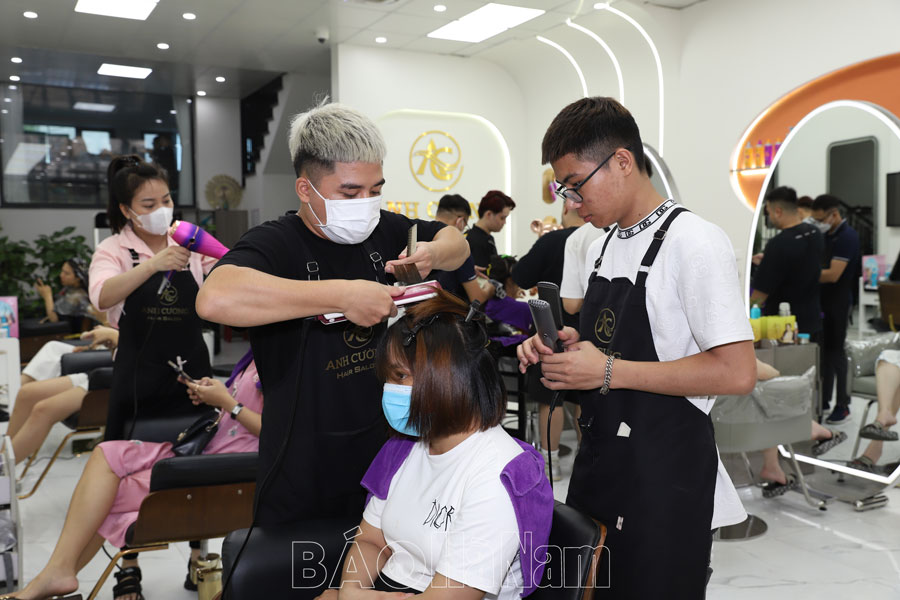
Learning and training in vocational training centers is a traditional form of education. Currently, although vocational schools exist, this form of training at vocational training centers still attracts a significant number of learners due to its effectiveness, the integration of theory and practice, and the ability to learn while working. However, vocational schools haven't focused much on the beauty industry, and because the beauty profession requires extensive hands-on experience, those seeking training often choose to learn at vocational establishments. These centers recruit trainees to increase their workforce, pass on skills, enhance their reputation, and generate some income. Many owners and lead stylists, even those already skilled, regularly participate in training courses and competitions to improve their skills and competitiveness, often receiving certificates and certifications. Therefore, they are well-qualified to teach. While this isn't the case in Ha Nam , in major cities, some owners of beauty establishments are invited by vocational schools to give guest lectures. Most apprentices, after learning the trade, stay and work at the establishment for a while—some for a few years, some for many years, becoming the main craftsman of the shop. Those who want to open their own shop after completing their training are mostly advised and supported by the owner of the establishment during the initial period.
The demand for beauty services is growing, leading to an increase in the number of establishments in this field, requiring a significant workforce. While vocational schools have not yet focused on beauty-related professions, teaching and learning these skills at private beauty establishments meets the needs of learners, helps businesses establish themselves, and contributes to vocational training and job creation in general.
Do Hong
Source link


![[Photo] Prime Minister Pham Minh Chinh attends the Conference on the Implementation of Tasks for 2026 of the Industry and Trade Sector](/_next/image?url=https%3A%2F%2Fvphoto.vietnam.vn%2Fthumb%2F1200x675%2Fvietnam%2Fresource%2FIMAGE%2F2025%2F12%2F19%2F1766159500458_ndo_br_shared31-jpg.webp&w=3840&q=75)


























































































Comment (0)