

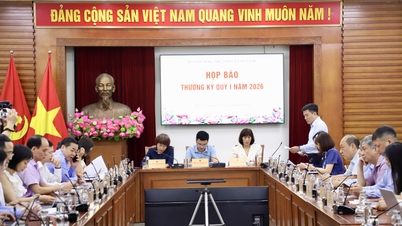
On May 28th, in Can Tho City, the Vietnam Federation of Commerce and Industry (VCCI), in collaboration with the Fulbright School of Public Policy and Management (FSPPM), held a ceremony to announce the annual Mekong Delta Economic Report 2025, themed "Enterprise Development - A Key Driver for Growth".
At the ceremony, Mr. Ho Sy Hung, Chairman of the Vietnam Chamber of Commerce and Industry (VCCI), stated that the choice of the theme was not random but closely followed current events, reflecting the guiding spirit of the Party and Government . Through the report, businesses were also identified as the key players in restructuring the Mekong Delta region's economy, rather than resources, raw materials, or labor…

Mr. Ho Sy Hung, Chairman of VCCI, speaks at the ceremony announcing the 2025 Annual Economic Report of the Mekong Delta.
PHOTO: THANH DUY
However, from this perspective, the Mekong Delta is facing many development paradoxes. The region contributes significantly to the nation's agricultural output (rice, seafood, fruits, rice exports), but many indicators are among the lowest in the country, such as enterprise density, labor productivity, and FDI attraction.
According to Mr. Hung, what is noteworthy is that the Mekong Delta does not lack businesses, but rather that businesses are unable to grow. Over 87% of businesses are "micro-enterprises," and the rate of transitioning to "small" businesses has decreased sharply. Remarkably, the Mekong Delta has an absolute advantage in agriculture, contributing over 30% to the GRDP, yet agricultural businesses account for less than 5%. This is a structural paradox that demands a completely new policy approach.
Furthermore, logistics bottlenecks are eroding the competitiveness of businesses. The report indicates that logistics costs account for 20-25% of product prices. Approximately 70% of the region's export goods still have to be transshipped through ports in Ho Chi Minh City and the Southeast region. The journey from Can Tho to Cat Lai, a distance of only 165km, takes up to 5 hours.
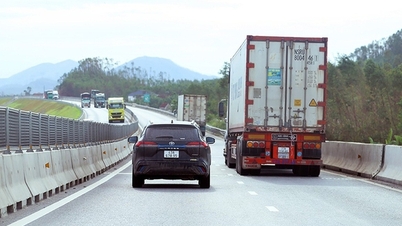
According to the VCCI Chairman, the expressway infrastructure in the Mekong Delta has improved significantly. However, expressways will only truly create a breakthrough when accompanied by a "second layer of infrastructure." This includes cold storage, sorting and inspection centers, digital logistics, and a necessary network of businesses capable of organizing supply chains.
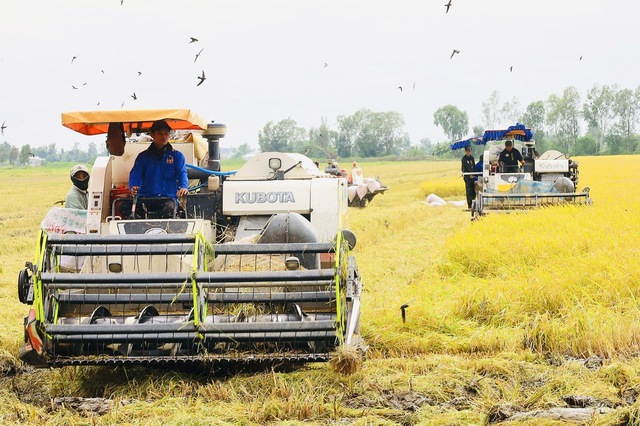
According to a VCCI report, the Mekong Delta region is facing many paradoxes in its development.
PHOTO: THANH DUY
Furthermore, credit financing in the Mekong Delta region has not yet become a tool for business transformation. By 2025, the region's credit outstanding growth rate will only account for 2.67% of the national total, lower than the rate of capital mobilization growth. The financial system still relies heavily on asset collateral, lacking the capacity to finance deep processing, green transformation, and value chain upgrading.
According to Mr. Hung, the breakthrough for the Mekong Delta by 2030 will not lie in producing more rice, fish, or fruit, but rather in its ability to form an integrated business ecosystem encompassing agriculture, processing, logistics, finance, and technology, capable of competing in a green, digitized, and high-standard market.
In that spirit, the Chairman of VCCI believes that a "shift in thinking" is needed for the development of the Mekong Delta. This means shifting from investment and production to businesses and the ecosystem. "If we do not identify businesses as the driving force, do not truly care for them, and do not create a suitable business environment and policy framework, then Vietnamese businesses and entrepreneurs, especially in the Mekong Delta, will find it difficult to grow strong enough to meet the demands of national development in the new era," Mr. Hung emphasized.
Source: https://thanhnien.vn/dbscl-dang-doi-dien-voi-nhieu-nghich-ly-phat-trien-185260528170815588.htm





![[Photo] Standing Committee member of the Party Central Committee Tran Cam Tu working with the Central Inspection Committee](https://vphoto.vietnam.vn/thumb/1200x675/vietnam/resource/IMAGE/2026/05/28/1779969579668_ndo_br_bnd-2495-jpg.webp)


































































































Comment (0)