


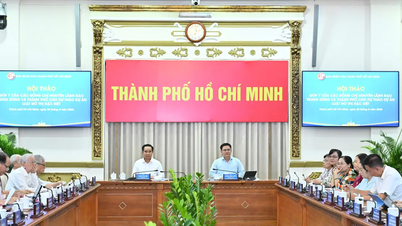
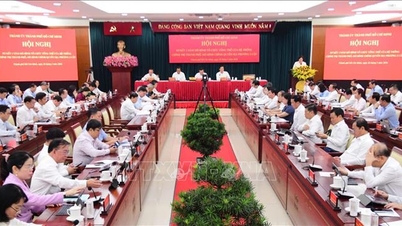
According to the delegates, calling it the Law on Special Urban Area of Ho Chi Minh City not only clearly reflects the role and position of Ho Chi Minh City as a special urban area, in keeping with the city named after President Ho Chi Minh - the place where he left to find a way to save the country - but also avoids duplication that could lead to multiple special urban area laws for other localities in the future.
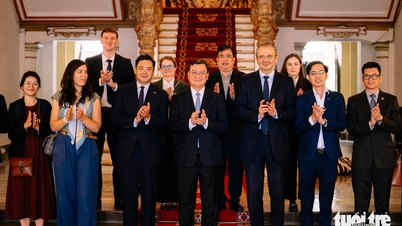
Mr. Huynh Dam, former Chairman of the Central Committee of the Vietnam Fatherland Front, former Deputy Secretary of the Ho Chi Minh City Party Committee, and former Chairman of the Ho Chi Minh City People's Council, believes that naming the Law on Special Urban Areas of Ho Chi Minh City stems from the city's unique characteristics. According to Mr. Huynh Dam, this is primarily due to its historical significance, as the city proudly bears the name of President Ho Chi Minh; it is also a locality that has always been at the forefront of innovation, pioneering the piloting of many new mechanisms and policies, thereby contributing practical experience for the Central Government to consider and decide on implementation nationwide.
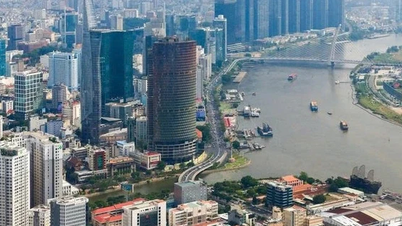
In addition, Ho Chi Minh City possesses unique potential, strengths, location, role, and stature; making significant contributions to the country in the fields of economy , culture and society, national defense and security, international integration, science and technology, and innovation.
Along with proposing a name for the draft law, former leaders of Ho Chi Minh City also suggested that the law should clearly reflect the spirit of decentralization and delegation of power to the city. According to their opinions, the goal of building the Law on Urban Development is to increase the city's authority regarding mechanisms and policies; to create a favorable legal basis for mobilizing more resources, developing potential and strengths, and meeting the requirements of development in the new phase.
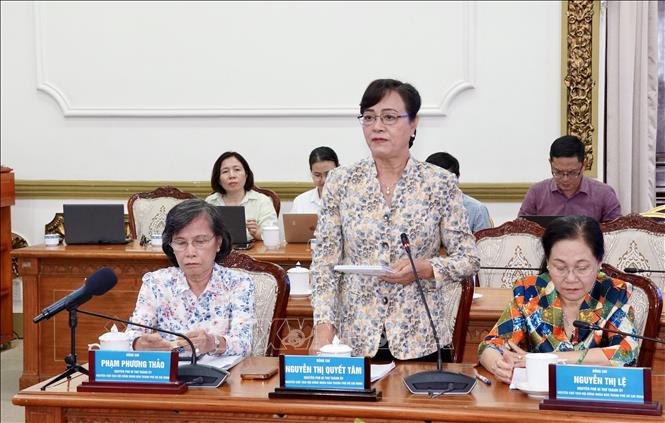
According to Ms. Nguyen Thi Quyet Tam, former Deputy Secretary of the City Party Committee and former Chairwoman of the Ho Chi Minh City People's Council, the draft law needs to clearly demonstrate a stronger spirit of decentralization and delegation of power than current regulations, based on the city's capabilities, potential, strengths, and competitive advantages.
Ms. Nguyen Thi Quyet Tam argued that Ho Chi Minh City needs to demonstrate to the Central Government, the National Assembly , and relevant ministries and agencies the bottlenecks in its development practice stemming from a lack of appropriate mechanisms, policies, and legal frameworks to leverage its existing advantages. Therefore, she proposed a stronger decentralization and delegation of power, tailored to the city's practical needs; and granting sufficient authority to the People's Councils and People's Committees at both the city and commune levels.
Former leaders of the Central Government and Ho Chi Minh City also suggested removing the provisions on pilot implementation and consultation with ministries and agencies from the Law on Special Urban Areas, as this would be inconsistent with the spirit of the Law on Special Urban Areas, as well as the spirit of Resolution 09 of the Politburo, issued on May 19, 2026, which promotes decentralization and delegation of power, granting Ho Chi Minh City many breakthrough and superior mechanisms and policies.

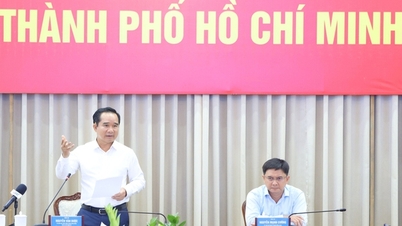
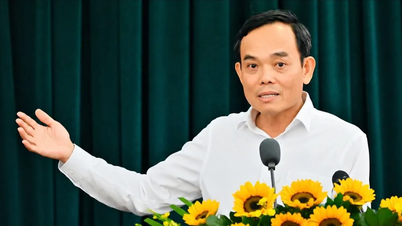
Acknowledging the contributions of former leaders, Chairman of the People's Committee of Ho Chi Minh City Nguyen Van Duoc expressed his confidence that Resolution 09 on the development of Ho Chi Minh City in the new era, along with the Law on Special Urban Areas, presents a historic opportunity, giving the city the chance to possess a unique and superior institutional framework, while also providing a solid foundation and stable mechanism for Ho Chi Minh City to break through and develop rapidly and sustainably in the future.
The draft Law on Special Urban Areas, comprising 9 chapters and 45 articles, will continue to receive feedback from ministries, sectors, and localities, especially those sharing the development space of the Ho Chi Minh City special urban area and the Southern key economic region, in order to finalize it. Ho Chi Minh City aims to complete the draft law by June 2026, then submit it to the Ministry of Justice for appraisal and report to the Government and the Prime Minister before presenting it to the National Assembly for consideration, expected at the National Assembly session in October 2026.
Source: https://baotintuc.vn/tp-ho-chi-minh/de-xuat-dat-ten-luat-do-thi-dac-biet-thanh-pho-ho-chi-minh-20260528193840354.htm


![[Photo] Standing Committee member of the Party Central Committee Tran Cam Tu working with the Central Inspection Committee](https://vphoto.vietnam.vn/thumb/1200x675/vietnam/resource/IMAGE/2026/05/28/1779969579668_ndo_br_bnd-2495-jpg.webp)














































































Comment (0)