By 2030: What are the options for public passenger transport in Hanoi?
VietNamNet•10/10/2024
According to architect Tran Huy Anh, to develop the public transportation system by 2030, Hanoi needs to choose a low-cost, high-efficiency model, investing in short-term, medium-term, and long-term phases.
In his paper submitted to the National Scientific Conference: “New Vision, New Opportunities for Building a Culturally Rich, Civilized, and Modern Hanoi, a Globally Connected City,” Architect Tran Huy Anh, Standing Committee Member of the Hanoi Architects Association, offered insights into the issue of public passenger transport in Hanoi by 2030. He stated that Hanoi plans to develop an urban railway network in 2024. From 2024 to 2030, the city plans to build 96.8 km of railway with a total investment of approximately 14.6 billion USD . Simultaneously, Hanoi will implement a project to develop public transport using electric and green energy buses (referred to as green buses) in the city. The total cost for these two projects is nearly 18 billion USD. However, architect Tran Huy Anh stated that the green bus project and the development of Hanoi's urban railway system currently lack clear investment sources, while human resources are limited and dependent on foreign technology. Furthermore, the route planning has many limitations, is not suitable for travel needs, and has poor connectivity with the inter-provincial railway network.
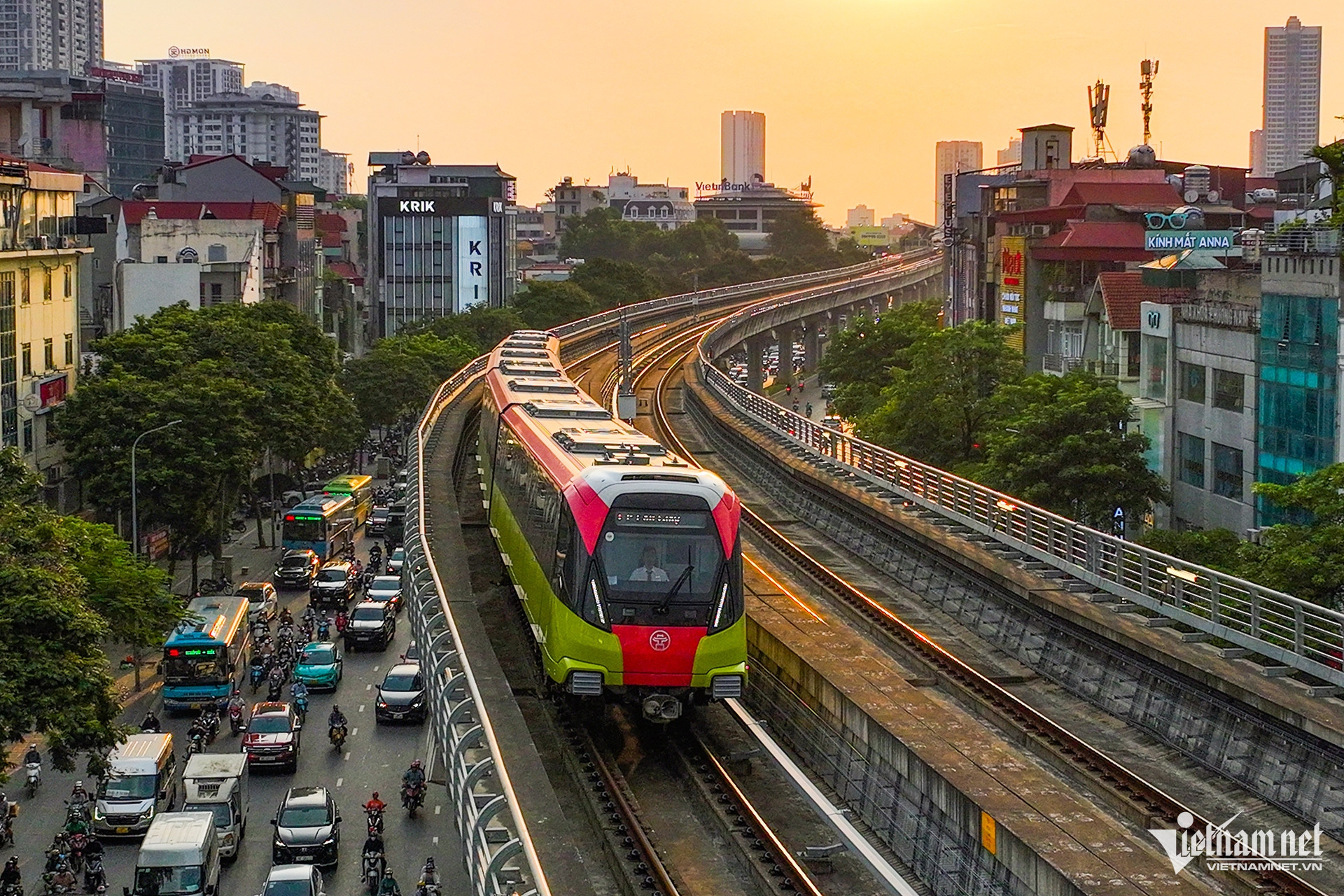
Nhon - Cau Giay Station urban railway line. Photo: Hoang Ha
“Therefore, these projects and plans are not feasible in terms of utility. They are not attractive and are unlikely to attract investment from sponsors and the social community. Therefore, new, more suitable proposals are needed, leveraging existing advantages to achieve greater efficiency,” Mr. Ánh analyzed. According to him, the development of public transport in Hanoi needs to maximize existing advantages. In fact, the Green Bus route will run parallel to the Văn Cao - Hòa Lạc urban railway, serving the Hòa Lạc satellite city and the National University, covering nearly 3,000 hectares. The state budget has invested billions of USD to accommodate 600,000 people by 2030. “However, by September 2024, only a few tens of thousands of students from some universities had arrived. It is projected that in the coming years, about 10% of the population will come here. To attract more residents, a metro line is needed. In 2014, JICA conducted a study on “Data Collection for the BRT Bus Line in Hanoi,” showing that a 38km metro line from Van Cao through Lang to Hoa Lac, with a total investment of 2.8 billion USD, is projected to serve 400,000 passengers per day, but it would take 48 years (2016-2064) to recoup the investment. In January 2024, the Pacific Construction Group (China) and its Vietnamese partners signed a memorandum of cooperation to study this line and are urgently developing a plan with a total investment and timeline.” "The implementation is very attractive. Although there is a need for urgency in the next 2-3 years to deploy the metro line, achieving the target of 400,000 passengers/day will require more time, along with the completion of other technical, economic , and social infrastructure to ensure efficient operation," architect Tran Huy Anh stated. To accelerate Hanoi's public transport development by 2030, Mr. Anh believes it is necessary to review and evaluate the effectiveness of the two projects: the green bus development and the metro. The total investment is nearly 18 billion USD, but only about 3 million trips are recorded daily using the metro and buses. He suggests choosing a model with lower investment costs . Mr. Anh believes that developing public transport in Hanoi is an opportunity for the community to enjoy public benefits, while simultaneously increasing livelihoods and participating in providing affordable transportation services. He cited the example of Tokyo (Japan), which has a metropolitan rail system (underground, elevated, high-speed, and intercity rail) with a total length of thousands of kilometers, invested in, managed, and operated by 12 companies. Initially, the railway lines were publicly owned and managed, then handed over to private companies for operation according to nationwide safety and technical standards. Similarly, Seoul (South Korea) has a 1,100km metropolitan rail system, in which the infrastructure (below the tracks) is state-owned, while the above-ground sections are operated by corporations, accounting for 60-70% (including equipment and operating trains). Notably, after years of investing in expensive but underutilized metropolitan rail systems, many developing Asian cities have promoted affordable metropolitan rail and integrated multimodal transport into their low-cost public transportation systems. “For example, the JAK LINGKO model in Jakarta (Indonesia) links all types of public transport: suburban rail, urban rail, BRT, regular buses, and minibuses (7 seats), providing public transportation services through a single payment card. Urban residents can access various types of public transport at different prices to travel anywhere in the city. The city also has incentive policies to encourage residents to use more public transport,” Mr. Anh said. Integrating public transport projects with enhanced access to public amenities and increased livelihood opportunities for urban residents is a goal of sustainable development. From these models, according to Mr. Anh, the lesson for Hanoi in developing its public transport system by 2030 is to choose a model with low investment costs and high efficiency, investing in short-term, medium-term, and long-term phases. Accordingly, all infrastructure under the railway tracks is publicly owned and has a capital recovery plan in place even before implementation. It is necessary to encourage businesses to invest fully in infrastructure equipment, rolling stock, and operation. “Developing public transport integrated with public works and urban redevelopment will create an urban transport service economy (carrying people and goods) with the participation of all economic sectors, from large corporations to ride-hailing drivers,” Mr. Ánh explained.
Also related to the urban railway system, in a paper submitted to the conference by Dr. Khuat Viet Hung and Dr. Vu Linh from the Institute of Development Strategy and Transport (Ministry of Transport), the authors stated that to complete the total length of 598.5km, of which approximately 96.8km of urban railway will be put into operation by 2030, Hanoi needs appropriate solutions, mechanisms, and policies. Regarding capital mobilization, it is necessary to ensure that the city budget plays a leading and decisive role, prioritizing the allocation of resources in the medium-term public investment plan, along with increased revenue and savings in annual expenditures. At the same time, it is necessary to effectively utilize resources from land funds to develop the urban railway system. The central government budget also needs to balance and allocate targeted supplementary capital to Hanoi's budget in the medium-term periods of 2026-2030 and 2031-2034 to invest in the construction of the capital's urban railway system.


![[Image] Pleasant weather helps students enter the 10th grade entrance exam with confidence.](https://vphoto.vietnam.vn/thumb/1200x675/vietnam/resource/IMAGE/2026/05/29/1780034401612_ngay-1-thi-lop-10-minh-duy-8-5009-jpg.webp)

![[Photo] Ba Lang An Lighthouse - the "eye of the sea" amidst the "rock museum" of Quang Ngai province.](https://vphoto.vietnam.vn/thumb/1200x675/vietnam/resource/IMAGE/2026/05/29/1780038698840_anh-man-hinh-2026-05-29-luc-14-10-42.png)













































































Comment (0)