

4 trillion VND for over 20 years of investment in the Olympics and ASIAD.
For many months now, while developing the Program for the Development of Key Sports in preparation for participation in the Olympic Games and ASIAD Games from 2026-2046, managers at the Vietnam Sports Department and many experts have calculated the number at 17 sports. These 17 sports are divided into two groups.

Group 1 includes strong disciplines and sports with a high potential for Olympic medal contention (8 sports): Shooting, archery, weightlifting, taekwondo, boxing, fencing, rowing, and badminton. Approximately 100-110 athletes in this group will receive long-term training abroad.
Group 2 consists of sports and events with high potential for medal contention at the ASIAD (9 sports): Athletics, judo, karate, wushu, gymnastics, wrestling, swimming, sepak takraw, and cycling. Athletes in this group (65-70 athletes) will receive investment through a combination of intensive domestic training and short-term training and competition abroad under a special program.
Thus, in the period 2026-2046, to achieve the goals at the ASIAD and the Olympics, Vietnamese sports will invest annually in approximately 165-170 key athletes in 17 sports. This will enable the achievement of the goals in three smaller phases within the 2026-2046 period, as recently shared by Mr. Hoang Quoc Vinh - Head of the High-Performance Sports Department (Vietnam Sports Administration).
For the period 2026-2030, in addition to maintaining its position among the top 3 delegations at the SEA Games, Vietnamese sports aim to be among the top 20 delegations at the Asian Games, with specific targets of 5 gold medals at the 2026 Asian Games (focusing on shooting, karate, rowing, and sepak takraw), and 6 gold medals at the 2030 Asian Games (shooting, archery, karate, rowing, and sepak takraw).
With the 2028 Olympics in this phase, the goal is to win 2 bronze medals (shooting, archery, weightlifting).
For the period 2030-2036, in addition to maintaining its position among the top 3 delegations at the SEA Games, Vietnamese sports will continue to aim for a position among the top 20 delegations at the Asian Games, with specific targets such as 7 gold medals at the 2034 Asian Games (shooting, archery, karate, rowing, sepak takraw, boxing). At the 2032 Olympics, the goal is to win 2 bronze medals (shooting, archery, weightlifting); and at the 2036 Olympics, 1 silver and 2 bronze medals (archery, weightlifting, shooting). During this period, Vietnamese sports will also continue to stabilize the group of key sports that have received investment in training in the 2026-2030 period and add new, groundbreaking events.
For the period 2036-2046, in addition to maintaining a position among the top two teams at the SEA Games, Vietnamese sports aim to be among the top 15 teams at the Asian Games and among the top 50 teams at the Olympic Games. Setting a target of being among the top 50 teams at the Olympic Games also means that Vietnamese sports must win gold medals at each Games they participate in.
According to calculations by the Vietnam Sports Department, the estimated budget for the ASIAD and Olympic Games in the period 2026-2046 is approximately 4,000 billion VND. This includes: 2026-2030: Approximately 175-180 billion VND/year/17 sports; 2030-2036: Approximately 175-180 billion VND/year/17 sports plus 10% of the 2026-2030 period; 2036-2046: Approximately 175-180 billion VND/year/17 sports plus 10% of the 2030-2036 period.
Will the number of key subjects be recalculated?
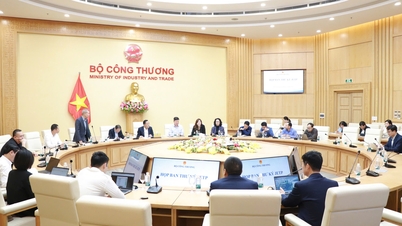
Not only at the workshop to provide feedback on the development program for key sports in preparation for participation in the Olympic Games and ASIAD in the period 2026-2046, which recently took place in Hanoi , but also before that, some experts suggested that the sports sector probably needs to carefully consider the number of key sports.
Nguyen Hong Minh, former Head of the High-Performance Sports Department of the National Sports Committee (now the High-Performance Sports Division, Vietnam National Sports Administration), believes that the number of key sports and events for Olympic and ASIAD goals should be reduced. This would allow for a concentration of investment resources in these priority sports after the reduction. Mr. Nguyen Hong Minh cited the example of developed sports nations that focus their investment on only about 4-7 key sports to compete for Olympic gold medals. He argued that the group of sports competing for ASIAD medals should also be streamlined.
Former Deputy Director General of the General Department of Sports and Physical Training, Lam Quang Thanh, proposed dividing key sports into three groups instead of the current two. He suggested that Group 1, comprising only about 3-4 sports, should be considered national sports, capable of competing for Olympic medals, and should receive significantly different levels of investment compared to the other groups.
The experts' opinions all have their merits, especially given the limited investment in Vietnamese sports from the state budget, while the resources from social mobilization are similarly limited. The President of the Vietnam Taekwondo Federation, Truong Ngoc De, recounted that to have an athlete win an Olympic gold medal, the Thai Taekwondo Federation once spent 3 million USD annually (approximately 75-76 billion VND), while the investment from the state budget for Taekwondo by the Vietnam Department of Sports and Physical Education is only about 250,000 USD/year. Even with additional funding from the Vietnam Taekwondo Federation, it would still take a long time to reach the 3 million USD level of Thailand. Therefore, the only solution is to reduce the number of priority sports to ensure they are truly priority. This would ensure that priority sports for the Olympics have a clear chance to compete for Olympic medals, and priority sports for the Asian Games have a clear chance to compete for Asian Games gold medals. Currently, some sports designated as "key" for the Olympics, such as fencing and Taekwondo, or for the Asian Games, such as Judo, are also struggling to compete for Olympic medals or Asian Games gold medals.
The leaders of the Vietnam Sports Department have promised to consider streamlining the list of key sports disciplines preparing for the Olympic Games and ASIAD Games between 2026 and 2046 to ensure that the officially selected disciplines are truly priority. In other words, this is to avoid a scattered approach in building the group of key sports disciplines, those that will define the future standing of Vietnamese sports.
Withdraw from the course but not withdraw your tuition.
Another concern is whether reducing the number of priority sports will lead to a decrease in annual investment for the 17 priority sports currently being developed by the sports sector. Everyone hopes this will not happen, as it would meet the requirements for recalculating the "priority" of the priority sports group. This is also a matter of concern for those involved. (Minh Khue)
Source: https://cand.com.vn/Tieu-diem-van-hoa/di-tim-trong-diem-cua-trong-diem-i763905/

![[Image] Central Party Office summarizes work in 2025](/_next/image?url=https%3A%2F%2Fvphoto.vietnam.vn%2Fthumb%2F1200x675%2Fvietnam%2Fresource%2FIMAGE%2F2025%2F12%2F18%2F1766065572073_vptw-hoi-nghi-tong-ket-89-1204-jpg.webp&w=3840&q=75)


![[Video] Launch of two books on history and heritage preservation](https://vphoto.vietnam.vn/thumb/402x226/vietnam/resource/IMAGE/2025/12/18/1766072185865_2663241292917005256-4230-jpg.webp)






























































Comment (0)