

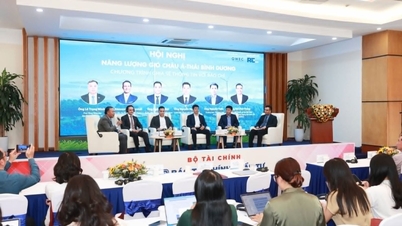
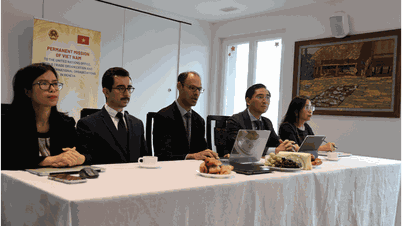
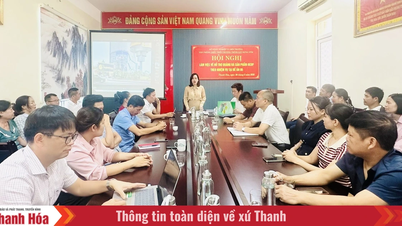
This was also the overarching theme shared by experts and businesses at the press conference introducing the Asia-Pacific Wind Energy Summit 2026 (APAC Wind Energy Summit 2026), organized by the Global Wind Energy Council (GWEC) in collaboration with the Finance and Investment Newspaper on the afternoon of May 26th.
Offshore wind power opens up new avenues for development.
No longer just a story of individual projects, wind power in Vietnam is now seen as a crucial component in the long-term energy security strategy, green industrial development, and enhancing technological self-reliance.
Following a period of strong growth thanks to the FIT mechanism before 2021, Vietnam has now developed an onshore wind power capacity of over 6,000 MW. Although there are still issues that need further optimization in operation and planning, experts believe that more importantly, Vietnam has accumulated valuable practical experience that few countries in the region possess.

Mr. Ngo Tien Dat, Country Director for Vietnam of Suzlon Energy, assessed that Vietnam is currently among the markets with a relatively good wind power foundation in the Asia-Pacific region.
“Vietnam is in a relatively high position in the region. We have a large installed capacity compared to neighboring countries, and we have learned many practical lessons. Investors, contractors, general contractors, and suppliers have all accumulated experience from the project implementation process,” Mr. Dat said.
According to Mr. Dat, the previous period of rapid growth helped the market quickly form a business ecosystem, a technical team, and project implementation capabilities. This will be an important foundation for the new development cycle, especially as market demands for investment efficiency and project quality become increasingly higher.
"Future wind power projects will be planned much more carefully. Investors now have to meticulously consider technical, legal, and operational efficiency aspects to ensure investment returns," Mr. Dat said.
According to experts, this reflects the natural maturation process of the market. While the initial phase prioritized the speed of capacity development, the next phase will focus more on planning quality, operational optimization, and long-term economic efficiency.
One point that many businesses particularly emphasized was the enormous potential of offshore wind power. Mr. Nguyen Tuan, Head of Commercial Department of PetroVietnam Technical Services Corporation ( PTSC ), believes that offshore wind power will play a key role in Vietnam's future energy development strategy.
"Offshore wind power can generate large-scale power. Offshore wind conditions are better, and the turbines can operate for much longer periods compared to onshore," Mr. Tuan shared.
According to him, the greatest benefit of offshore wind power lies not only in electricity production, but also in its ability to foster the formation of a completely new industry with enormous economic value. "The offshore wind industry is a huge industry. Developing offshore wind power without developing the domestic industry would be a major failure," Mr. Tuan emphasized.
Currently, many Vietnamese businesses have begun to participate more deeply in international supply chains. PTSC stated that it has participated in the fabrication of offshore wind turbine foundations and offshore substations for numerous international projects with a total scale of approximately 6 GW.
"Just one offshore wind turbine foundation manufacturing project has generated hundreds of millions of USD in export revenue, creating jobs for nearly 3,000 workers and almost 100 domestic businesses over the past three years," Mr. Tuan said.
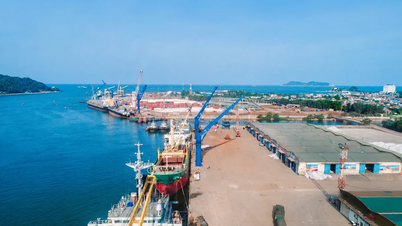
According to experts, this is an opportunity for Vietnam to gradually participate more deeply in the global value chain of the wind power industry, from equipment manufacturing, steel structures, logistics to port infrastructure and technical services.
From capacity development to efficiency optimization
One notable point shared by businesses is that the Vietnamese wind power market is entering a more substantive development phase, where economic efficiency and project design quality will be prioritized.
Mr. Nguyen Tuan stated that in wind power, optimizing turbine placement is crucial to the project's operational efficiency. "If the turbines are not positioned properly, a 'wake effect' will occur, meaning the turbines ahead will disrupt the airflow, causing the turbines behind to reduce their power generation efficiency," he said.
According to him, in the previous period, due to the market's rapid growth, many projects were implemented in a short time, which inevitably led to certain limitations. However, this is also an important lesson for the market to enter a more systematic development phase.
Investors today are not only interested in the total investment cost (CAPEX), but also pay special attention to operating costs (OPEX), capacity factor, and levelized cost of electricity (LCOE). "It is expected that in upcoming investment rounds, not only investors but also financing banks will more carefully evaluate the design and technical optimization to improve project efficiency," Mr. Tuan commented.
Many experts believe that the shift in the market from "rapid growth" to "efficient growth" is a positive trend, helping the wind power industry operate more sustainably in the long term.
Despite a period of stagnation following the previous boom, businesses generally agree that wind power will remain an inevitable development trend for Vietnam in the next 5-10 years.
Mr. Ngo Tien Dat believes that Vietnam possesses several important advantages simultaneously, such as abundant wind resources, rapidly increasing electricity demand, and significant economic development potential. "In my assessment, the Vietnamese wind power market will certainly continue to develop. The only question is to what extent and how quickly," he said.
According to experts, along with the revised Power Development Plan VIII, the goals of green economic development, carbon neutrality, and the need to ensure energy security will continue to create significant potential for wind power in the long term.
In particular, Vietnam's hosting of the Asia-Pacific Regional Wind Energy Conference 2026 (June 9-11, 2026 at the National Convention Center, Hanoi ) is expected to contribute to promoting connections with investors, equipment manufacturers, and international supply chains.
In the context of the ongoing global energy transition, wind power is no longer just a supplementary power source. For Vietnam, it is gradually becoming an opportunity to build a new industry with regional competitiveness, create jobs, attract investment, and enhance the economy's position in the global green supply chain.
Source: https://baotintuc.vn/kinh-te/dien-gio-viet-nam-truc-co-hoi-but-toc-moi-20260527120452591.htm

![[Photo] The heat at the fireworks display site on the opening night of the Da Nang International Fireworks Festival 2026](https://vphoto.vietnam.vn/thumb/1200x675/vietnam/resource/IMAGE/2026/05/27/1779889741485_ndo_br_z7872039145157-fecaba5112f39e8352544099d7ef4738-5140-jpg.webp)
![[Photo] The courage of new recruits of Brigade 144 on the training ground.](https://vphoto.vietnam.vn/thumb/1200x675/vietnam/resource/IMAGE/2026/05/27/1779881651341_anh-man-hinh-2026-05-27-luc-18-32-52.png)












































![[Photo] The courage of new recruits of Brigade 144 on the training ground.](https://vphoto.vietnam.vn/thumb/402x226/vietnam/resource/IMAGE/2026/05/27/1779881651341_anh-man-hinh-2026-05-27-luc-18-32-52.png)






















Comment (0)