

The incentive mechanism has been discussed extensively but remains only on paper.
In the recent action plan for Decision 1126 on strengthening electricity saving and developing rooftop solar power, the Ministry of Industry and Trade stated that it will coordinate with the Ministry of Finance , the State Bank of Vietnam, and relevant agencies to promptly research and finalize a proposal for the Prime Minister to consider issuing a Prime Minister's decision regulating policies to support households installing rooftop solar power and electricity storage systems, in accordance with technical capabilities, economic conditions, and state budget capacity in each period.

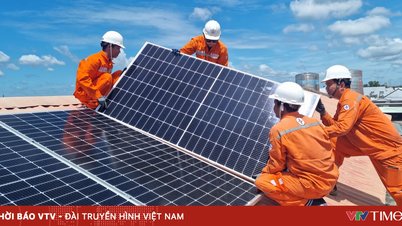
There's a real need to free up rooftop solar power.
PHOTO: NHAT THINH
In fact, policies related to supporting households in installing self-sufficient rooftop solar power systems and battery storage systems have been discussed quite extensively. Most recently, in October 2025, the Ministry of Industry and Trade submitted to the Ministry of Justice for appraisal a draft decision of the Prime Minister on policies to support households in installing self-sufficient rooftop solar power systems and electricity storage systems. This draft clearly states that preferential loans of up to 40 million VND will be provided to households at the Social Policy Bank, with a preferential interest rate of 8.4% per year, a loan term of 36 months, and no collateral required. A maximum loan of 20 million VND will be provided for solar power systems (loan support of 4 million VND/kWp, up to 5 kWp capacity) and 20 million VND for electricity storage systems (loan support of 2 million VND/kWh, up to 10 kWh capacity).
Furthermore, the draft clearly states support for the installation of bidirectional electricity meters; households installing rooftop solar power systems with accompanying storage systems will receive support of 2-3 million VND, provided that the system capacity reaches 1 kWp, the storage capacity is 2 kWh, and they commit to using it for a minimum of 3 years… This policy is expected to be effective from the beginning of 2026 until December 31, 2030. However, about a month later (November 2025), the draft proposes that households receiving support for solar power installation will only receive 500,000 VND - 1 million VND for rooftop solar power installation; those with accompanying battery storage will receive an additional 1 million VND, provided that the total capacity of the installed electricity storage system reaches 2 kWh or more. Households receiving support must commit to using the system for a minimum of 3 years. Thus, the proposed financial support for installing rooftop solar power systems in the drafts has changed in the direction of reduction.
Furthermore, regarding the maximum allowable percentage of electricity sold to the grid, which is currently set at only 20%, in the draft amendments to Decrees 57 and 58 submitted to the Ministry of Justice for review earlier this year, the Ministry of Industry and Trade proposed allowing rooftop solar power systems operating under a self-production-self-consumption model to sell a maximum of 50% of their surplus electricity to the national grid.
Energy experts acknowledge that while there are many proposals for mechanisms to support the development of rooftop solar power, most remain on paper and have not yet been enacted. "Previous proposals related to removing obstacles to direct electricity trading for rooftop solar power, increasing the percentage of power fed into the grid, simplifying procedures… if implemented and with determination, would have already provided significant support to solar power investors," commented a manufacturing enterprise in an industrial park currently facing difficulties in directly trading electricity to serve its production.
The three restraints need to be removed from the MTMN.
Dr. Nguyen Duy Khiem, a lecturer at Quy Nhon University (Gia Lai province), believes that rooftop solar power is still "constrained" by three factors: the percentage of electricity sold, the pricing mechanism, and the procedures for connecting to the power grid.
Specifically, current regulations still limit the percentage of electricity sold to the grid to 20%. If this were raised to 50%, or even 80%, or if people were allowed to sell as much surplus as they want, many more people would participate in investing. Secondly, there's the pricing mechanism. The current price for selling solar power to the grid is just over 1,000 VND/kWh, while people buy electricity from the grid for their own use at around 3,000 VND/kWh (average of the progressive tariff), and businesses at around 4,000 VND/kWh. "This inconsistency makes rooftop solar power unattractive. The price for selling electricity to the grid should at least be 80% of the price for buying electricity at the first tier," he said.
Thirdly, the procedures for connecting to the grid are still complicated. Currently, besides the formalities, installing rooftop solar panels involves many agencies and units such as the Department of Construction, the Department of Industry and Trade, and the Fire Prevention and Control Department. These requirements should be reviewed and either omitted or simplified, with a single point of contact at the local power company.
"In my opinion, these are the three decisive factors for accelerating rooftop solar power development. Simply freeing up these three factors would be far more effective than providing financial support or interest rates," Mr. Khiem affirmed.
According to Mr. Khiem, solar power and renewable energy in general have the limitation of low stability. Therefore, when capacity develops strongly, a corresponding backup system is needed. Encouraging people to develop storage facilities aims to increase this backup. However, when storing more electricity, it means less power is fed into the grid. "While developing storage and backup systems is something the electricity sector should invest in, people only consider their own household economic situation: generating electricity for the grid during the day and receiving electricity from the grid for use at night. And everyone tries to achieve a balance from 'breaking even to making a profit' – if the profit is high, people will invest more, and vice versa," Mr. Khiem said.
Sharing the same view, energy expert Nguyen Quoc Viet, General Director of Vinasol Joint Stock Company, emphasized the need for strong incentive policies such as allowing the sale of surplus electricity up to 50%. The electricity selling price needs to be reconsidered because currently, the average selling price is quite low compared to the price customers pay. "In my opinion, electricity prices for production and business have time slots, so the price of rooftop solar power sold to the grid should also be calculated according to time slots. For example, rooftop solar power investors with storage systems, if they feed electricity into the grid during peak hours, should be sold at a better price than during off-peak hours. Solar power sold to the grid at night, during peak hours, should be priced differently to ensure fairness and encourage households and businesses to invest in rooftop solar power with storage systems," Mr. Viet stated.
In addition, Mr. Viet also suggested removing the mechanism of limiting the capacity of rooftop solar power installations. To accelerate the development of this renewable energy source, limiting the maximum power output (Pmax) is a major obstacle because many businesses want to install solar power with higher capacity for their own use, storage for resale, or use at night when solar radiation is low. At that time, they would still have a relatively high output capacity to meet their reuse needs.
According to Dr. Nguyen Duy Khiem: It is extremely important to establish a mechanism for direct electricity trading between producers and consumers. This is a modern and crucial model to encourage more people to participate in electricity development. With electricity demand projected to increase rapidly, especially during the current El Nino phenomenon and the goal of double-digit economic growth, this is a good solution to quickly increase supply.
Source: https://thanhnien.vn/dien-mat-troi-mai-nha-uu-dai-the-nao-de-tang-toc-185260522220307432.htm
![[Photo] General Secretary and President To Lam presides over the meeting to approve the draft report on the results of the second inspection by the Politburo of the Standing Committee of the Hanoi City Party Committee.](https://vphoto.vietnam.vn/thumb/1200x675/vietnam/resource/IMAGE/2026/05/26/1779789811432_a2-bnd-4430-9620-jpg.webp)

















































































Comment (0)