

Laxity is the cause of the deviation from socialism.
In reality, "self-evolution" and "self-transformation" were the "explosive" factors that caused the "earthquake" that led to the collapse of the socialist regimes in Eastern Europe and the Soviet Union in the 1990s. One of the main reasons for the formation and explosion of this terrible "explosive" factor was the laxity in inspection, supervision, and discipline within the Communist Party of the Soviet Union. I would like to quote some content from the article "Why Did the Communist Party of the Soviet Union Collapse?" by the late General Secretary Nguyen Phu Trong in the Communist Magazine in 1992: With the slogans "Return power to the people," "All power to the Soviets," and the policy of abolishing Article 6 of the Soviet Constitution (affirming the leadership of the Communist Party of the Soviet Union over the entire society), they gradually diminished and then denied the Party's leadership role.
In practice, people have neglected to strengthen Party organizations, failed to uphold the principles of Party organization and activities, and downplayed the issue of leading the state through Party organizations, leading to a weakened Party organizational system and lax discipline; Party organizations have failed to inspect and supervise Party members, and the fighting capacity of grassroots Party organizations has been severely weakened. Hundreds of thousands of grassroots Party organizations have fallen into a state of weakness. Indeed, the laxity in the Party's inspection, supervision, and discipline has caused extremely heavy and painful losses and "shocking tremors among communists worldwide ."
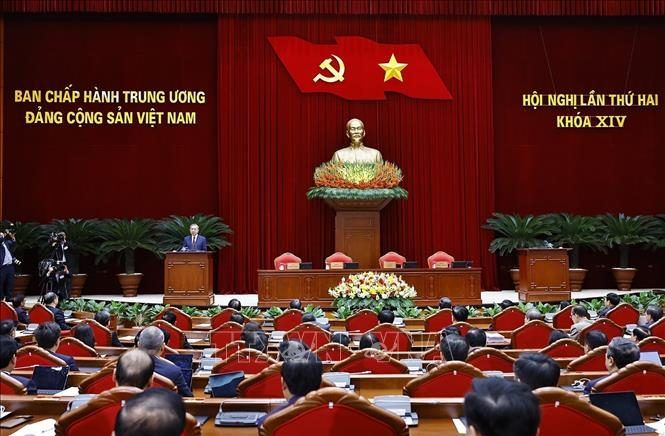 |
Second meeting of the 14th Central Committee of the Communist Party of Vietnam. Photo: VNA |
The great poet Nguyen Du once wrote in The Tale of Kieu: "Looking at others, we reflect on ourselves." With the spirit of facing the truth squarely and assessing the truth accurately, the 14th National Congress of the Communist Party of Vietnam frankly pointed out: During the term of the 13th National Congress, Party committees and inspection committees at all levels disciplined more than 2,380 Party members for corruption, 313 Party members for violations of asset and income declaration regulations; and more than 29,600 Party members for ideological and political degradation, moral and lifestyle decline, violations of exemplary conduct, and violations of the rules that Party members are not allowed to break. During this term, 174 officials under the management of the Central Committee were disciplined, including some former key leaders of the Party and State; of which 66 officials were prosecuted criminally, including both current and retired officials.
It is worth remembering the case of Van Thinh Phat Group and Saigon Commercial Joint Stock Bank (SCB) in 2023-2024, one of the biggest economic scandals. The State Bank of Vietnam's inspection team at SCB overlooked violations and reported untruthfully on SCB's weak financial situation, helping Ms. Truong My Lan commit fraud and causing exceptionally large financial losses. Former Director of the Banking Inspection and Supervision Department II (Department II), Banking Inspection and Supervision Agency, State Bank of Vietnam, Do Thi Nhan, received a very large amount of bribes. This is a very serious consequence of lax inspection, supervision, and discipline within the Party, infiltrating law enforcement agencies such as the prosecution and inspection agencies. For example, the Standing Committee of the Thanh Hoa Provincial Party Committee for the 2020-2025 term (from the beginning of the term to September 2024) violated regulations on land, resource, and mineral management, neglected inspection and supervision, causing serious consequences, resulting in significant losses of state budget funds, and diminishing the prestige of the Party organization. These typical cases show that the Party's inspection, supervision, and disciplinary work is still being carried out superficially and formally by some Party committees and organizations.
During this term, the Party's organizational principles were not strictly upheld in some areas and were neglected; the principle of democratic centralism was violated; self-criticism and criticism were weak, and in some places merely ceremonial; democracy was not well-developed, and the fighting spirit of many Party organizations and members declined; internal relations were at times and in some places dominated by money and power. In particular, the decline in political ideology, morality, and lifestyle, "self-evolution," "self-transformation," bureaucracy, group interests, and corruption became increasingly sophisticated and serious, spreading from the economic sector to cultural, educational, and even charitable activities...
Some officials and Party members are distant from the people, afraid of the people, unwilling to engage in dialogue with the people, and uninterested in resolving the people's pressing issues. As a result, mass and escalated complaints have occurred, are occurring, and continue to occur. In some places, officials and Party members who make mistakes, when criticized by the people, not only refuse to accept the feedback but also retaliate... These "rotten apples" not only cause significant damage to State assets but, more dangerously, erode the people's trust, affect the prestige and honor of the Party, and undermine the good nature of our regime. On the other hand, they create conditions for political opportunists and hostile forces to exploit, sow discord within the Party, and carry out the "peaceful evolution" plot and actions to sabotage our revolution. Accordingly, the Party's inspection, supervision, and disciplinary work must be emphasized and strengthened to actively prevent, deter, and reverse the decline in political ideology, morality, and lifestyle, "self-evolution," "self-transformation," bureaucracy, corruption, group interests, and "backroom deals," thereby contributing to enhancing the Party's leadership capacity and fighting strength.
Party inspection, supervision, and disciplinary work - a matter of life and death for the Party.
In his opening speech at the Second Plenum of the 14th Central Committee of the Communist Party of Vietnam, General Secretary and President To Lam clearly stated: It is essential to correctly define the position of the Party's inspection, supervision, and disciplinary work, as well as the fight against corruption, waste, and negative phenomena. This is not merely a matter of "maintaining internal order," but a vital issue for the Party, a prerequisite for maintaining the people's trust, upholding discipline and unity within the Party, ensuring that the correct policies are strictly implemented, that power is tightly controlled, and that cadres are regularly trained and screened.
Indeed, "properly positioning" the Party's inspection, supervision, and disciplinary work is an urgent requirement to ensure the Party's leading role is maintained and the socialist path in Vietnam is steadfast. The Party's inspection, supervision, and disciplinary work directly contributes to curbing, preventing, and reversing the decline in political ideology, morality, and lifestyle, the manifestations of "self-evolution" and "self-transformation" within the Party, corruption, vested interests, "term-based thinking," and the abuse of power among a segment of cadres and Party members.
The documents of the 14th Party Congress emphasize: “Strengthening inspection and supervision with focus, priorities, and breakthroughs; strictly and effectively controlling power; promoting the fight against corruption, waste, and negative phenomena, with the motto “continuous, relentless,” “no forbidden zones,” and “no exceptions” (*). Accordingly, for the Party's inspection, supervision, and disciplinary work to truly become the “sharp sword of the Party,” it is necessary to “correctly position the thinking”: Inspection and supervision are not about “finding fault” but about maintaining the main and very important method of leadership to uphold the Party's discipline and order. Therefore, immediately after the 14th Party Congress, the Party's inspection, supervision, and disciplinary work must be thoroughly understood and implemented comprehensively based on closely adhering to the political tasks and practical realities of each locality and unit.
First and foremost, it is necessary to review, adjust, supplement, and overcome the limitations, shortcomings, gaps, and weaknesses in the Party's inspection, supervision, and disciplinary work. We must resolutely prevent prolonged violations from going undetected early on, as seen in the cases at the Vietnam Register and local inspection centers. There must be clear and specific mechanisms to hold cadres, Party members, and grassroots Party organizations accountable for effectively and correctly carrying out the Party's inspection, supervision, and disciplinary work. The head (of the Party committee or organization), each committee member, and each Party member who fails to detect violations within their own grassroots Party organization, only intervening after public opinion or the press speaks out, will be subject to disciplinary action within the Party, depending on the severity of the offense.
At the same time, it is urgent to overcome the "hot at the top, cold at the bottom" situation in many aspects of work, including the Party's inspection, supervision, and disciplinary work. Currently, the Central Committee, the Politburo, the Secretariat, and the Government are resolutely directing and exemplary work from the top, with "no forbidden zones," in the work of Party building and rectification in general and the fight against corruption in particular, achieving many positive results and gaining the people's approval, support, and trust. This is a good and favorable opportunity that needs to be seized to strengthen the Party's inspection, supervision, and disciplinary work and continue to implement more decisive and effective measures to "rekindle" the entire Party system.
Party committees and organizations at all levels need to focus on self-inspection and supervision at the grassroots level, proactively preventing, warning, and handling violations early and proactively, preventing small violations from accumulating into major ones. Strengthen Party discipline, proactively detect and strictly handle Party members who have degenerated in terms of political ideology, ethics, and lifestyle, and who are undergoing "self-evolution" and "self-transformation," while protecting cadres who dare to think, dare to act, dare to take responsibility, and dare to make breakthroughs for the common good.
Socialism is the goal and aspiration of our people. To prevent the "revolutionary ship" from veering off course amidst the turbulent waves of the times, especially internal "self-evolution" and "self-transformation," the Party's inspection, supervision, and disciplinary work must act as a "safe rudder" and the most accurate navigational aid. As an objective necessity, only when the Party's inspection, supervision, and disciplinary work is done well can we affirm that our Party is strong because the people trust it, and the socialist regime is stable because the Party always knows how to purify itself to serve the Fatherland and the people.
...............
Source: https://www.qdnd.vn/phong-chong-tu-dien-bien-tu-chuyen-hoa/dinh-vi-dung-cong-tac-kiem-tra-giam-sat-ky-luat-cua-dang-1036354


![[Photo] Solemn bathing ceremony and Buddha procession in Hue](https://vphoto.vietnam.vn/thumb/1200x675/vietnam/resource/IMAGE/2026/05/31/1780228263543_1-jpg.webp)
![[Image] Hanoi Police officially crowned champions of V-League 2025/2026](https://vphoto.vietnam.vn/thumb/1200x675/vietnam/resource/IMAGE/2026/05/31/1780244769054_ndo_br_039d561b692be875b13a-jpg.webp)
![[Photo] The General Secretary, President and his wife begin their state visit to the Philippines.](https://vphoto.vietnam.vn/thumb/1200x675/vietnam/resource/IMAGE/2026/05/31/1780230559452_anh-man-hinh-2026-05-31-luc-19-28-11.png)
![[Photo] Admire the coral "masterpiece" amidst the million-year-old heritage of Dak Lak province.](https://vphoto.vietnam.vn/thumb/1200x675/vietnam/resource/IMAGE/2026/05/31/1780221235105_anh-man-hinh-2026-05-31-luc-16-53-27.png)










![[Video] Sunset at Lap An Lagoon – Where the sun sets over the fishing nets](https://vphoto.vietnam.vn/thumb/340x192/vietnam/resource/IMAGE/2026/05/31/1780192137701_beach-landscape-sea-water-nature-grass-745871-pxhere-com.jpeg)


























































Comment (0)