

Removing bottlenecks, creating breakthroughs in development.
According to the Ministry of Education and Training's report summarizing its work in 2025 and the 2021-2025 term, one of the outstanding achievements of the term was the completion of the system of mechanisms and policies. Notably, the Ministry advised the Party Committee of the Government to submit to the Politburo Resolution No. 71-NQ/TW on breakthroughs in education and training development, outlining new policies and decisions to remove bottlenecks, create breakthroughs in development, modernization, and revitalization of the national education system.

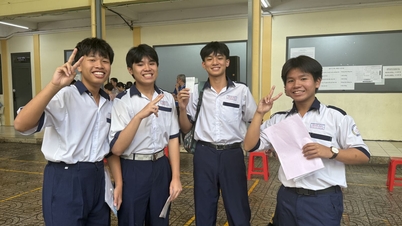
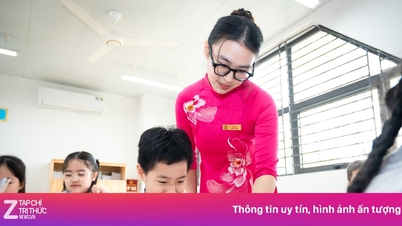
Students in public schools are completely exempt from tuition fees.
PHOTO: PHC
A notable highlight, receiving widespread support from society, is the National Assembly's official approval of a resolution in 2025 to waive tuition fees for preschool and primary school students. This is considered a major step forward in public policy, as for decades, tuition fee waivers have only been applied to primary school, while we have long since achieved universal secondary education. However, in less than a year, from the time the policy idea was initiated by General Secretary To Lam at the National Assembly session at the end of 2024, to the Politburo issuing the policy and the National Assembly passing the resolution, this policy has become a reality.
In his article, Dr. Nguyen Si Dung, former Deputy Head of the National Assembly Office, commented: "This is a policy with nationwide application, impacting nearly 20 million students and tens of millions of households… We are not only waiving tuition fees but also unleashing the potential of millions of students. We are giving hope to poor families, sowing the best seeds for tomorrow."
The past term also marked a significant step forward in educating and training "global citizens" when the Prime Minister issued a Decision approving the Project "Making English the second language in schools in the period 2025 - 2035, with a vision to 2045". The Ministry of Education and Training has developed a plan to implement the above decision to improve English proficiency for children, high school students, and university students, contributing to the development of Vietnamese people in the era of science and technology, the digital age, and strengthening international integration.
Mr. Dang Tu An, Director of the Vietnam General Education Development Support Fund, commented: "The biggest benefit from the new policies is the expectation of a healthy and modern educational environment. It can be said that schools nationwide are entering a new phase of educational development. Obviously, investing in education is investing in the pillar of national development, a key factor in human development, and a driving force for social transformation."
Preparing human resources for the new development phase.
At the Higher Education Review Conference for the 2024-2025 academic year in September 2025, Mr. Nguyen Tien Thao, Director of the Department of Education and Training, presented noteworthy information: The average university entrance exam scores in 2025 will be about 3 points lower than in 2024, but there will be a strong differentiation between majors, with significantly higher scores for STEM majors. In particular, among the 74 majors with entrance exam scores of 28/30 or higher based on high school graduation exam results, 17 are key engineering and strategic technology majors (computer science, artificial intelligence (AI), semiconductor microchips, control and automation, etc.). This is a crucial prerequisite for the feasibility of a requirement set forth in the Draft Political Report of the 13th Central Committee of the Communist Party of Vietnam presented to the 14th National Congress: "Focus on training high-quality human resources according to international standards to meet the development requirements of strategic industries and technologies."

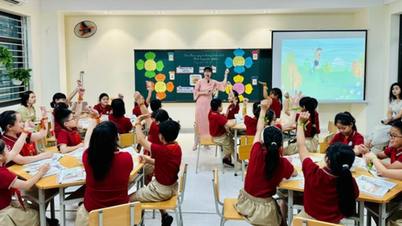
The Ministry of Education and Training is developing a plan to introduce English as a second language in schools.
Photo: NG.LÂM
In recent years, enrollment and training in STEM fields have seen significant improvements, with 2025 truly being a pivotal year for human resource training in these sectors. The Ministry of Education and Training has submitted and implemented many key projects on the development of science and technology, innovation, and high-tech human resource training. Among these, Prime Minister's Decision 1002/QD-TTg approving the "Scheme for training human resources to serve high-tech development in the period 2025-2035, with a vision to 2045" is a crucial basis for implementing many breakthrough solutions to develop STEM human resources in the coming years. One of the overall objectives of the project is to prepare a highly qualified STEM workforce with advanced technical and professional skills to meet the needs of expanding investment and development in high-tech fields, focusing on a talented workforce capable of deeply participating in the research and development of strategic and high-tech technologies that are prioritized.
To achieve the set goals, the Ministry of Education and Training has requested universities to innovate their STEM and strategic technology training programs according to international standards. Fields such as AI, data science, biotechnology, and new materials technology are prioritized for investment and strong development at both undergraduate and postgraduate levels. Training methods are also being diversified. Universities must also identify the crucial pillar of enhancing the capacity of their faculty and scientists. Policies prioritizing recruitment and providing appropriate compensation for STEM lecturers, and encouraging international experts and overseas students to return home, are considered prerequisites for retaining and developing talent.
Responding to questions before the National Assembly, Minister Nguyen Kim Son stated that the Ministry of Education and Training has implemented various solutions such as investing in equipment, attracting talented human resources, proactively engaging in international cooperation, and adjusting training programs. Currently, 13 universities have proactively developed programs and prepared staff to undertake the implementation of training in cutting-edge technology sectors, aiming to serve the country's development in the coming period.
Don't miss this opportunity.
Speaking at the conference summarizing the past term of the education sector, Minister Nguyen Kim Son assessed: The 2021-2025 term was a "term of change," profoundly impacting the entire sector; creating many values and opening up promising directions for the future. "Never before has the position of the education sector been given such attention and clearly defined as it is today. The sector has received profound attention from the Party, the State, the Government, and the people, and has been placed in a position of special importance for national development. Throughout the term, the spirit of unity and cooperation of the entire sector was clearly demonstrated as educational institutions, from preschool and primary to secondary and university levels, and provincial Departments of Education and Training, all worked towards the goal of innovation," the head of the education sector emphasized.
In his new term, Minister Kim Son stated that the education sector needs to pay special attention to three key issues. First, it is necessary to clearly identify the existing development opportunities, not to miss the chance, not to fall behind, and not to disappoint the expectations of the Party, the State, and the people. Second, it is necessary to maximize the advantages of the newly established institutional framework, considering it a crucial competitive resource, and to promptly implement the provisions of the law and specific mechanisms and policies. Third, it is necessary to prepare well to effectively absorb and transform large investment resources for education, turning these resources into a genuine driving force for development.
In particular, the Minister affirmed that the fundamental and decisive factor for the quality and operation of the entire education system is the teaching staff. The promulgation of the Law on Teachers and the continued improvement of policies for developing the teaching staff demonstrate the sector's steadfast commitment to caring for the "subjects" of education. According to the Minister, where there are excellent teachers, there is good quality education; this is a major lesson of the term and also a guiding principle for the coming period.
Source: https://thanhnien.vn/dinh-vi-ro-net-vai-role-of-education-and-training-185260110223134394.htm


























![[Photo] Reception to welcome General Secretary and President To Lam and his wife on their State visit to the Philippines](https://vphoto.vietnam.vn/thumb/1200x675/vietnam/resource/IMAGE/2026/06/01/1780295488620_vna-potal-chieu-dai-chao-mung-tong-bi-thu-chu-tich-nuoc-to-lam-va-phu-nhan-tham-cap-nha-nuoc-toi-philippines-8798060-7855-jpg.webp)
























































Comment (0)